Mono-Material vs Multi-Layer Lamination for Pet Food Packaging: Which Is More Sustainable?

Sustainability has become one of the biggest pressure points in pet food packaging and if you’re on the manufacturing side, you’ve probably felt it. Brand owners want greener structures. Retailers are tightening their requirements. And regulations in key markets, especially Europe, are moving faster than many production lines can keep up with.
At the center of this shift is a question that keeps coming up: should you move to mono-material lamination, or stick with traditional multi-layer structures?
The honest answer is that it depends but not in a vague, unhelpful way. There are specific factors that make one option clearly better than the other in a given situation. This article breaks it down so you can make a more informed decision for your production line and your customers.
What Is Lamination Doing in Pet Food Packaging, Anyway?
Before comparing the two approaches, it helps to understand what lamination is actually solving.
Pet food packaging has to do a lot of work. It needs to block oxygen and moisture to keep food fresh, handle physical stress during transport, protect against light degradation, and in many cases, survive high-temperature processing like retort. A single film material usually can’t do all of that on its own — which is why multiple layers are bonded together.
The question is: can you achieve all of that with just one type of material?
What It Is Mono-Material Lamination?
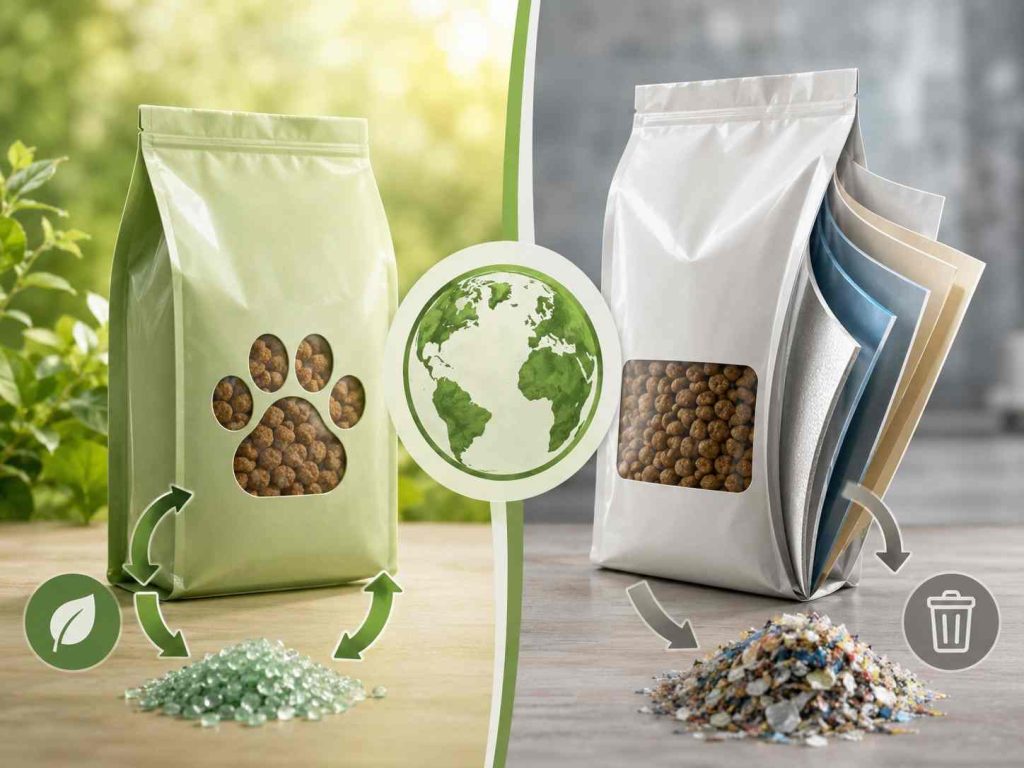
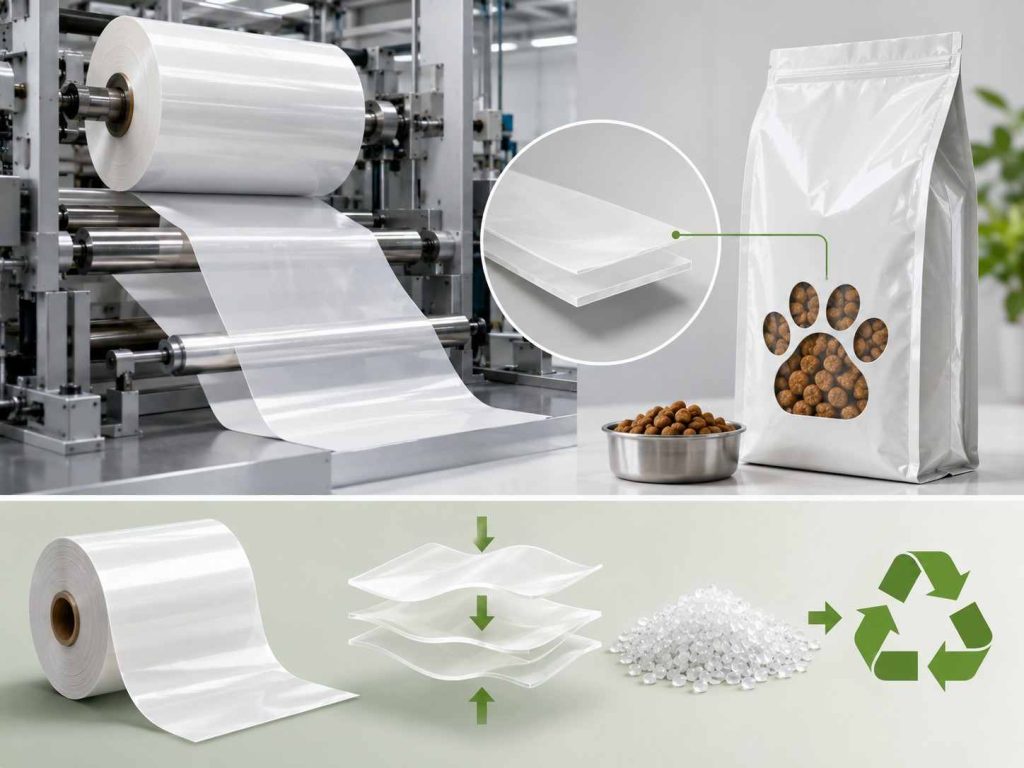
Mono-material structures use films made from a single resin family typically all-PE (polyethylene) or all-PP (polypropylene). Even though there are still multiple layers, they’re all chemically compatible, which means the final structure can be recycled through existing streams.
Common examples include PE/PE, BOPP/CPP, and all-PE stand-up pouches.
The main advantage is recyclability. Because the layers are made from the same base material, they don’t need to be separated before recycling. This is a significant point — the Ellen MacArthur Foundation has repeatedly highlighted that material incompatibility is one of the primary barriers to flexible packaging recycling at scale.
The challenge is barrier performance. Pure PE or PP films don’t naturally block oxygen as well as PET or aluminum. Manufacturers address this with specialized coatings (like EVOH or SiOx), but this adds cost and processing complexity. Sealing behavior and heat resistance also behave differently, which has real implications for your lamination settings.
What It Is Multi-Layer Lamination?
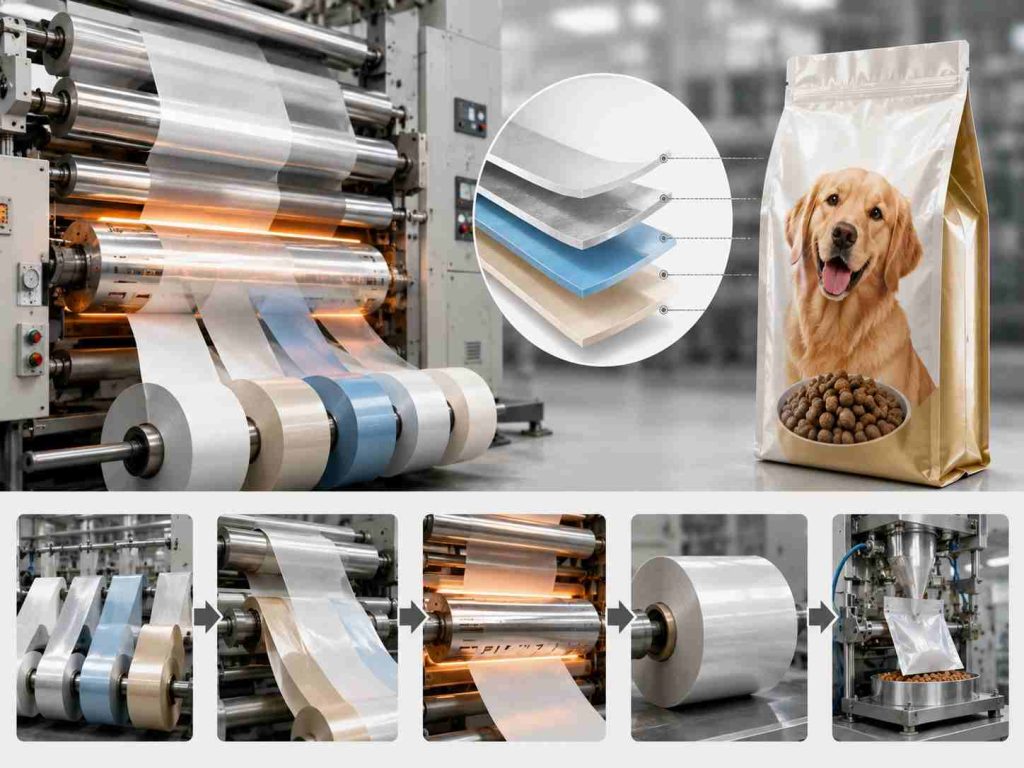
Multi-layer structures combine different materials to get the best properties from each. A typical pet food pouch might use PET for stiffness and printability, aluminum foil for barrier, and PE for heat-sealing. Some structures go up to five layers.
The strength here is performance. Multi-layer structures have decades of proven results in food packaging. They offer excellent oxygen and moisture barriers, long shelf life, and well-understood processing parameters. For wet food, retort pouches, or any product that needs extended shelf stability without refrigeration, multi-layer has been the standard for good reason.
The problem is end-of-life. Mixed-material structures are extremely difficult to recycle. Different resins can’t be processed together, and separation is not economically viable at most recycling facilities. The result is that most multi-layer flexible packaging ends up in landfill.
That’s increasingly becoming a regulatory liability, not just a PR concern. The EU’s Packaging and Packaging Waste Regulation (PPWR), which requires all packaging to be recyclable by 2030, is pushing brands to rethink structures that were perfectly acceptable five years ago.
A Direct Comparison Across Five Key Factors
| Factor | Mono-Material | Multi-Layer |
| Recyclability | ✅ High | ❌ Low |
| Barrier performance | ⚠️ Improving, but variable | ✅ Strong and proven |
| Food safety compliance | ✅ Achievable | ✅ Well established |
| Production complexity | ⚠️ Higher machine sensitivity | ✅ Mature and stable |
| Regulatory direction | ✅ Aligned with future rules | ⚠️ Under increasing pressure |
One thing this table doesn’t capture is the pace of change. Mono-material technology has improved significantly in the last three to four years, and the performance gap with multi-layer is narrowing, particularly for dry products. But for high-barrier applications, multi-layer still holds a real advantage.
Which One Fits Your Product?
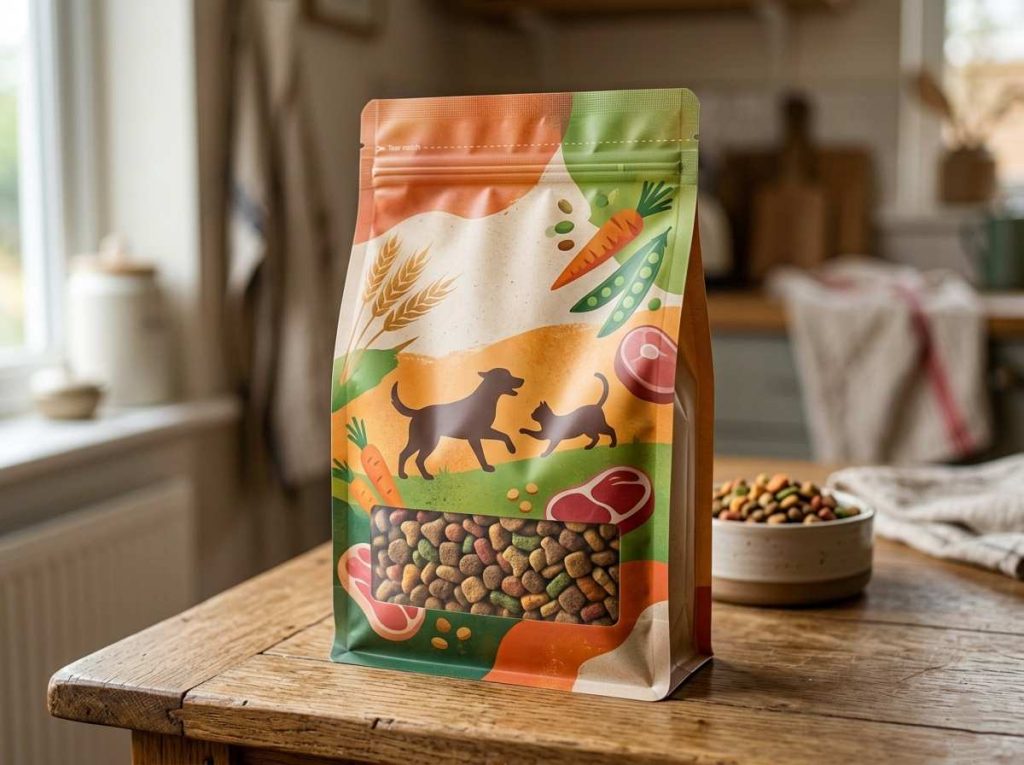
Dry kibble and treats are the strongest candidates for mono-material structures. Moisture and oxygen requirements are relatively moderate, and shelf life expectations are often achievable with advanced coatings. Several large pet food brands have already transitioned their dry product lines to recyclable mono-material pouches.
Wet food and retort applications are a different story. High-pressure thermal processing, long ambient shelf life, and the need for very low oxygen transmission rates make multi-layer including aluminum-based structures still the practical choice for most manufacturers. The technology for mono-material retort pouches exists, but it’s not yet mainstream, and performance consistency can be an issue.
Premium and organic pet food brands face a different kind of pressure. Their customers expect sustainability credentials, which pushes them toward mono-material. But they also expect premium shelf presence and product integrity, which means performance can’t be compromised. For these clients, the decision often comes down to very specific barrier spec requirements.
If you want to go deeper on structure selection for different pet food formats, this article on best lamination structures for pet food packaging covers the technical breakdown in more detail.
What This Means for Your Lamination Line
Here’s something that often gets overlooked in the sustainability conversation: switching to mono-material isn’t just a material decision. It’s a production decision.
Mono-material films especially all-PE structures behave very differently on a lamination line compared to PET-based multi-layer constructions. PE has a lower melting point, higher elongation, and is much more sensitive to tension variations. If your machine isn’t equipped to handle that, you’ll see wrinkling, poor adhesion, or inconsistent coat weight distribution.
Specifically, you need to pay attention to:
- Web tension control — PE film is more elastic and stretches easily under tension. Precise, responsive tension control across all unwinding and rewinding zones is essential.
- Nip roll temperature — the processing window for PE is narrower, and even small deviations can affect bond strength.
- Adhesive compatibility — not all solventless adhesives perform equally on polyolefin substrates. Some require specific formulations to achieve the necessary bond strength on low-surface-energy films.
Many production lines that run multi-layer structures well are not optimized for mono-material. That doesn’t mean you can’t make the transition, but it does mean you need to evaluate your equipment carefully before committing. Understanding how pet food packaging requirements affect your lamination process is a good starting point for that assessment.
The Development Future of Sustainable Pet Food Packaging
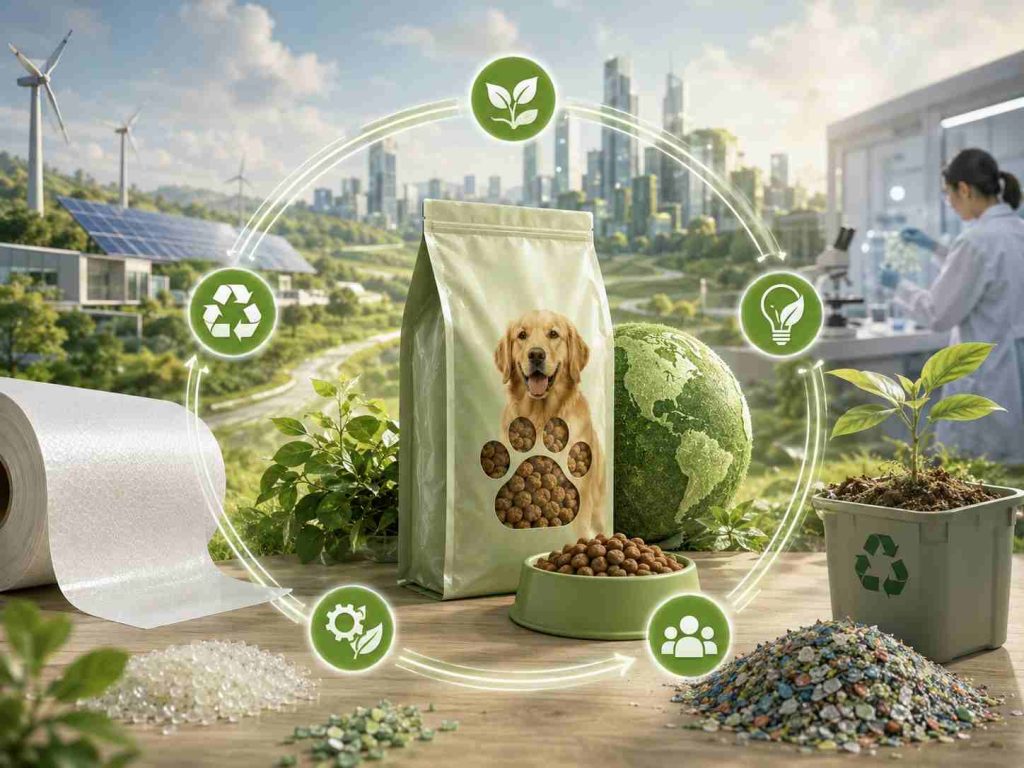
The regulatory picture is clear, even if the timeline varies by market. The EU’s PPWR sets 2030 as the deadline for all packaging to be recyclable or reusable. The UK, several Southeast Asian markets, and parts of Latin America are developing similar frameworks. Brand commitments from major players like Mars Petcare and Nestlé Purina are accelerating the timeline further, as their sustainability targets flow downstream to packaging suppliers and converters.
This doesn’t mean multi-layer lamination disappears overnight. For certain product categories, it will remain necessary for years to come. But the direction of travel is clear, and manufacturers who wait too long to develop mono-material capabilities may find themselves locked out of key customer requirements.
Neither mono-material nor multi-layer is universally better. The right answer depends on what the product needs, what the brand requires, and what your production line can actually deliver.
What is clear is that the push toward mono-material is not slowing down. For dry pet food, the case for transitioning is already strong. For wet food and retort applications, the industry is still working through the technical challenges but they’re being worked through.
If you’re evaluating whether your current lamination equipment can handle mono-material structures, or looking to understand what an upgrade would require, contact our team for a technical consultation.