
Five-Roller Coating vs Traditional Coating: Why Solventless Laminators Prefer the Five-Roller System

In solventless lamination, coating weight is usually 0.8–2.5 g/m². Film-to-film structures commonly use 1.2–2.0 g/m², while aluminium foil structures may require 1.8–2.5 g/m².
The bigger issue is coating uniformity. With ±10% variation, a 1.50 g/m² minimum may require an average coating weight of about 1.67 g/m² to avoid under-coated areas. This means higher adhesive consumption and a greater risk of edge squeeze-out, white spots, or bubbles, especially at speeds above 300 m/min.
Five-roller coating systems help reduce this variation through independent roller speed control and precise gap adjustment. With variation closer to ±5%, the machine can maintain a more stable coating weight without simply adding extra adhesive, helping reduce consumption and improve bond consistency.
How the Five-Roller System Works
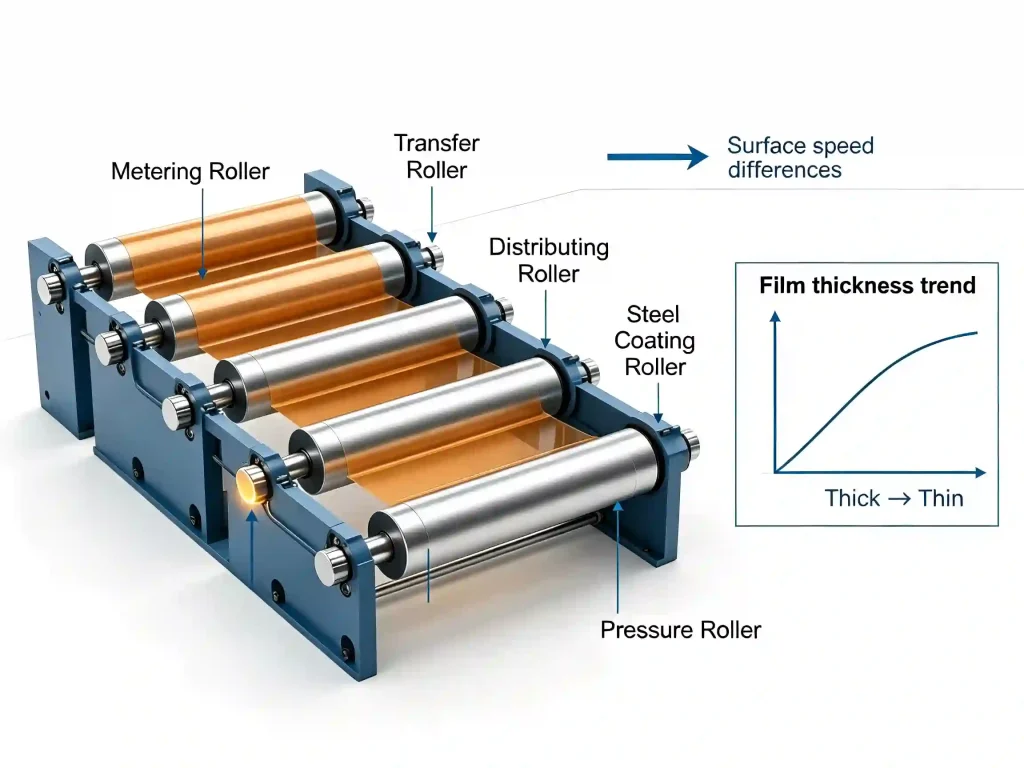
A typical five-roller system uses five rollers to build and control the adhesive film: a metering roller, transfer roller, distributing roller, steel coating roller, and pressure roller. The first nip takes a relatively thick layer of adhesive, while the following rollers gradually reduce it. Because the rollers run at different surface speeds, the adhesive is spread and metered down step by step. For example, an initial gap of around 80 µm can be reduced to a final wet film of about 0.8 µm.
In normal production, the coating weight is usually kept within 0.8–2.3 g/m², depending on the material and adhesive. Roller accuracy also matters. A surface finish of around ±0.0002 mm and concentricity of ±0.005 mm help keep the coating stable across the web. The steel rollers and adhesive reservoir are generally maintained at 40–55 °C. Keeping the temperature in this range helps control adhesive viscosity and allows it to flow more evenly through the roller gaps.
The adhesive reservoir does not need to be large. At normal production speeds, it can usually be topped up within a few minutes, so the operator can replenish the adhesive without significantly affecting production. This is particularly useful with two-component solventless adhesives, where the available pot life has to be considered.
For the roller surface, many machines use tungsten-carbide coatings. Compared with conventional ceramic surfaces, tungsten carbide can provide a smoother working surface, higher hardness and good heat transfer. It is also easier to clean when adhesive residue builds up during long production runs.
Five-Roll Coating vs. Traditional Coating
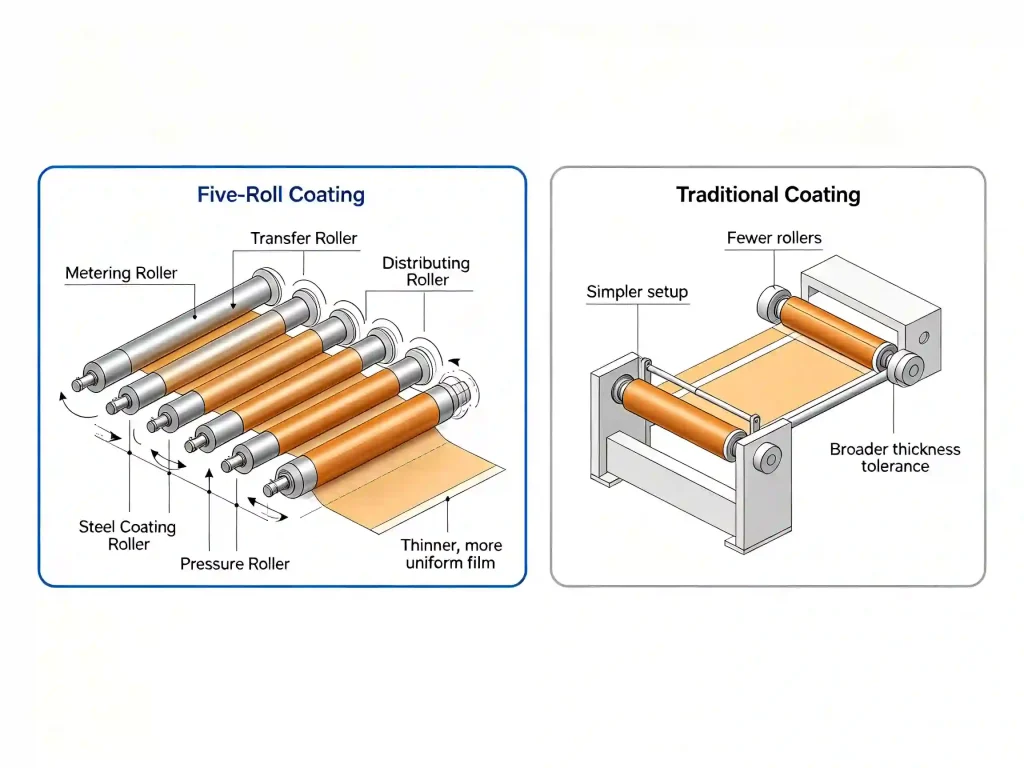
The difference becomes clearer when the two approaches are considered from a production perspective.
| Comparison | Five-Roll Coating System | Traditional Coating |
| Adhesive viscosity | About 500–10,000 cps, suitable for 100% solids adhesive | More commonly associated with lower-viscosity systems |
| Typical coating weight | 0.8–2.5 g/m² | More difficult to maintain at very low coating weights |
| Coating uniformity | Can reach around ±5% under suitable conditions | Often around ±10% or higher |
| High-speed operation | Around 300–450 m/min on suitable machines | Instability may become more noticeable at higher speeds |
| Adhesive supply | Small coating reservoir, less residual adhesive | Larger open tray or adhesive pan may create more residue |
| Adjustment | Roller gap and speed can be controlled separately | Often relies more heavily on fixed gaps or gravure-cell volume |
| Thin substrates | Controlled nip pressure helps reduce substrate stress | Greater risk of stretching or surface damage in some setups |
The important point is that traditional coating methods are not inherently unsuitable. Gravure coating, for example, remains widely used for solvent-based adhesives and other coating applications. The issue is the combination of high-viscosity, 100% solids adhesive + very low coating weight + high production speed.
That combination leaves much less room for coating errors.
The coating-weight calculation also shows why uniformity matters. At a target minimum of 1.50 g/m², ±10% variation requires approximately 1.67 g/m² average coating weight, while ±5% variation requires approximately 1.58 g/m². The theoretical difference is about 0.09 g/m².
At 10 million m² of annual production, that represents roughly 900 kg of adhesive. The actual saving will depend on the adhesive formulation, production losses and process conditions, but the calculation shows why small improvements in coating control can have a measurable financial effect.
What Does Better Coating Control Mean in Production?
The first benefit is adhesive consumption. Reducing coating weight by only 0.1 g/m² saves about 1 tonne of adhesive per 10 million m² of production. For a high-volume packaging converter, this is not a theoretical advantage. Adhesive price, production volume and actual coating weight can be used to calculate the direct annual saving.
The second benefit is product quality. More uniform adhesive distribution helps reduce problems associated with insufficient adhesive, including weak bonding, white spots and localized defects. For aluminum foil structures, controlled coating and nip conditions are particularly important because excessive mechanical stress can contribute to substrate damage.
The third benefit is production speed. Modern solventless laminators can operate at several hundred meters per minute. Sinstar’s WRJ series, for example, is designed for high-speed solventless lamination, with configurations reaching up to 450 m/min. At these speeds, adhesive stability becomes increasingly important because small variations are repeated over a very large production area.
There is also a practical maintenance advantage. A smaller adhesive reservoir means less adhesive remains in the coating unit when changing jobs. For two-component adhesives, this matters because the usable processing time can be limited; adhesive that remains in the system for too long can increase cleaning and maintenance work.
How Does Sinstar Apply the Five-Roll System?
Sinstar solventless laminating machines use a five-roll coating structure combined with independent servo drives, tungsten carbide-coated rollers, coating-gap memory and coating-weight input controls.
In actual machine operation, the objective is not simply to reach a particular coating-weight number. The coating unit has to maintain that value while the machine accelerates, decelerates and changes production conditions.
The system can be configured for coating weights around 0.8–2.3 g/m², depending on adhesive and substrate conditions. It can also work together with the machine’s tension-control system and remote monitoring functions, allowing operators to monitor production parameters more consistently.
Sinstar has accumulated installation experience from more than 2,680 machines in operation across 38 countries, covering applications such as PET/PE, BOPP/CPP, metallized films, aluminum foil and paper-based structures.
Choosing the Right Five-Roll Coating System
A five-roll coating system is not automatically the best choice for every laminating application. The key is whether the coating unit can maintain the required coating weight and uniformity with your actual adhesive, substrate and production speed.
If you are planning to purchase or upgrade a solventless laminating machine, share your material structure, adhesive type, target coating weight and production speed with the Sinstar team. We can recommend a suitable coating configuration and arrange a machine test based on your actual production requirements.
Contact Sinstar to discuss your application or request a solventless laminating machine test.