WVTR vs MVTR in Breathable Film Lamination

WVTR vs MVTR in Breathable Film Lamination – What’s the Difference?

Every week, we hear the same question from our quality control team or a confused customer: “Our breathable film spec sheet says WVTR, but our customer’s test report says MVTR. Are we talking about two different things?” Let me just clear this up for you right now so you can save time at your technical meetings:…

Laminate Breathable Films for Sanitary Products

How to Laminate Breathable Films for Sanitary Products?

The backsheet of a diaper or sanitary napkin is easy to overlook, it’s the layer nobody sees. But for manufacturers, it’s one of the most technically demanding components to produce. Getting it wrong affects everything: product comfort, regulatory compliance, and ultimately, whether a brand’s end users come back. Most hygiene backsheets are a laminate of two…

Bubbling in 3-Layer Lamination

Why Aluminum Foil Causes Bubbling in 3-Layer Lamination

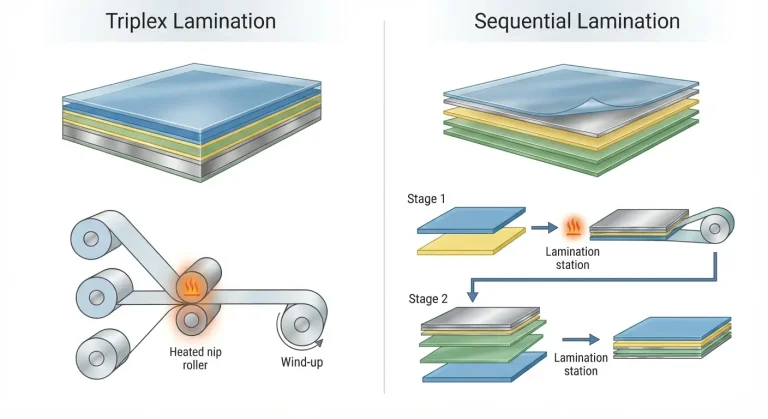
Flexible packaging manufacturing presents several technical challenges when using a solventless lamination machine to implement a 3-layer lamination structure involving PET/AL/PE or BOPP/AL/PE material layers, like PET/AL/PE or BOPP/AL/PE, such as PET/AL/PE. Though solventless lamination eliminates organic solvents and reduces energy costs, without drying oven stages found in dry lamination, this requires exact mechanical control, chemical balancing, substrate…

PET AL PE Lamination principle

How to Reduce Waste in PET AL PE Lamination

As technical professionals working daily on the production floor of a pharmaceutical flexible packaging plant, our primary metric of success is operational efficiency combined with strict regulatory compliance. In the manufacturing of high-barrier materials, the PET AL PE triplex structure represents the industry standard for protecting sensitive solid dosage forms, powders, and liquids against oxygen, moisture, and…

BOPP PE 2-ply Lamination in Flexible Packaging

PET/PE vs. BOPP/PE 2-layer Lamination in Flexible Packaging: How to Choose

In the business of flexible packaging manufacturing, choosing the right substrate in 2-layer lamination technology is one of the most basic decisions that determines the shelf life of the package, the operability on equipment, and overall manufacturing cost. Being a technical professional at a packaging facility, I find myself often confronted with clients who have difficulty…

Solventless adhesive curing reaction curve

How to Cure Time in Solventless Lamination Adhesive via Precise Temperature Control

The efficiency and quality of flexible packaging production depend heavily on the chemical and physical performance of the materials used. This type of bond involves the use of solventless lamination adhesives. Solventless lamination process is the preferred method due to its environmentally friendly nature and convenience in that it does not require drying tunnels used by…

pet-food-packaging

How Pet Food Packaging Requirements Affect Lamination Process and Equipment?

Not all flexible packaging performs the same job. A snack pouch and a wet cat food pouch may look similar on a converting line, but the demands placed on each structure — and the lamination process behind it — are genuinely different. Pet food packaging has to contend with a set of product characteristics that…

loss of transparency in solvent-free lamination

How to Improve Clarity in Solventless Lamination: Causes and Solutions

Solventless lamination stands out as the primary force of adoption in the field of flexible packaging due to advancing benefits, reduced costs of production, and faster production speeds. Nonetheless, maintaining the expected visual quality has been a challenge. Unlike solvent-based systems that allow film flows by solvent evaporation, solventless lamination systems depend on material flow/volume and how…

Hot vs Cold Laminating technology

Hot vs Cold Laminating Systems: Technical Analysis of Surface Protection

The process of lamination involves applying a thin plastic protective layer to a substrate, which consists of paper, cardstock, and synthetic media to enhance durability, moisture resistance, and visual clarity. The decision to select thermal or pressure-sensitive systems for industrial and professional printing environments represents an essential technical choice. This article provides a comprehensive comparison…

Adhesive Coating Machine

What Is the Ideal Adhesive Coating Weight for Liquid Packaging Lamination?

The safety of products and their durability and visual presentation depend on the laminated film quality used in liquid packaging. The adhesive coating weight serves as a key factor that determines whether the lamination process will succeed or fail. The packaging performance will experience major changes from even the smallest differences in this particular aspect….

End of content

End of content