
How to Calculate Solventless Laminating Machine ROI

A solventless laminating machine should be evaluated as a production investment, not simply as a piece of equipment. Its return depends on how much additional financial value the machine creates through usable production capacity, lower waste, reduced labor, shorter downtime and operating cost savings.
For flexible packaging converters, the key question is not simply “How much does a solventless laminator cost?” It is: How much additional financial value can this investment generate each year, and how quickly can the investment be recovered?
This guide provides a practical framework for calculating the ROI and payback period of a solventless laminating machine using real factory production data.
What Is the ROI of a Solventless Laminating Machine?
The basic formula is: Annual ROI = Annual Net Benefit ÷ Total Investment × 100%
However, both figures need to be defined carefully. And, before calculating the investment return, converters should also understand the factors behind the solventless laminating machine cost.
Total Investment can include:
- Laminating machine
- Installation and commissioning
- Operator training
- Factory modifications
- Electrical infrastructure
- Auxiliary equipment
- Initial spare parts
Annual Net Benefit may include:
- Operating cost savings
- Labor savings
- Reduced material waste
- Lower downtime losses
- Additional production contribution
- Maintenance savings
This means a machine with a higher initial investment can still deliver a better ROI if it generates substantially greater annual financial benefits. The objective is to measure the value created by the investment, not simply its purchase price.
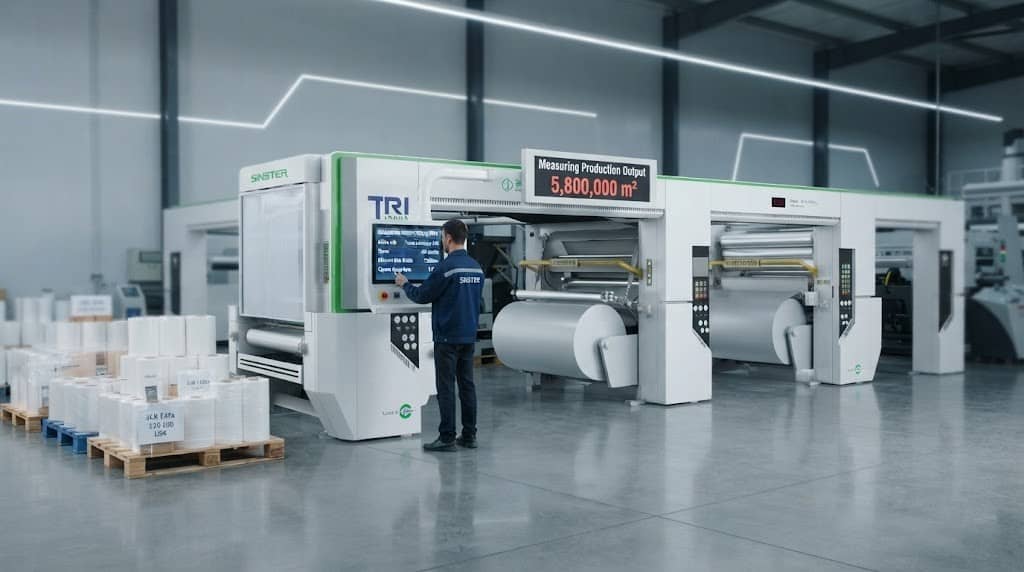
Start With Actual Production Data
Machine specifications alone cannot determine ROI. A rated speed represents technical capability, while ROI depends on how much production the factory can actually use and sell.
Before calculating the investment return, collect:
- Average operating speed
- Effective web width
- Production hours
- Working days per year
- Machine utilization
- Changeover frequency
- Downtime
- Current scrap rate
- Annual laminated output
These parameters are also important when evaluating solventless laminating machine selection for a specific production environment. A useful baseline is: Usable Annual Output = Effective Production Rate × Available Production Time × Utilization
The difference between the existing line and the proposed machine represents potential additional capacity. However, additional capacity only has financial value when it can be converted into profitable production.
If a factory has unused capacity or insufficient orders, a faster laminator may not produce the expected ROI.
Calculate the Financial Value of Additional Capacity
Additional production should not automatically be treated as additional revenue.
A better measure is contribution margin: Additional Annual Contribution = Additional Sellable Output × Contribution Margin
For example, if a new laminator allows a converter to process more customer orders without adding another production line, the resulting contribution can become an important part of the investment return.
Additional capacity may also create indirect financial value by:
- Reducing overtime
- Shortening delivery times
- Increasing order acceptance
- Relieving bottlenecks on older equipment
- Supporting future production growth
The key principle is: Use profitable and usable capacity—not maximum machine speed—to calculate the financial return of additional production.
Measure Operating Savings as Annual Financial Benefits
Energy and adhesive savings can contribute to ROI, but they should be calculated from actual factory consumption rather than generic industry assumptions. These savings should be evaluated together with overall laminating machine efficiency and actual production utilization.
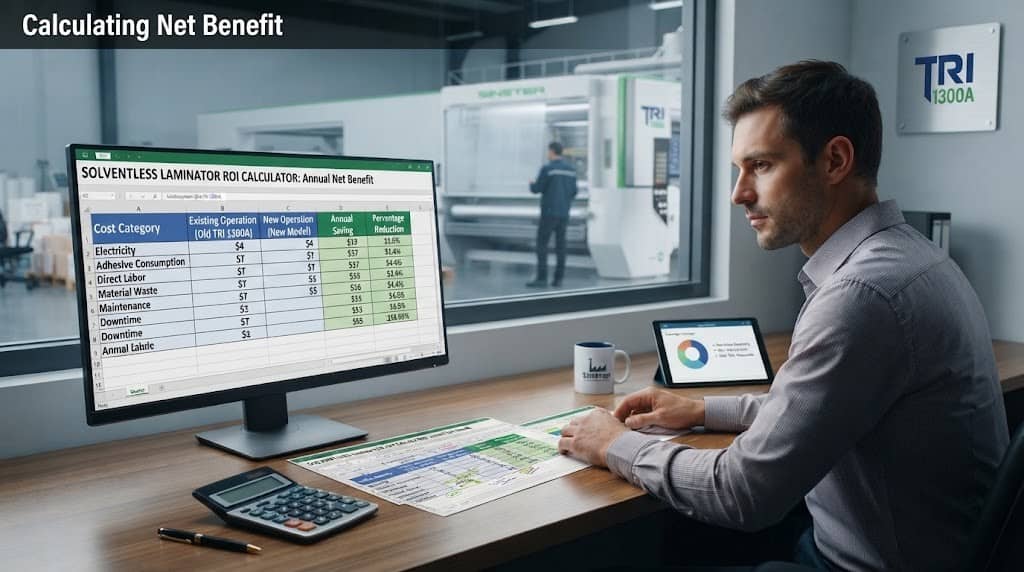
Create a before-and-after cost model:
| Cost Category | Existing Operation | New Operation | Annual Saving |
| Electricity | $X | $Y | $X−Y |
| Adhesive | $X | $Y | $X−Y |
| Direct labor | $X | $Y | $X−Y |
| Material waste | $X | $Y | $X−Y |
| Maintenance | $X | $Y | $X−Y |
| Downtime | $X | $Y | $X−Y |
This approach answers a more useful question than simply asking whether solventless lamination has lower operating costs: Which costs will actually change after the new equipment enters production?
For example, automation may have little financial value in a low-volume plant but become highly valuable when the machine operates multiple shifts with frequent job changes.
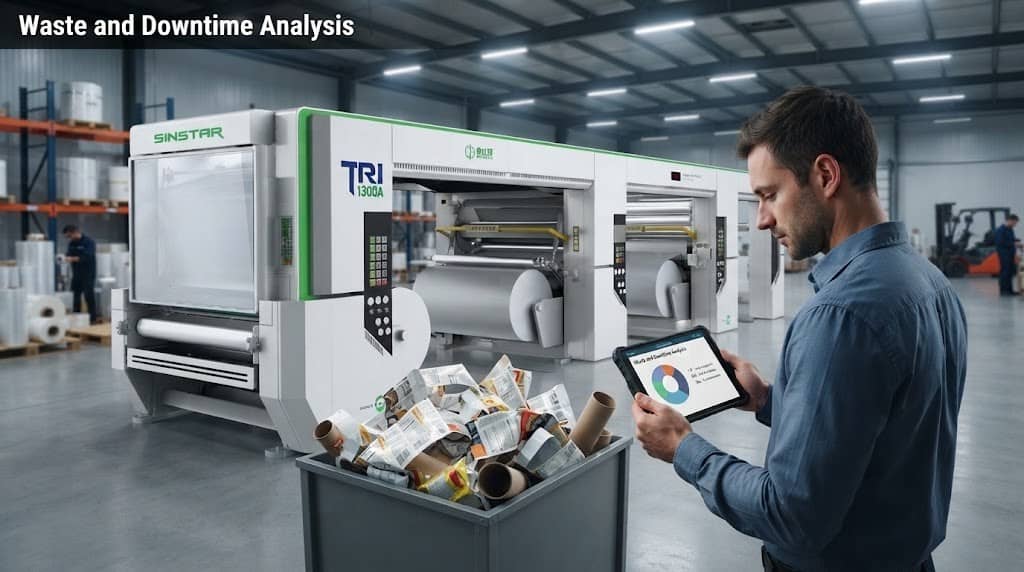
Include Waste, Downtime and Changeover Costs
These three factors are often overlooked in equipment ROI calculations.
1. Material Waste
A basic formula is: Annual Scrap Cost = Annual Production × Scrap Rate × Material Cost
For example, a factory producing 10 million m² annually with a 3% scrap rate and $0.20/m² material value has 10,000,000 × 3% × $0.20 = $60,000 in annual scrap cost.
If the effective scrap rate falls from 3% to 2%, the potential saving is $20,000 per year. The actual improvement depends on substrate type, laminate structure, process conditions and quality requirements.
2. Downtime
Downtime should be translated into lost production value: Downtime Cost = Lost Production × Contribution Margin
For a highly utilized production line, reducing unplanned downtime can have a greater financial impact than relatively small reductions in utility consumption.
3. Changeover Time
Frequent short production runs make changeover efficiency particularly important.
The potential benefit can be estimated as: Annual Changeover Saving = Hours Saved × Contribution Margin per Production Hour
Automatic roll changes, faster setup and recipe-based parameter management can therefore be evaluated according to the production time they recover.
Calculate Payback Period and Long-Term ROI
Once annual benefits have been identified, calculate the simple payback period: Payback Period = Total Investment ÷ Annual Net Benefit
Consider an illustrative project with:
- Total investment: $220,000
- Energy savings: $18,000/year
- Labor savings: $25,000/year
- Waste reduction: $30,000/year
- Operating savings: $22,000/year
- Additional production contribution: $70,000/year
Annual financial benefit: $18,000 + $25,000 + $30,000 + $22,000 + $70,000 = $165,000
Estimated payback: $220,000 ÷ $165,000 ≈ 1.33 years
Illustrative annual ROI: $165,000 ÷ $220,000 × 100% ≈ 75%
These numbers are examples rather than guaranteed equipment performance. A real ROI calculation should use the converter’s own production, labor, material and operating data.
For major capital investments, also evaluate the three- or five-year net return rather than relying exclusively on simple payback.
When Does a New Laminator Make Financial Sense?
A new solventless laminating machine is more likely to generate a strong ROI when it addresses an existing production or commercial constraint.
Typical conditions include:
- Existing laminating capacity is consistently high
- Production demand is increasing
- Scrap costs are significant
- Changeovers consume substantial production time
- Existing equipment has frequent downtime
- Labor requirements are increasing
- Customers require shorter lead times
- Additional capacity can support profitable orders
The investment may be less attractive when:
- Existing equipment is underutilized
- Order volume is uncertain
- Additional capacity cannot be sold
- The new machine duplicates unused production capability
Therefore, technical capability and investment attractiveness are not the same thing. A high-speed or highly automated laminator does not automatically provide a strong ROI. The equipment needs to solve a measurable business problem.
Build Your ROI Model Before Requesting a Quotation
Before evaluating a new laminating line, prepare these basic figures:
- Annual laminated output
- Average operating speed
- Effective web width
- Production hours
- Machine utilization
- Scrap rate
- Material cost
- Adhesive consumption
- Labor and downtime cost
- Expected investment
Then calculate: Annual Net Benefit = Cost Savings + Additional Contribution − New Annual Costs, and ROI = Annual Net Benefit ÷ Total Investment × 100%
Providing this information to a laminating machine manufacturer also makes equipment configuration more accurate. Film structures, web widths, annual output, production mix, changeover frequency and target capacity can all affect the appropriate machine configuration.
Frequently Asked Questions
Q1: What is the most important factor in laminating machine ROI?
A1: Actual utilization and profitable production capacity are generally more important than maximum rated speed.
Q2: Should labor savings be included in ROI?
A2: Yes, when automation genuinely reduces operator hours, manual intervention or changeover time.
Q3: Does material waste affect laminating machine ROI?
A3: Yes. Scrap reduction can significantly improve ROI when high-value films, foil or complex laminate structures are processed.
Q4: Should additional capacity be counted as revenue?
A4: Only when the factory can actually sell or use that capacity. Theoretical output should not be treated as guaranteed revenue.
Q5: What is a reasonable ROI evaluation period?
A5: Use simple payback for an initial assessment and a three- to five-year model for a broader capital investment analysis.
Q6: Can a more expensive laminator provide better ROI?
A6: Yes. A higher initial investment can be justified when additional capacity, lower waste, reduced downtime or labor savings generate sufficient additional financial value.
For flexible packaging converters, the most reliable ROI calculation starts with one question: Where does the factory currently lose production value, and how much of that loss can the new laminating machine realistically eliminate?
Once those numbers are established, machine investment becomes a measurable business decision rather than a comparison based only on equipment price or headline specifications.