
How to Control Adhesive Coating Accuracy to ±0.1 g/m² in Solventless Lamination

In solventless lamination, adhesive coating weight is one of the first things to check when laminate quality becomes unstable. A small change in coating weight can affect bond strength, appearance, curing, and adhesive consumption. The problem is that simply setting a target value on the machine does not guarantee that the actual coating weight will stay there.
For example, when the target is 1.5 g/m², keeping the actual coating weight within ±0.1 g/m² means the working range is only 1.4–1.6 g/m². At high production speeds, maintaining this level of consistency requires more than operator adjustment. Roller precision, speed ratio, temperature, adhesive viscosity, pressure, and measurement all have to work together.
So, how can a solventless laminating machine achieve this level of control? The answer starts with the metering system.
Why Does ±0.1 g/m² Matter?
Coating weight directly affects how much adhesive is available to form the bond between two substrates.
When the coating weight is too low, there may not be enough adhesive to cover the substrate evenly. This can lead to weak bonding, local delamination, or unstable peel strength after curing.
Too much adhesive creates a different set of problems. It increases material consumption and can extend curing time. Depending on the adhesive and substrate, excessive coating may also contribute to orange peel, waves, or other appearance defects.
The cost difference is also worth considering. Suppose a production line runs 1 million m² per year with a target coating weight of 1.5 g/m². If the actual process fluctuates considerably around the target, the additional adhesive consumption can become significant. Improving control from approximately ±0.3 g/m² to ±0.1 g/m² does not simply improve product consistency; it also reduces unnecessary adhesive use.
This becomes even more important when running high-speed production or frequently changing orders. Better coating accuracy means less material is wasted while the line stabilizes after startup or a product change.
For food and pharmaceutical packaging, consistency is particularly important because customers usually expect stable bonding performance and controlled production conditions. Standards such as those covered by the FDA’s food-contact regulations can also make material selection and process control more important.
How Is Solventless Adhesive Coating Formed?
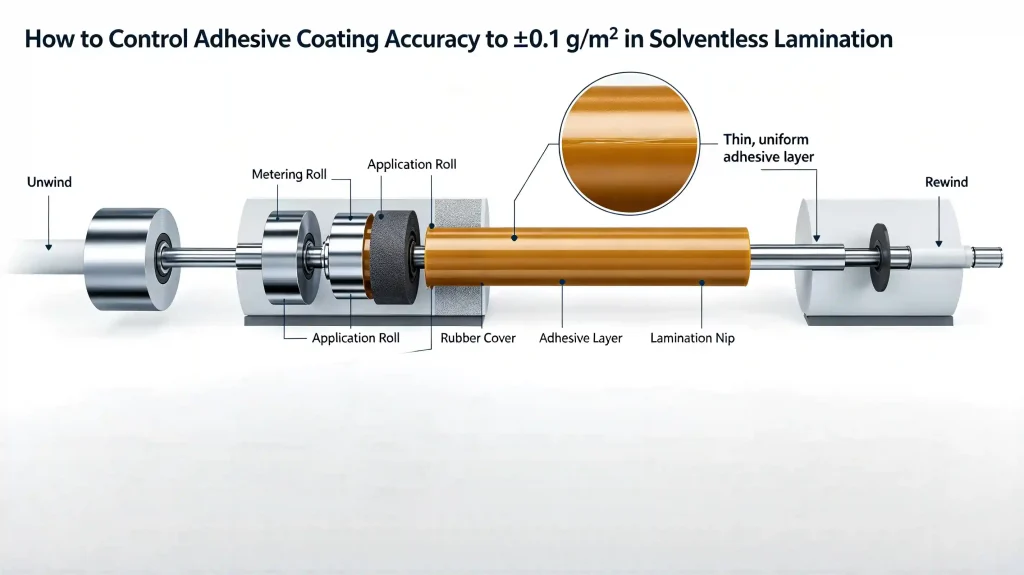
A typical five-roller coating system uses several rollers to meter, transfer, and finally apply the adhesive to the substrate. The exact configuration varies between machines, but a typical arrangement can include:
- Fixed metering steel roller (R1)
- Rotating metering/transfer steel roller (R2)
- Transfer rubber roller (R3)
- Coating steel roller (R4)
- Coating pressure roller (R5)
The adhesive first passes through the metering gap. The roller speed relationship then determines how the adhesive layer is transferred through the system before reaching the substrate.
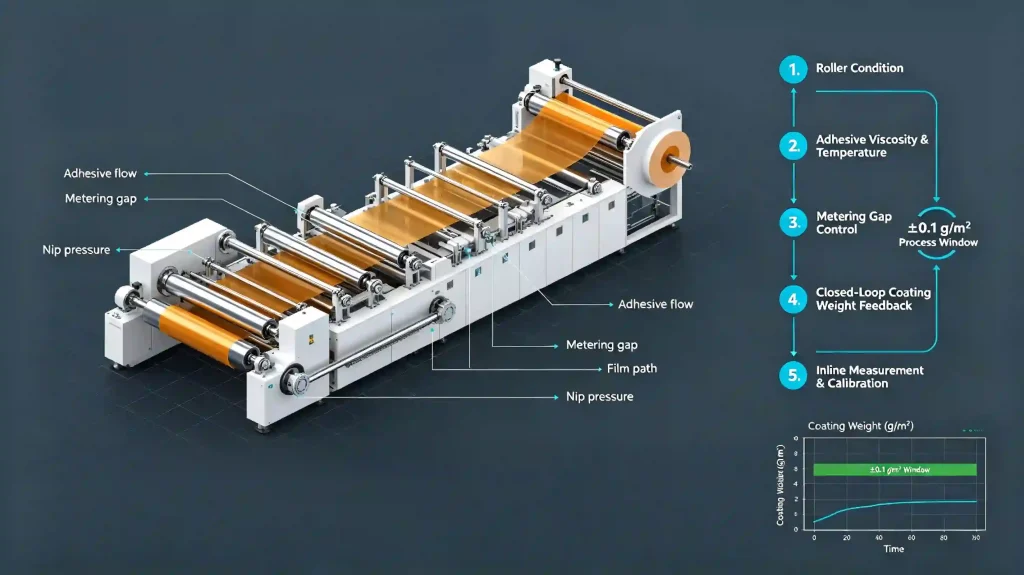
This is why coating weight is not controlled by one setting alone. The main variables include:
- Metering gap
- Roller speed ratio
- Roller temperature
- Rubber roller pressure
- Adhesive viscosity
- Adhesive mixing and supply stability
There is also a difference between the set value and the actual coating weight. A machine may be set to produce 1.5 g/m², but changes in roller temperature, adhesive viscosity, substrate tension, or mechanical clearance can cause the actual value to move.
For this reason, high-precision coating requires measurement and feedback rather than relying entirely on machine settings.
Key Controls for ±0.1 g/m² Coating Accuracy
1. Keep the Metering Gap Precise and Stable
The metering gap is one of the most important mechanical factors. A commonly used setting may be around 0.08–0.10 mm, depending on the machine, adhesive, and target coating weight. It should not, however, be treated as a universal setting for every application.
At this scale, even small mechanical errors matter. Roller runout, concentricity, parallelism, bearing condition, and assembly accuracy can all influence the actual gap across the working width.
Traditional feeler gauges can be useful for basic adjustment, but they rely heavily on operator technique. Electronic measurement or an automatic gap-adjustment system can provide better repeatability, particularly on machines designed for high-precision production.
Temperature should also be considered. Steel rollers expand as their temperature changes, which can alter the effective gap by several micrometres. A gap that is correct when the machine is cold may not be exactly the same after the rollers reach operating temperature.
That is why gap adjustment should be checked under stable production conditions rather than only during machine setup.
2. Control Roller Speed Ratios with Independent Servo Drives
The speed relationship between the transfer and coating rollers has a direct effect on adhesive transfer.
With independent servo motors, each roller can be controlled more precisely instead of relying on a fixed mechanical transmission. This gives the operator greater flexibility when adjusting coating weight for different adhesive systems and substrates.
The transfer rubber roller also matters. Its speed ratio affects how evenly the adhesive is carried through the coating section. A suitable speed relationship helps maintain a consistent adhesive film instead of creating excessive shear or uneven transfer.
Another point is acceleration and deceleration. During line speed changes, the coating process can temporarily move away from its normal condition. A well-designed control system can compensate for these changes by adjusting roller speed ratios during ramp-up and ramp-down.
This is particularly useful on high-speed laminators, where even a short period of unstable coating can generate a significant amount of waste.
3. Keep Temperature and Adhesive Viscosity Consistent
Temperature control is often underestimated.
Solventless adhesives are sensitive to temperature because temperature affects viscosity. If the adhesive becomes more viscous, its flow and transfer characteristics change. If it becomes too fluid, the coating behaviour can change in the opposite direction.
For this reason, the metering and coating rollers should maintain a stable operating temperature. A practical control target may be around ±1°C, although the appropriate range depends on the adhesive supplier’s specifications.
The mixed adhesive temperature also needs attention. The adhesive should enter the coating system within the required process window, and its working life should be managed according to the manufacturer’s technical data.
When coating weight begins to drift, it is therefore worth checking temperature and viscosity before immediately changing the metering gap. Otherwise, one adjustment may temporarily hide the real cause of the problem.
4. Manage Rubber Roller Pressure and Hardness
The coating pressure roller affects how the adhesive is finally transferred onto the substrate.
Pressure that is too high or too low can change the transfer condition and create coating differences. The correct setting depends on the roller material, substrate structure, adhesive and machine design.
Roller hardness also changes over time. A rubber roller that has been used for a long period may develop wear or changes in surface properties. This can result in inconsistent coating across the web even when the machine settings remain unchanged.
Regular inspection of the roller surface, hardness and wear condition should therefore be part of routine maintenance.
5. Use Measurement to Create a Closed Loop
No matter how accurate the machine is, coating weight should be verified with actual measurements.
A simple method is the offline weighing method. Samples can be taken from the left, centre and right areas of the web and measured under controlled conditions. Comparing these results helps identify whether the problem is an overall coating-weight deviation or a cross-web uniformity issue.
For higher-end production lines, online measurement systems can provide continuous monitoring. Depending on the application, systems based on infrared or other sensing technologies can detect coating-related changes without waiting for laboratory sampling.
Another practical method is to compare adhesive consumption with production length. If the mixed adhesive output and processed area are known, the average coating weight can be calculated:
Average coating weight (g/m²) = Adhesive consumption (g) ÷ Laminated area (m²)
This does not replace direct coating-weight measurement, but it is useful for identifying longer-term deviations and checking whether the production data matches the expected process conditions.
Daily Operation and Maintenance Checklist
Before starting production, operators should confirm that the metering gap is correctly set, roller temperatures have reached a stable condition, and the roller surfaces are clean.
During production, coating weight should be checked at a defined frequency rather than only when a visible defect appears. Small adjustments are generally preferable to large changes. If the coating suddenly becomes higher or lower, first check adhesive temperature, viscosity, supply pressure, roller speed ratios and mechanical conditions.
Cross-web differences also provide useful clues. A large left-to-right difference may indicate a gap or roller parallelism problem, while a centre-to-edge difference may point toward roller deformation, pressure distribution or temperature-related issues.
Different laminate structures naturally require different coating weights. Transparent films, printed films, metallised films and retort structures should not all be treated with the same setting. The adhesive manufacturer’s technical data and the actual laminate performance should be used together when establishing production standards.
Designing the Machine for Better Coating Stability
High coating accuracy ultimately depends on the machine’s mechanical and control design.
A solventless laminator intended for precise coating should combine accurate roller machining and assembly with independent servo drives, stable temperature control and reliable gap adjustment. These features reduce the number of variables that operators have to compensate for manually.
For lamination machine manufacturers such as Sinstar, the focus is not simply on achieving a particular coating value during machine testing. The more important goal is maintaining stable performance during actual production, including speed changes and different product structures.
IoT and remote monitoring can also provide useful support by recording production parameters and identifying abnormal changes over time. However, it should be viewed as an additional control tool rather than a substitute for correct mechanical adjustment and process management.
Whether a machine can consistently achieve ±0.1 g/m² depends on the complete system, adhesive, substrate and production conditions. It is better to verify the result through actual testing than to assume that a nominal machine specification will automatically deliver the same accuracy on every product.
Conclusion
Maintaining ±0.1 g/m² coating accuracy is not a matter of making one adjustment on the laminator. It comes from keeping several conditions stable at the same time.
A practical starting point is simple:
- Measure first to understand the machine’s actual coating-weight variation.
- Focus on the three main variables: metering gap, roller speed ratio and temperature.
- Record and standardise the process so that operators can reproduce the same conditions from one production run to the next.
When these controls are combined with accurate mechanical design, regular maintenance and reliable measurement, high coating consistency becomes much easier to maintain—and adhesive consumption can be controlled at the same time.
For manufacturers looking to improve coating stability on an existing line or specify a new solventless laminator, working with Sinstar’s technical team can help determine which parameters need to be adjusted for the actual adhesive and laminate structure.