
All-PE vs PET/PE Lamination: What Changes for Flexible Packaging Converters?

For flexible packaging converters, the All-PE vs PET/PE decision is no longer simply a material selection question. PET/PE remains a practical structure because PET provides stiffness, dimensional stability and print support, while PE provides flexibility and heat sealing. All-PE structures, meanwhile, are increasingly being evaluated for packaging programs focused on mono-material design and recyclability.
But changing from PET/PE to All-PE is not simply a matter of replacing PET film with another PE film. The change can affect web handling, lamination stability, winding, slitting, pouch making, barrier performance and finished-package qualification. It can also change how a converter evaluates its existing PET/PE lamination equipment.
For converters considering mono-PE vs PET/PE, the more useful question is therefore: What actually changes on the production floor when a PET/PE structure is converted to All-PE?
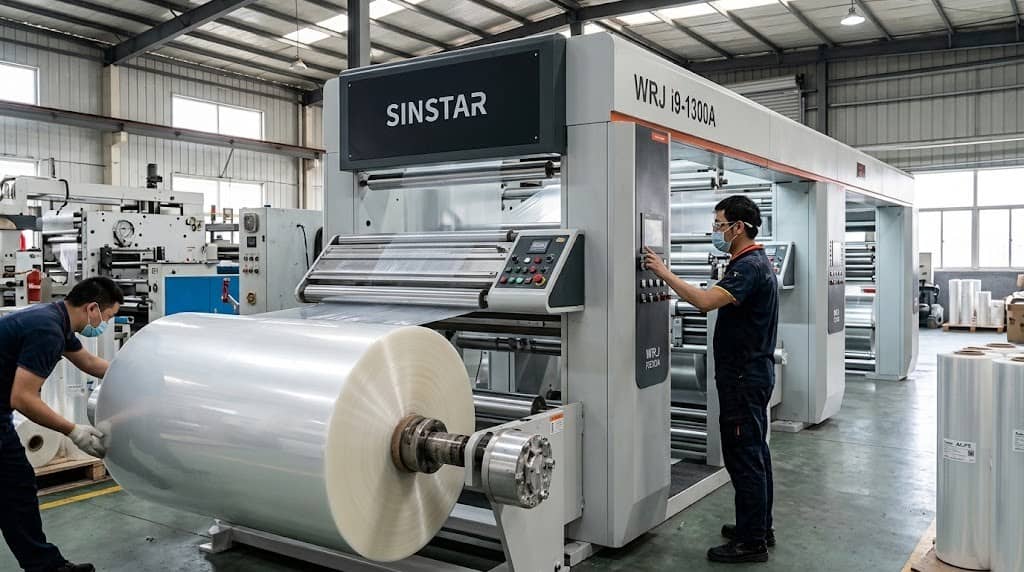
All-PE vs PET/PE: The Structural Difference Converters Need to Consider
In conventional PET/PE packaging, the two films perform different functions. PET generally provides structural stiffness, dimensional stability and a stable printing surface, while PE provides flexibility and heat sealing.
An All-PE structure uses PE-based films for the main layers. Different PE film constructions can be selected to balance stiffness, strength, sealability and processability.
| Factor | PET/PE | All-PE |
| Material family | Polyester + polyethylene | Polyethylene-based |
| Structural stiffness | Generally higher | Depends on PE film construction |
| Dimensional stability | Generally strong | More dependent on film design and processing |
| Heat sealing | Primarily provided by PE | Provided by PE |
| Flexibility | Moderate | Generally higher |
| Stretch sensitivity | Generally lower | Often higher |
| Mono-material potential | Limited by mixed polymer structure | Higher, depending on package design and recycling pathway |
| Converter focus | Established process stability | Web handling and structure optimization |
This is the key distinction in all PE vs PET/PE packaging. PET contributes functions that cannot simply disappear when it is removed. The replacement PE structure must provide sufficient mechanical performance, processability and package functionality.
Therefore, All-PE should be treated as a conversion pathway rather than a direct material substitution. SINSTAR’s existing mono-material guidance similarly identifies PET/PE → PE/PE as a conversion pathway where stiffness, web handling and sealing need to be reconsidered.
What Changes on the Laminating Line When Moving to All-PE?
The basic principle of adhesive lamination remains similar, but the practical process window can change. This is particularly important for all-PE lamination, because PE films can respond differently to tension and mechanical stress than PET.
1. Web tension becomes more critical
PET generally provides a relatively stable web during transportation through the laminator. Many PE films are more flexible and can stretch more readily when tension is excessive.
If two PE-based webs respond differently to tension, dimensional variation can contribute to:
- Wrinkles
- Curling
- Tunneling
- Tracking problems
- Roll deformation
- Registration problems during downstream converting
The objective is therefore not simply to use “low tension.” The correct approach is to establish a stable tension window according to:
- PE film thickness
- Film modulus
- Web width
- Line speed
- Roll diameter
- Film construction
- Rewinding requirements
For converters already running PET/PE, the existing tension settings should therefore be treated as a starting reference rather than a final production setting.
2. Web tracking and winding require closer attention
A laminated web can appear acceptable immediately after the laminating nip but develop roll-quality problems during rewinding.
With an All-PE structure, converters should monitor:
- Edge alignment
- Rewind tension
- Roll hardness
- Web tracking
- Roll geometry
- Curl
- Telescoping
This becomes especially important when the laminate is later transferred to high-speed slitting or pouch-making equipment.
3. Adhesive coating must remain stable
Changing from PET/PE to All-PE does not eliminate the importance of accurate adhesive metering. The converter still needs to control:
- Adhesive mixing ratio
- Coating weight
- Adhesive temperature
- Nip pressure
- Web tension
- Curing conditions
However, the important difference is that a solventless lamination process optimized for PET/PE should not automatically be considered optimized for All-PE. The new film combination should be trialed and qualified under actual production conditions.
What Changes in Printing, Slitting and Pouch Making?
The effect of an All-PE transition does not stop at the laminator. The laminated roll must also run through printing, slitting, pouch making or form-fill-seal operations. These downstream processes can reveal problems that are not visible during initial lamination.
1. Printing
PET/PE structures generally benefit from the dimensional stability of PET, which can help maintain consistent web behavior during printing and converting. When PE-based structures are introduced, converters may need to reassess:
- Surface treatment
- Ink adhesion
- Web stretch
- Print registration
- Surface characteristics
- Handling conditions
The exact requirements depend on the film construction and printing process.
2. Slitting
All-PE laminates may require closer control of slitting and winding because of their mechanical flexibility. Important parameters include:
- Edge quality
- Web tension
- Slit width
- Roll hardness
- Telescoping
- Curl
A stable laminate does not automatically guarantee a stable slit roll.
3. Pouch making and form-fill-seal
This is one of the most important differences when evaluating mono-PE vs PET/PE. The final laminate has to become a functional package. The PE-based structure must therefore provide suitable:
- Seal initiation temperature
- Seal strength
- Seal window
- Coefficient of friction
- Puncture resistance
- Flexibility
- Dimensional stability
A useful production principle is that a laminate that runs successfully on the laminator is not necessarily a laminate that runs successfully on the pouch-making machine.
For this reason, All-PE qualification should extend beyond lamination trials and include actual downstream converting.
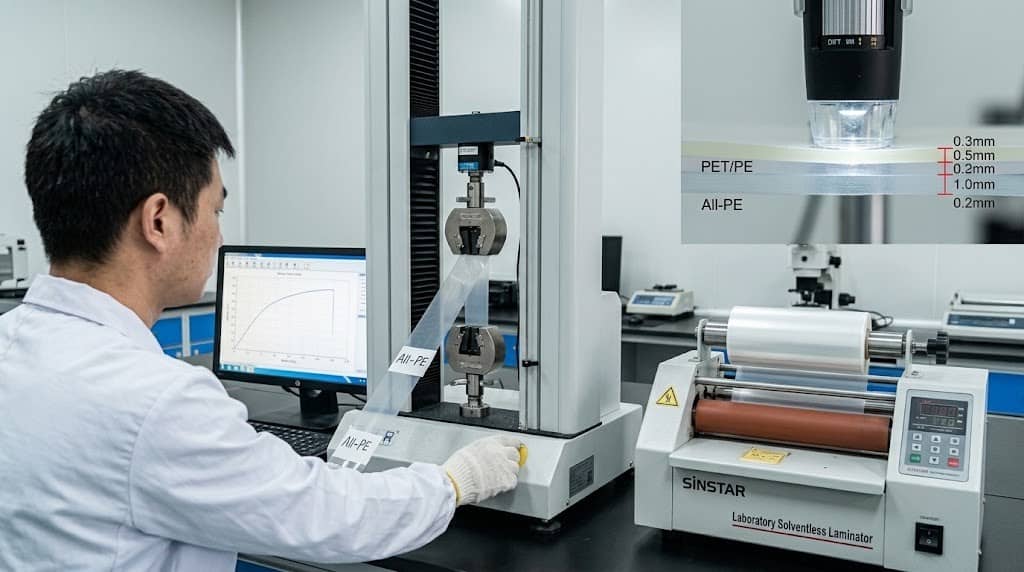
How Packaging Performance Changes: Barrier, Stiffness and Sealability
The All-PE vs PET/PE comparison should ultimately be made at the finished-package level. PET/PE benefits from the complementary properties of PET and PE. All-PE structures instead depend on the selected PE film combination and any additional functional layers or coatings used within the structure.
| Performance | PET/PE | All-PE |
| Stiffness | Generally higher | Depends on PE construction |
| Dimensional stability | Generally strong | More dependent on film design |
| Flexibility | Moderate | Generally high |
| Moisture resistance | Structure dependent | Structure dependent |
| Oxygen barrier | Structure dependent | Requires appropriate PE-based barrier design |
| Heat sealing | PE-controlled | PE structure-controlled |
| Puncture resistance | Structure dependent | PE structure dependent |
| Recyclability potential | Limited by mixed polymer structure | Higher potential for compatible mono-material systems |
One important point should be emphasized that all-PE does not automatically reproduce the barrier performance of every PET/PE structure.
If the existing package has specific oxygen, moisture, aroma or shelf-life requirements, the new PE-based structure must be evaluated against those requirements. Depending on the application, testing may include:
- Oxygen transmission rate (OTR)
- Water vapor transmission rate (WVTR)
- Seal strength
- Puncture resistance
- Tensile strength
- Drop resistance
- Shelf-life performance
SINSTAR’s current film-selection content also distinguishes PE film options according to characteristics such as strength, stiffness and sealability, reinforcing the need to select the PE structure according to the package requirement rather than treating “PE” as a single material category.
This is why the engineering question behind all PE vs PET PE packaging is not simply which structure contains fewer material types. It is: Can the selected All-PE structure reproduce the functions required by the finished package?
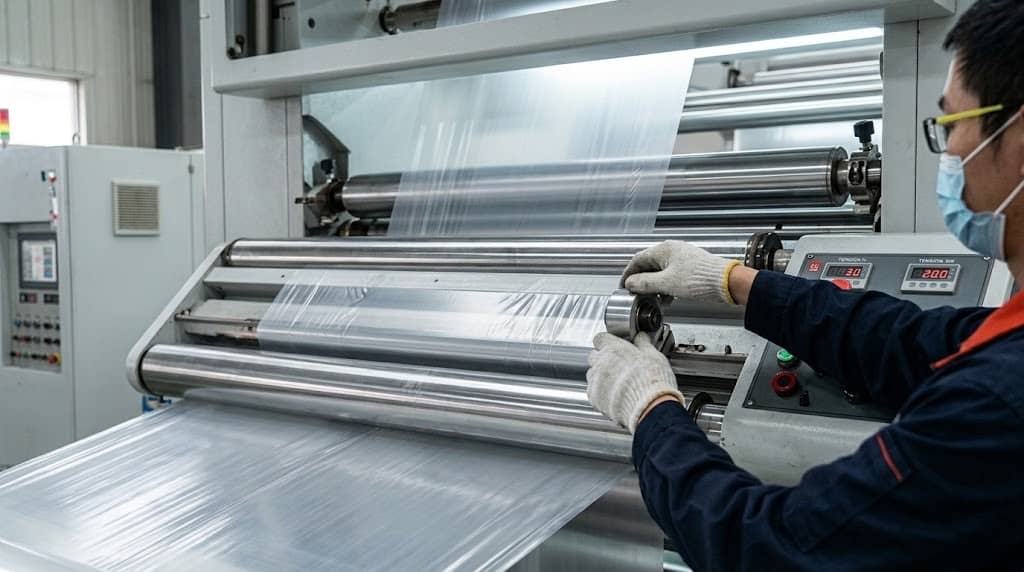
What Changes in Quality Control and Product Qualification?
A PET/PE-to-All-PE transition should be treated as a qualification project, rather than simply a film replacement. The converter should verify the new structure from initial film preparation through finished-package performance.
All-PE qualification checklist
| Test Area | What to Verify |
| Surface | Surface treatment and surface condition |
| Lamination | Bond strength and coating uniformity |
| Roll quality | Curl, blocking, telescoping and winding stability |
| Mechanical | Tensile and puncture performance |
| Barrier | OTR and WVTR where required |
| Sealing | Seal strength and seal window |
| Slitting | Edge quality and width consistency |
| Pouch making | Running stability and sealing performance |
| Finished package | Leakage, drop and distribution performance |
A practical qualification workflow is:
Film selection → Surface verification → Trial lamination → Curing → Roll inspection → Slitting → Pouch making → Seal testing → Finished-package validation
This sequence helps identify whether a problem originates from the material structure, lamination process or downstream converting.
For R&D and pre-production testing, laboratory-scale equipment can also reduce the material required for trials. SINSTAR’s MINI-500 is designed for solventless adhesive development, material compatibility testing, sample lamination and process simulation. It supports flexible packaging substrates including PET, PE, OPP, CPP and PA.
This makes laboratory validation particularly useful when a converter is testing new All-PE structures before committing to full-scale production.
Does Switching to All-PE Require a New Laminating Machine?
Not necessarily. Moving from PET/PE to All-PE does not automatically mean that a converter needs to replace its laminator. The more useful question is whether the existing equipment can provide stable processing for the selected PE structure.
Four areas should be reviewed.
1. Web handling capability: Can the laminator maintain stable tension and web tracking with the selected PE films?
2. Adhesive coating control: Can the coating system maintain consistent adhesive distribution across the working width and at the target production speed?
3. Temperature and pressure control: Can the equipment maintain stable process conditions without introducing unnecessary thermal or mechanical stress?
4. Rewinding performance: Can the machine produce stable laminated rolls suitable for subsequent slitting and pouch making?
For converters that need greater process-control precision, a digital system may provide additional control over tension, temperature, pressure and speed.
For example, SINSTAR’s S1-1300A digital solventless laminating machine provides digital control of temperature, pressure and speed, adaptive tension control and intelligent rewinding taper control, with a published maximum speed of 500 m/min and maximum laminate width of 1350 mm.
For mainstream two-layer structures, SINSTAR’s WRJ i9 series is another relevant equipment option. SINSTAR’s current PET/PE technical page identifies the WRJ i9-1300A as a two-layer solventless laminator suitable for PET/PE and other flexible packaging structures.
A converter should consider equipment upgrading when the existing line has limitations such as:
- Unstable tension control
- Poor web tracking
- Inconsistent rewinding
- Limited process monitoring
- Excessive waste during material changes
- Difficulty handling flexible PE webs
- Insufficient automation for the required production conditions
The important principle is that the need for a new laminating machine should be determined by process capability, not simply by the change from PET/PE to All-PE.
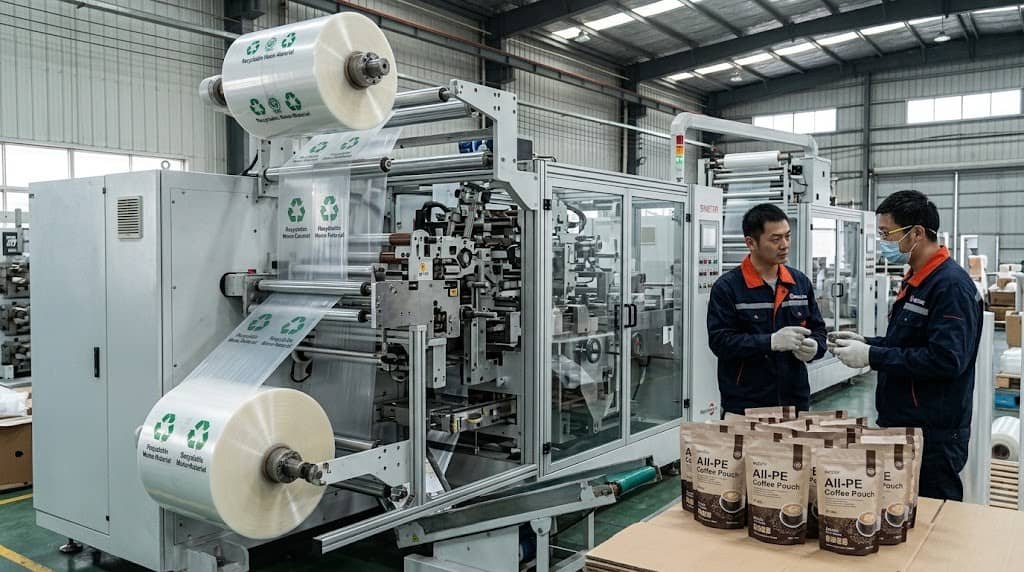
All-PE vs PET/PE: Which Structure Fits Different Converter Strategies?
There is no universal structure that replaces every PET/PE application. The appropriate structure depends on the required package performance, production process, material technology, recycling pathway and downstream equipment.
| Converter Situation | Structure to Evaluate |
| Existing PET/PE production with stable performance | PET/PE may remain appropriate |
| Recyclability-focused packaging program | All-PE should be evaluated |
| High stiffness requirement | PET/PE may provide useful structural properties |
| Flexible PE-based pouch | All-PE may be suitable |
| High barrier application | Evaluate the complete barrier structure |
| Existing laminator with limited PE handling capability | Review equipment capability |
| New mono-material packaging program | Evaluate All-PE and compatible PE structures |
| Demanding finished-package application | Complete package qualification is required |
For converters moving from PET/PE to All-PE, a structured transition can follow this sequence:
Existing PET/PE structure
↓
Identify the functions provided by PET
↓
Define target package performance
↓
Select suitable PE-based films
↓
Validate all-PE lamination
↓
Optimize web handling and winding
↓
Test slitting and pouch making
↓
Validate barrier and sealing performance
↓
Confirm finished-package performance
This approach treats All-PE lamination as a complete conversion process rather than a simple material substitution.
All-PE vs PET/PE: Key Takeaways
All-PE vs PET/PE is primarily a package and process engineering decision, not simply a material substitution.
- PET/PE combines PET’s structural stability with PE’s flexibility and heat-sealing performance.
- All-PE can support mono-material packaging strategies, subject to the specific structure, package design and recycling pathway.
- All-PE structures can require closer attention to web tension, tracking and winding because PE films can be more mechanically flexible.
- Changing from PET/PE to All-PE can affect printing, slitting, pouch making and form-fill-seal performance.
- Barrier performance should be validated at the complete package level rather than assumed from the material name.
- A new laminating machine is not automatically required for an All-PE conversion.
- Existing equipment should be reviewed for tension control, coating stability, web handling, temperature control and rewinding capability.
- The new structure should be qualified through both lamination testing and finished-package testing.
For flexible packaging converters, the most reliable approach is to treat the transition from PET/PE to All-PE as a process, material and package qualification project. The objective is not simply to remove PET. It is to reproduce the required mechanical, barrier, sealing and converting performance within a PE-based structure while maintaining stable production.
That is where precise all-PE lamination, controlled web handling and appropriate solventless laminating equipment become important parts of the overall conversion strategy.