
Solventless Lamination for Mono-PE Packaging: Materials, Process & Recyclability

As flexible packaging moves to recyclable and mono-material structures, mono-PE packaging is becoming an important option for converters to reduce material mixes without compromising functional performance. Solventless lamination for mono-PE offers a method to bond PE-based films without the use of solvent-based laminating adhesives.
However, successful mono-PE lamination requires more than changing the substrate. Film compatibility, solventless adhesive selection, coating weight, web tension, lamination conditions, curing and recycling requirements must be considered as one process.
What Is Mono-PE Solventless Lamination?
Mono-PE solventless lamination is the process of joining two or more layers of PE film with a solvent-free adhesive system.
“Mono-PE” does not mean that the PE film is only one layer thick. Different PE-based films can cater for different functions such as printability, stiffness, puncture resistance, barrier performance or heat sealing.
The distinction is important: Mono-PE defines the structure of the packaging material, and solventless lamination defines the bonding process. Thus, solventless lamination can be applied for the combination of functional PE films while preserving the main polymer family in PE.
But recyclability is determined by the entire package, not just the adhesive process. Substrates, adhesives, inks, coatings, and barrier layers can affect compatibility with the intended recycling.
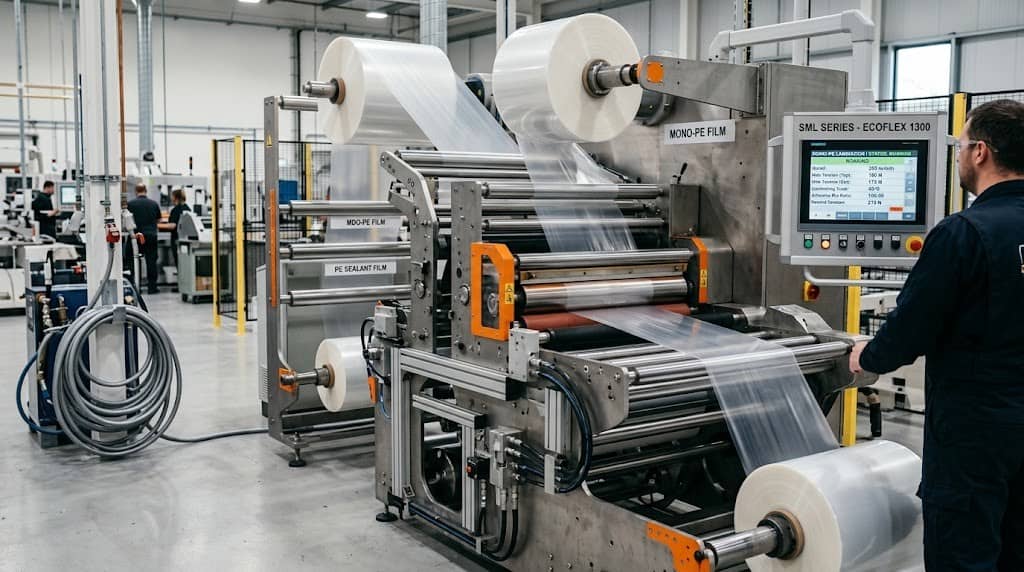
Why Use Solventless Lamination for Mono-PE Packaging?
Solventless lamination offers several process advantages for PE-based flexible packaging. For converters evaluating production equipment, the choice of a solventless laminating machine should be based on adhesive control, web handling, production speed and the target film structure.
- No conventional solvent-drying stage: Solventless adhesive is applied without evaporating organic solvent through a traditional drying tunnel.
- Reduced solvent handling: The process avoids the storage, evaporation and recovery requirements associated with solvent-based laminating adhesives.
- Functional film combination: Different PE films can be combined to balance mechanical strength, sealing, printing and barrier requirements.
- Efficient continuous production: With controlled adhesive metering, web tension and nip conditions, solventless laminators can support high-speed production.
The objective should not simply be to minimize adhesive consumption or maximize machine speed. The target is a stable process window that delivers consistent bonding and packaging performance.
Common Mono-PE Film Structures for Solventless Lamination
Different PE-based substrates can serve different functions within a laminated structure.
| Mono-PE Structure | Typical Function | Key Consideration |
| PE / PE | General flexible packaging | Bonding and sealing |
| MDO-PE / PE | Stiffness and dimensional stability | Tension and film behavior |
| BOPE / PE | Strength and processability | Web handling and bonding |
| Printed PE / PE | Printing and sealing | Ink and adhesive compatibility |
| Barrier PE / PE | Enhanced barrier performance | Barrier and recycling compatibility |
| Metallized PE / PE | Higher barrier requirements | Metallization and bonding |
These structures should be selected according to the final packaging requirements rather than treated as direct replacements for conventional PET/PE or PET/AL/PE structures.
Mono-PE Solventless Lamination Process
A typical mono-PE lamination process follows:
PE Film → Surface Treatment → Unwinding → Adhesive Mixing → Precision Coating → Lamination → Curing → Slitting → Quality Inspection
1. Surface Treatment
PE films require appropriate surface conditions for stable adhesive wetting and bonding. Surface energy, corona treatment uniformity and film cleanliness should be verified before production.
2. Solventless Adhesive Mixing
Most two-component solventless adhesive systems require controlled A/B metering. Mixing ratio, adhesive temperature, viscosity and pot life directly affect coating stability and curing.
3. Precision Coating
Consistent coating weight is essential for stable mono-PE lamination. Adhesive coating accuracy depends on the interaction of adhesive viscosity, temperature, metering conditions, roller speed and machine control. Excess adhesive can increase material consumption and may affect curing, while insufficient adhesive can reduce bond strength.
Coating accuracy depends on the interaction of adhesive viscosity, temperature, metering conditions, roller speed and machine control.
4. Lamination and Curing
During lamination, nip pressure, web tension, line speed and film alignment influence adhesive transfer and substrate bonding. The laminated web then requires sufficient curing time for the adhesive to develop its final bond strength.
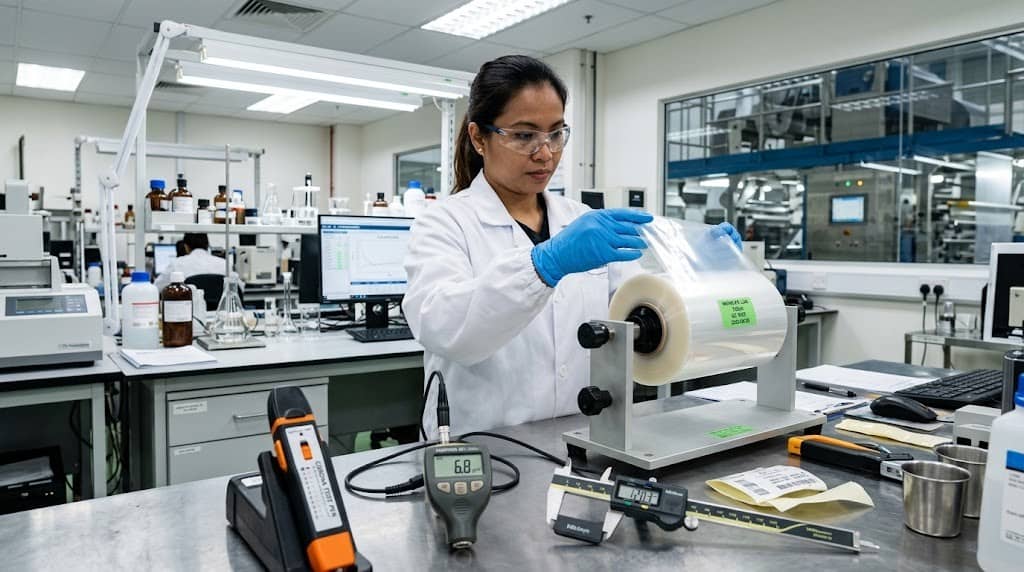
Key Parameters for Mono-PE Solventless Lamination
| Parameter | Why It Matters | Potential Problem |
| A/B adhesive ratio | Controls curing chemistry | Weak or inconsistent bonding |
| Adhesive viscosity | Influences coating stability | Uneven coating |
| Coating weight | Affects bonding and consumption | Delamination or excess adhesive |
| Web tension | Controls PE film stability | Wrinkles, curl or tunneling |
| Nip pressure | Supports adhesive transfer | Bubbles or poor bonding |
| Line speed | Affects wetting and process stability | Incomplete transfer |
| Curing time | Develops final bond strength | Premature converting issues |
These parameters should be optimized together. Changing one condition may affect several other parts of the process.
Mono-PE Lamination Defects and Troubleshooting
Common mono-PE lamination defects include delamination, bubbles, tunneling, curling, uneven coating and blocking. A practical troubleshooting approach is to connect each defect with the parameters most likely to influence it:
| Defect | Parameters to Check First |
| Delamination | Surface treatment, adhesive ratio, curing |
| Bubbles | Nip pressure, adhesive transfer, tension |
| Tunneling | Web tension, winding and adhesive distribution |
| Uneven coating | Adhesive viscosity, metering and roller conditions |
| Curling | Film stress, tension and curing |
| Blocking | Coating weight and curing |
A defect should not automatically be attributed to a single machine setting. PE film properties, adhesive chemistry and production conditions can interact and create similar symptoms.
Mono-PE Lamination and Recyclability
One of the main reasons converters consider mono-PE flexible packaging is its potential alignment with PE recycling streams. However, mono-PE recyclability should be evaluated as a complete packaging system:
PE Film + Adhesive + Ink + Coating + Barrier Layer + Other Components + Recycling Route
Solventless adhesive does support mono-PE package construction, but it’s not automatically recyclable just because it’s solventless laminated. The amount and chemistry of the adhesive and the inks, coatings and barrier materials could affect the recycling behaviour of the final package. Therefore, recyclability claims should be based on the relevant packaging design guidelines, testing methods and recycling pathway.
For converters developing recyclable PE packaging, material selection and lamination process development should be performed together rather than independently.
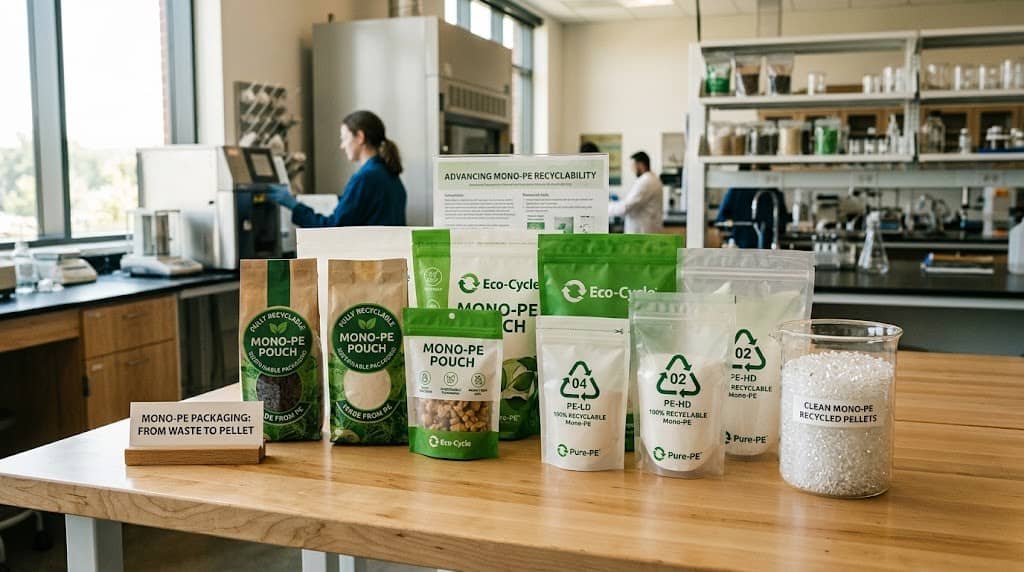
How to Choose a Solventless Laminating Machine for Mono-PE
Selecting a solventless laminating machine for mono-PE requires consideration of both the packaging structure and production conditions.
Key factors include:
- Film width and required production speed
- Duplex or triplex lamination
- Solventless adhesive mixing and metering accuracy
- Coating-weight control
- Web tension control for PE films
- Nip and rewinding stability
- Curing requirements
- Automation and production monitoring
For high-speed mono-PE production, stable control is especially important because variations in coating weight, tension or adhesive conditions can affect laminate quality. A suitable mono-PE laminating machine should therefore provide repeatable adhesive application, stable web handling and controlled lamination conditions for the selected PE film structure.
Conclusion
Solventless lamination for mono-PE packaging combines material engineering with precise converting control. The final result depends on the interaction between PE films, adhesive chemistry, coating weight, web tension, lamination, curing and recycling requirements.
For converters of recyclable flexible packaging, the practical way is to validate the entire mono-PE structure first and then select a solventless laminating system capable of maintaining the required process conditions consistently at production speed.