
Can High-Speed Solventless Lamination Handle Retort Packaging?

Retort packaging is widely used for ready-to-eat meals, meat products, seafood, sauces, and other foods requiring high-temperature sterilization. These applications place demanding requirements on laminated packaging structures, particularly their bond strength, heat resistance, and barrier performance. For flexible packaging manufacturers, the challenge is not simply producing multilayer films. It is maintaining reliable lamination quality while achieving commercially viable production speeds.
High-speed solventless lamination can process selected retort packaging structures, provided that the adhesive system, substrate combination, curing conditions, and production parameters are properly matched and validated. The key is to balance equipment performance with the requirements of the final packaging application.
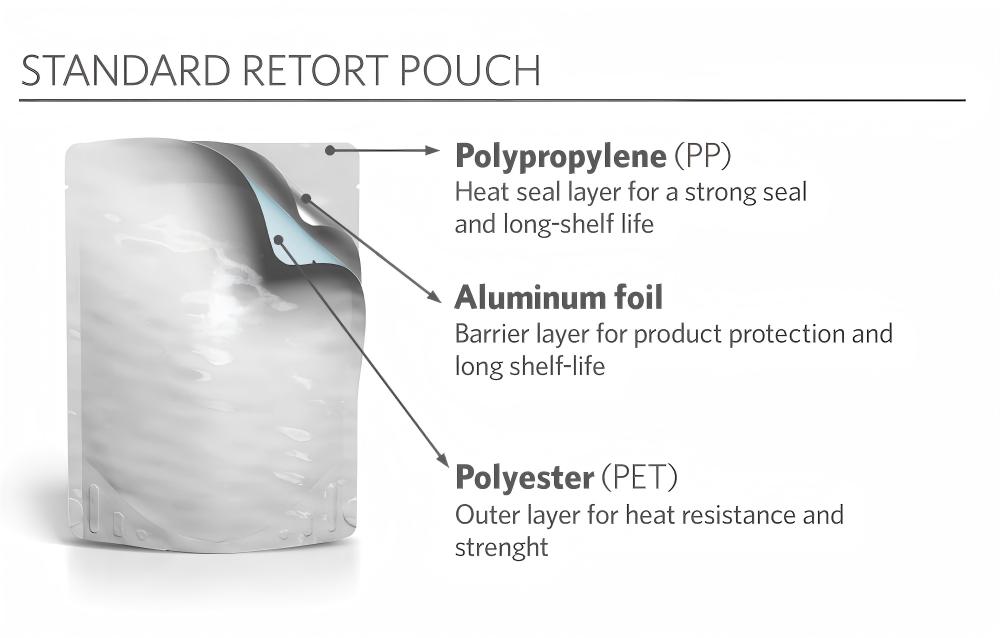
Why Does Retort Packaging Require More Demanding Lamination Performance?
Retort packaging must withstand defined thermal processing conditions without losing its essential packaging properties. Unlike conventional flexible packaging, retort pouches may experience prolonged exposure to elevated temperatures, moisture, and pressure during sterilization.
Typical multilayer structures include:
| Packaging Structure | Typical Application | Main Consideration |
| PET / AL / CPP | Aluminum foil retort pouches | Foil integrity and heat-resistant bonding |
| PET / PA / CPP | Flexible retort food packaging | Layer compatibility and bond durability |
| PET / PA / AL / CPP | Complex high-barrier packaging | Multilayer bonding and process qualification |
Each layer serves a different purpose. PET provides dimensional stability and printability, aluminum foil offers barrier protection, PA contributes mechanical strength, and CPP commonly serves as the heat-sealing layer.
The challenge is ensuring that the complete laminate maintains its performance after the intended retort cycle. A structure that performs well before sterilization may still experience delamination, blistering, or changes in barrier properties after thermal processing.
Can High-Speed Solventless Lamination Maintain Retort-Grade Bond Performance?
Yes, but equipment speed alone does not determine whether a laminated structure is suitable for retort applications. Several factors must work together.
1. Adhesive Compatibility with Retort Conditions
The adhesive system must be specifically qualified for the intended retort application.
Manufacturers should consider:
- Compatibility with PET, PA, aluminum foil, and CPP.
- Resistance to heat and moisture under the specified processing conditions.
- Required adhesive mixing ratio and application parameters.
- Curing requirements before downstream processing.
Using a retort-qualified adhesive is essential because general-purpose laminating adhesives may not provide the required post-retort bond performance. Adhesive selection should therefore be confirmed with the adhesive supplier based on the actual material combination and sterilization conditions.
2. Production Speed and Bond Development
High-speed production introduces an important consideration: laminated materials do not necessarily achieve their final bond strength immediately after lamination. The adhesive requires sufficient curing time under the specified conditions.
Packaging manufacturers should evaluate:
- Adhesive curing requirements.
- Time between lamination and pouch conversion.
- Bond strength before and after retort processing.
- Whether production scheduling allows sufficient curing time.
Increasing laminating speed must not compromise the required adhesive curing and final bond performance.
3. Compatibility Across Different Substrates
Different substrate combinations may require different processing conditions. For example, aluminum foil structures require attention to foil handling and surface integrity, while PA-containing structures require material-specific process qualification.
Manufacturers should validate each material combination rather than assume that one production setting is suitable for every retort structure.
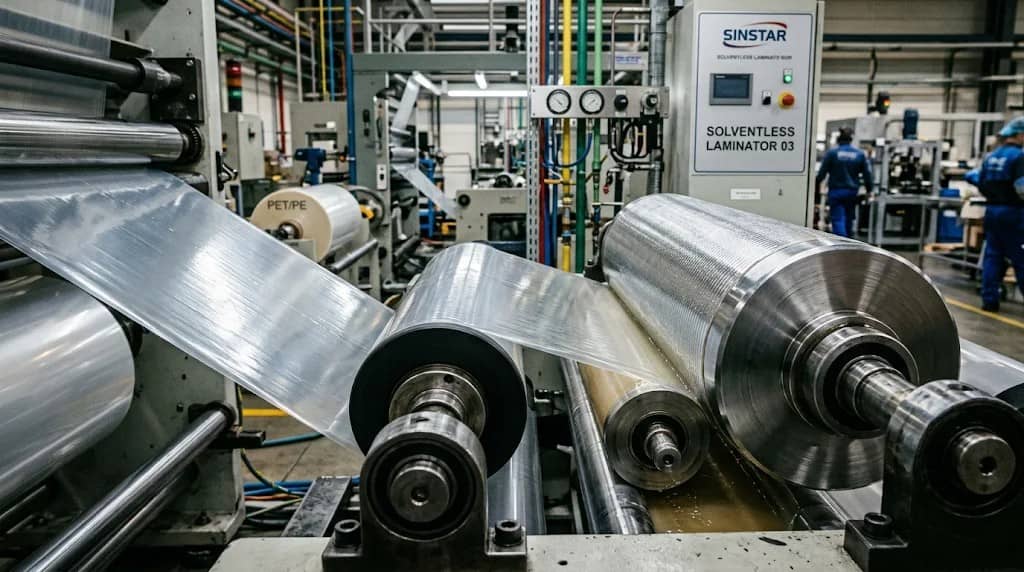
Which Retort Packaging Structures Can Be Processed?
High-speed solventless lamination may be suitable for several multilayer retort packaging configurations. However, suitability depends on the adhesive system, film properties, equipment configuration, and final application requirements.
1. Aluminum Foil Retort Structures
PET / AL / CPP is a common example of an aluminum foil-based retort structure. Production considerations include maintaining foil integrity, ensuring suitable adhesive compatibility, and verifying bond performance after sterilization.
2. PA-Based Retort Structures
PET / PA / CPP structures are used in flexible packaging applications where mechanical durability is important. The selected adhesive and processing conditions must be compatible with the specific film grades and intended thermal conditions.
3. Complex Multilayer Structures
Structures containing four or more layers introduce additional material interfaces that require qualification. Manufacturers should evaluate the complete laminate rather than testing only individual material combinations.
The objective is to ensure that every layer maintains the required functional performance throughout production and subsequent thermal processing.
What Should Manufacturers Validate Before Running Retort Packaging at High Speed?
A reliable retort packaging process requires more than an acceptable appearance immediately after lamination. Post-retort performance testing is essential for determining whether the finished laminate meets its intended application requirements.
The following checks provide a practical validation framework.
| Validation Item | What to Evaluate |
| Initial bond strength | Adhesion after lamination |
| Cured bond strength | Bond development after the specified curing period |
| Post-retort bond strength | Adhesion after the target sterilization cycle |
| Visual inspection | Delamination, blistering, distortion, and appearance |
| Barrier performance | Changes in oxygen and moisture barrier properties |
| Production consistency | Repeatability across production batches |
Post-Retort Bond Strength Testing
Bond strength should be measured before and after retort processing to identify changes in interlayer adhesion. ASTM F904 describes a practice for separating plies of cured laminated flexible materials for bond-strength evaluation.
It can support laminate evaluation, but it does not independently establish retort suitability. Test conditions and acceptance criteria should be defined for the actual packaging application.
Retort Testing Under Actual Conditions
Laboratory validation should reproduce the intended processing conditions as closely as practical.
Testing should consider:
- Retort temperature and exposure time.
- Processing pressure and cooling conditions.
- Post-retort visual appearance.
- Bond strength and barrier performance.
- Final pouch integrity and sealing performance.
For US-bound low-acid food applications, manufacturers should also understand the relevant food-processing requirements under FDA 21 CFR Part 113. This regulation addresses thermal processing of low-acid foods in hermetically sealed containers. It should not be interpreted as an approval or certification of a particular laminating machine or adhesive.
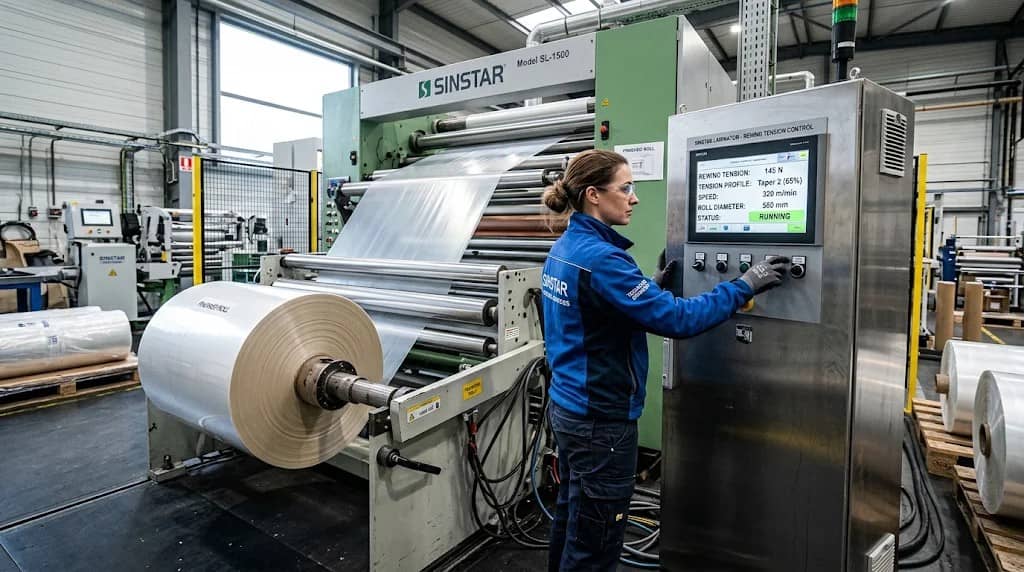
When Is a Triplex Solventless Laminator a Better Choice for Retort Packaging?
For manufacturers producing complex multilayer packaging, a triplex laminating configuration may offer production advantages. Instead of processing individual layers through separate lamination stages, a triplex machine is designed to support three-layer lamination within an integrated production configuration.
Potential benefits include:
- Fewer separate production stages.
- Reduced intermediate material handling.
- More integrated multilayer production.
- Better alignment of production planning across multiple layers.
However, one-pass triplex production is not automatically the best choice for every retort packaging structure. The decision depends on material compatibility, adhesive requirements, production volume, and the validation results of the complete structure.
SUPLOCK S3 Triplex for Advanced Multilayer Production
The SUPLOCK High-End Solventless Laminator includes the S3 Triplex configuration for three-layer lamination applications.
Its equipment design highlights several features relevant to demanding multilayer production:
- Three-layer lamination capability.
- Short web path design.
- Low-position aluminum foil loading.
- Digital tension control.
- High-speed production configuration.
For manufacturers considering retort packaging production, these capabilities provide a basis for evaluating equipment configuration and material handling requirements. The final machine configuration and achievable production speed should be confirmed through trials using the actual substrates and adhesive system.
How Should Manufacturers Determine the Right Production Speed?
The highest mechanical speed is not necessarily the most productive operating speed for retort packaging. A more practical approach is to determine the speed at which the complete production process consistently meets quality requirements.
Manufacturers should consider five factors:
- Material compatibility: Confirm that the selected film combination is suitable for the intended application.
- Adhesive requirements: Follow the adhesive supplier’s recommendations for mixing, application, and curing.
- Equipment performance: Evaluate stable operation at different production speeds.
- Downstream capacity: Match lamination output with curing, slitting, and pouch-making requirements.
- Quality validation: Confirm post-retort bond strength, barrier performance, and packaging integrity.
For a broader understanding of production efficiency, manufacturers can also refer to SINSTAR’s article on How to Improve Laminating Line OEE. The most suitable production speed is the one that delivers repeatable, qualified output rather than simply achieving the highest machine speed.
Conclusion: High-Speed Solventless Lamination Can Support Retort Packaging with Proper Validation
High-speed solventless lamination can be a suitable production solution for selected retort packaging structures. However, success depends on the compatibility of substrates, adhesive performance, curing conditions, and equipment capabilities.
Manufacturers should prioritize post-retort bond strength, barrier retention, and finished pouch integrity when qualifying a new production process.
For complex multilayer applications, a triplex configuration such as the SUPLOCK S3 provides an additional equipment option to evaluate. The right combination of laminating technology, material selection, and process validation helps flexible packaging manufacturers achieve reliable retort packaging production without treating machine speed as the only performance indicator.
Looking for a high-performance solventless laminator for multilayer retort packaging? Contact SINSTAR to discuss your material structures, production targets, and equipment configuration.