
Why Does Laminated Film Curl After Rewinding?

Laminated film may look flat immediately after lamination but develop edge curl, cross-direction bending, or roll deformation after rewinding. In most cases, laminated film curl after rewinding is caused by uneven internal stress, which can result from winding tension, differences in substrate properties, adhesive distribution, or dimensional changes during curing and storage.
For flexible packaging converters, film curl is more than an appearance issue. It can affect roll handling, slitting accuracy, pouch making, and the stability of downstream production. At SINSTAR, we recommend investigating the complete relationship between film properties, lamination conditions, and rewinding behavior rather than changing one machine setting without identifying the root cause.
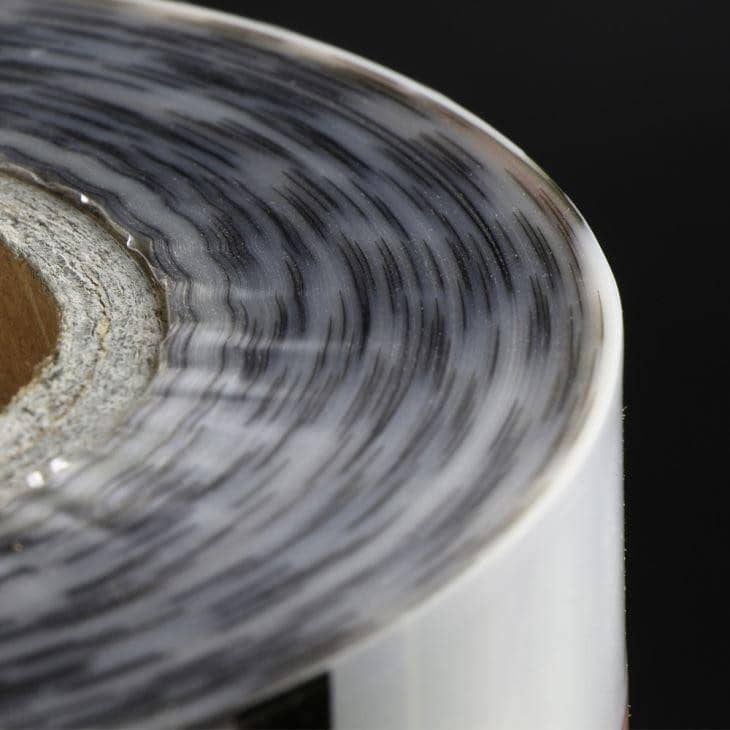
What Does Curling Look Like in Laminated Film Rolls?
Film curl can appear in several forms:
- Edge curl: One or both edges bend toward the inner or outer surface of the laminate.
- Machine-direction curl: The film bends along its running direction, often becoming noticeable when a strip is laid flat.
- Cross-direction curl: The film curves across its width, making the web difficult to keep flat.
- Roll deformation: The finished roll develops uneven edges or changes shape after winding or storage.
It is important to distinguish curling from other roll defects. Telescoping refers to roll layers shifting sideways, while tunneling involves localized channels or separation between laminated layers. Wrinkles are folds or creases in the web. These defects may occur together, but they do not have the same causes.
Why Does Laminated Film Curl After Rewinding?
Several factors can contribute to laminated film curling, and more than one may be involved in the same production run.
1. Uneven Stress Distribution Across Wound Layers
During rewinding, the laminate is wound around a core and compressed by subsequent layers. As the roll diameter increases, the pressure and stress distribution inside the roll also change.
If winding tension is too high or does not adapt properly to the increasing roll diameter, excessive compression can develop in the inner layers. When the roll is unwound or stored, this residual stress may be released unevenly, causing the film to curl.
The objective is to achieve a stable roll structure without creating excessive internal compression.
2. Different Shrinkage and Elastic Recovery of Film Substrates
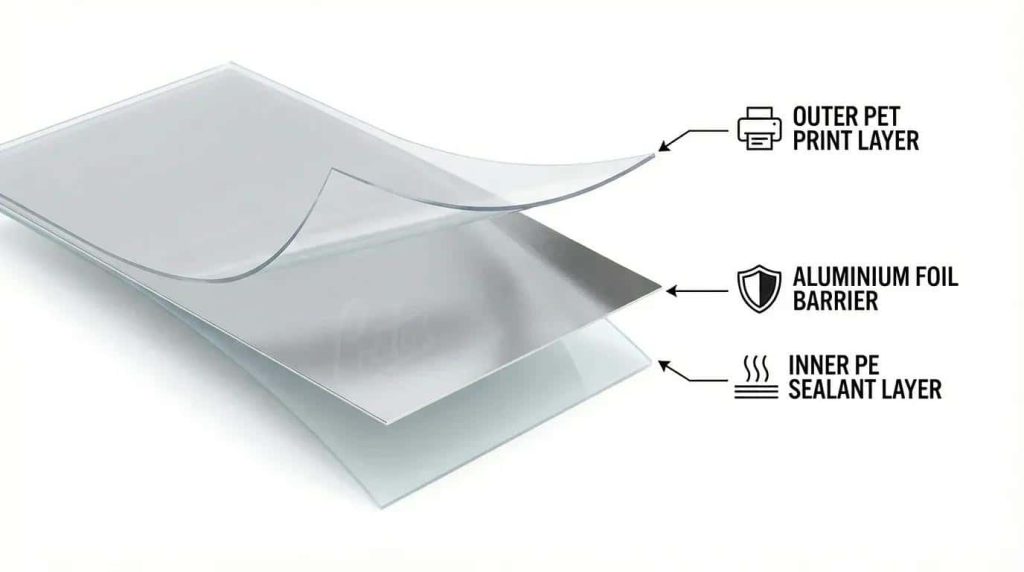
Different packaging films respond differently to tension, heat, and mechanical stress. PET, PE, CPP, and nylon do not have identical elastic modulus, elongation, or dimensional stability. For example, in a PET/PE laminate, the two substrates may respond differently when tension is released or when the laminate undergoes curing. If one layer contracts or recovers more than the other, the combined structure can develop a bending force.
This does not mean that PET/PE or another specific structure will always curl. The actual risk depends on film grade, thickness, manufacturing history, processing conditions, and the balance between the layers.
For a closer look at substrate behavior, see SINSTAR’s guide to PET/PE Lamination: Process, Adhesive and Machine Requirements.
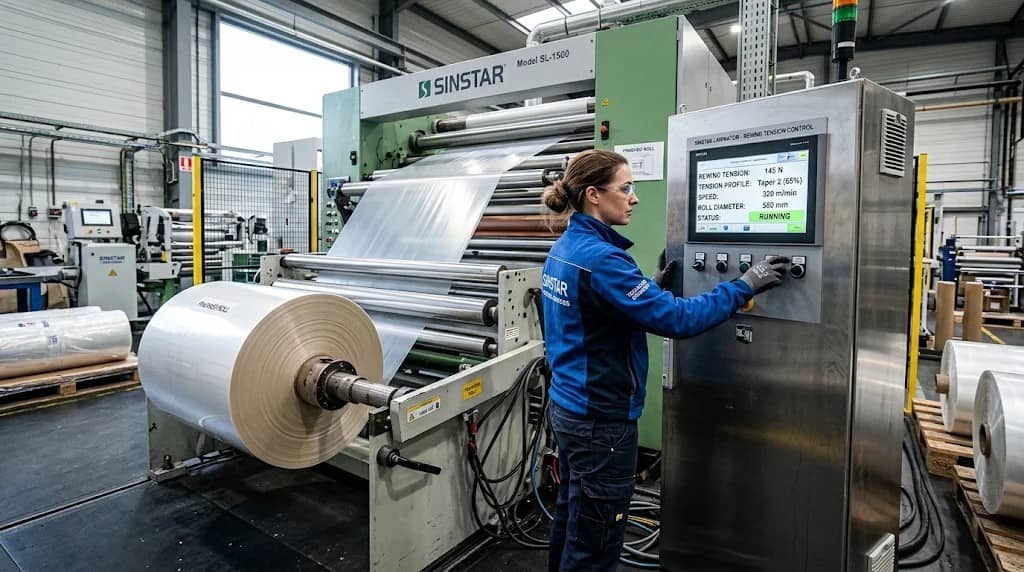
3. Excessive or Improper Rewinding Tension
Winding tension directly affects the internal structure of a finished roll. Too much tension may overstretch the laminate or squeeze inner layers, whereas erratic tension results in uneven hardness of a finished roll.
Good taper tension practices adjust winding tension as the roll diameter increases. The settings will vary depending on film structure, thickness, width, core, and machine configuration.
This article focuses on the stress created during winding. For a broader explanation of tension across the production line, refer to Mastering Web Tension in Solventless Lamination Machines for Defect-Free Packaging.
4. Uneven Adhesive Distribution and Laminate Thickness
The different spread rates of adhesives can change the thickness of the laminate and thus the mechanical behaviour of the web. Nonuniformity of coating may conspire with local stress to influence thinning or multilayering. Other areas to examine include coating uniformity, roll condition, nip alignment, and substrate flatness.
Even uniformity of adhesive coat contributes to more uniformity of laminate; yet, it should be treated together with the winding and material factors, not as the possible single cause.
5. Temperature Changes During Curing and Storage
Solventless adhesive has a post-lamination reaction. Curing can change the internal stresses of the laminate as the adhesive reaches its final bonding properties and the substrates are allowed to relax.
Curing or storage at an altered temperature may also affect the dimensions and mechanical properties of the substrates. Therefore, curling can manifest in a finished roll that is flat after rewinding.
Converters should observe the first instance of curing and any changes that occur in the state of the roll before and after curing. Curing and storage conditions should follow the technical advice of the adhesive supplier.
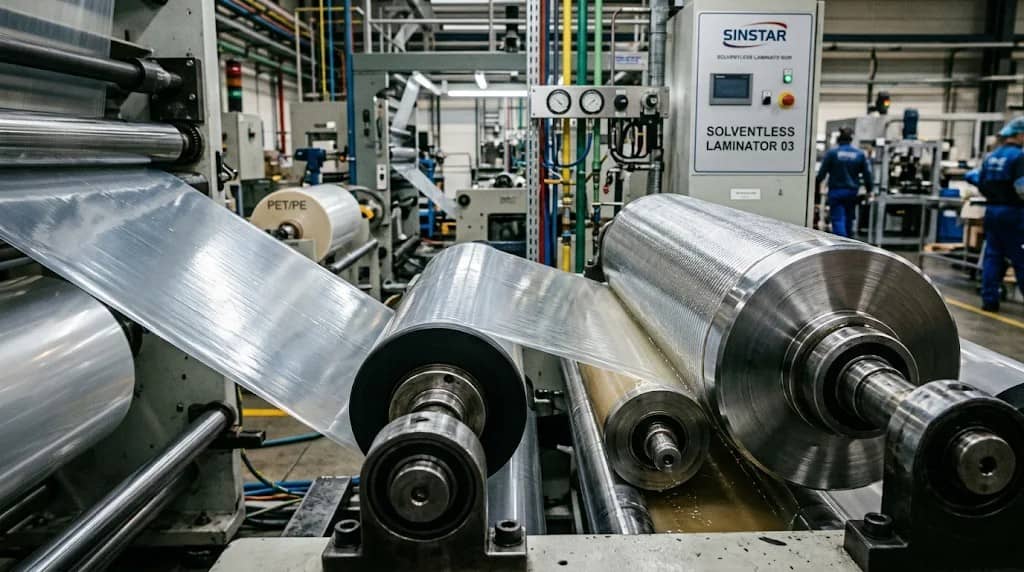
How to Identify the Root Cause of Laminated Film Curling
Instead of adjusting several parameters at once, converters should first establish when and where the curl develops.
| Observation | Possible cause to investigate |
| Curl appears immediately after rewinding | Rewind tension or roll compression |
| Curl becomes visible after curing | Residual stress, substrate relaxation, or shrinkage |
| Only one edge curls | Cross-web stress, coating variation, or roller alignment |
| Curl changes with roll diameter | Winding pressure and taper tension |
| Different film structures show different results | Substrate properties and thickness balance |
A practical diagnostic procedure includes:
- Inspect the laminate immediately after the nip and after rewinding. Record whether the web is already curved before winding.
- Compare rolls at different diameters. Check whether curl becomes more severe as the roll builds.
- Reinspect after curing and storage. Record changes in curl direction and severity.
- Check substrate specifications. Review film thickness, mechanical properties, and shrinkage data where available.
- Inspect cross-web uniformity. Examine coating distribution, roller alignment, and roll hardness.
For material testing, ASTM D882 provides a method for measuring the tensile properties of thin plastic sheeting. It can help characterize substrate behavior, although it is not a direct test method for laminate curl. See the ASTM D882 standard.
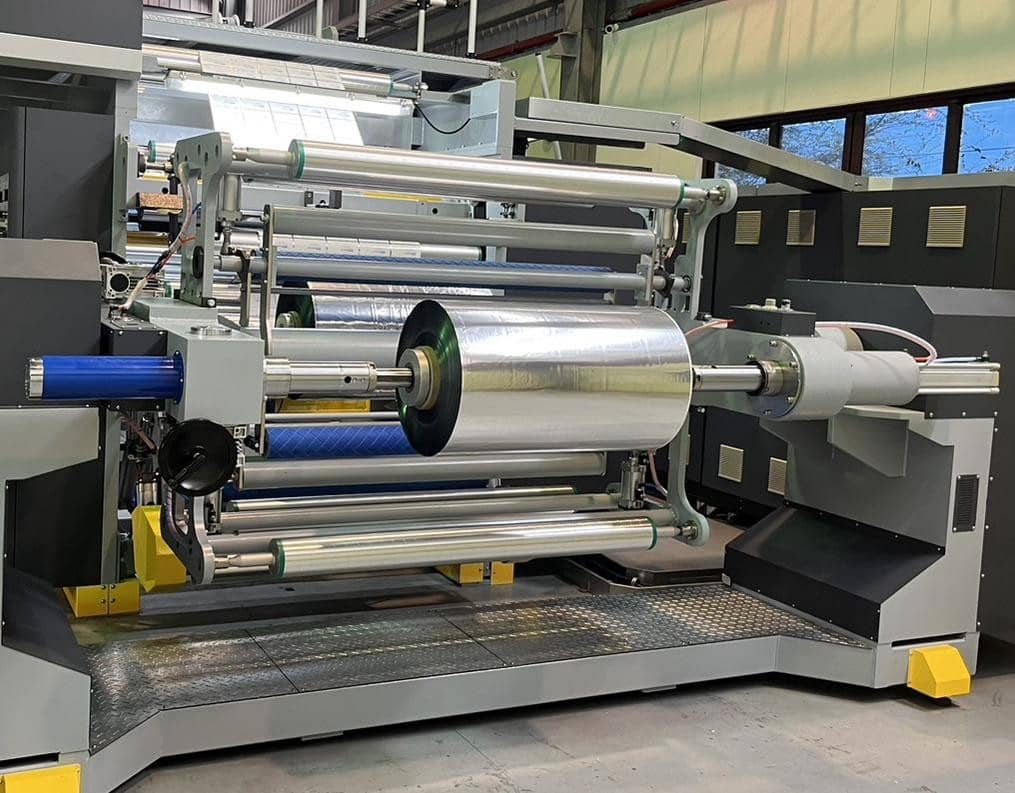
How to Prevent Curling During and After Rewinding
Once the root cause is determined, there are a number of coordinated steps converters can take to improve roll quality.
1. Modify Rewinding Tension and Taper Settings
Adjust rewinding tension to the laminate’s mechanical properties and the needs of the finished roll. Do not apply identical tension profiles for different material structures.
- Set proper initial winding tension.
- Increase taper tension as rolls increase in diameter.
- Inspect roll hardness and edge alignment.
- Check variation in core and winding.
- Capture configuration for repeat production.
The stable winding form should ensure the integrity of the roll while avoiding unnecessary compression on the inner layer.
2. Improve compatibility and stability of components
Test all substrates for thickness, stiffness, elongation, and stability prior to production. Test the laminate quality of a film combination after it has been re-wound and cured (not only at the laminator nip).
If the curl is inherent in the film combination, consult the material supplier about alternative film grades and combinations of thicknesses.
3. Control Adhesive Coating and Lamination Conditions
Check and verify temperatures, viscosities, and conditions of the adhesive and roller. Uniform coating will minimise variations in lamination structure locally.
To learn more about topping consistency, read How to Control Adhesive Coating Accuracy to ±0.1 g/m² in Solventless Lamination. So there is one to go with coating accuracy: the point is that consistent coating will result in more stable finished rolls.
4. Curing and Roll Storage Conditions
Adhere to the curing conditions recommended by the adhesive manufacturer. Try to keep storage temperature and humidity as constant as possible and avoid unnecessary temperature changes to finished rolls.
If possible, compare samples from different production runs cured and stored similarly. This helps to differentiate process-related curling from changes in the properties of the film.
How Does Laminating Machine Design Affect Rewinding Quality?
The optimal tension, coating, and winding conditions depend on the machine design and the control of operators. At SINSTAR, we take all of these into consideration in designing solventless laminating machines.
1. Independent and Precise Tension Control
Unwind, lamination, and rewind tension control reduce stretching and strain. SINSTAR’s precision tension control technologies and winding taper settings allow for repeatable production. Setup depends on the type of machine and the application.
2. Taper Tension Automatic Control
Variable taper tension winding allows for the adjustment of winding profile cutoff as roll diameter increases. This allows the operators to manage roll hardness and avoid over-compression.
3. Using Proper Roller Alignment and Achieving Uniform Coating
Proper roller alignment and adhesive metering will result in more uniform lamination of the web. This is important when laminating thin films or multi-layer packaging constructions.
4. Choosing Laminating Machinery
The SINSTAR Standard Solventless Laminator is a good machine for everyday two-layer flexible packaging. For challenging materials and more control/configuration for increased efficiency on demanding production needs, the SUPLOCK High-End Solventless Laminator offers a more controlled option.
The TRI-1300A Triplex Solventless Laminating Machine is also available and is ideal for three-layer structures like PET/AL/PE. The three-layer setup and digital tension control are factors of importance for getting the equipment right for multi-layer flexible packaging.
Your decision on machine selection should be based on the actual film structure, speed of production, roll specification, and control functions, not maximum rated speed.
Frequently Asked Questions
Q1: Why does film look flat while laminated, yet it curls up after rewinding?
Additional compression and residual stress may also be introduced by winding. Curl can occur when the roll is unrolled, or the internal stress can relax after curing and storage.
Q2: Can curling be caused by over-rewinding tension?
That is correct. Excess tension can lead to an inner roll layer being compressed and can also cause the laminate to stretch unnecessarily, either way contributing to uneven stress and curling of the film.
Q3: Does film thickness influence curling after lamination?
Yes. Thickness can affect the rigidity and mechanical balance of a laminate. Variations in substrate layers can influence the curling of the finished structure.
Q4: Will curing influence how curling films are laminated?
Curling may occur in this process during curing, due to the relaxation of substrates and the development of the final bonding properties of the adhesive. Curing, however, is not the only possible culprit.
Q5: How to distinguish material shrinkage from machine settings?
Try different material combinations at the same setting and the same material with different winding conditions. Measure curl pre-rewind, post-rewind, and post-cure to help determine the likely culprit.