
How to Improve Laminating Line OEE: Speed, Downtime and Scrap Reduction

Streamlining a laminating line does not mean simply running it faster. A laminating line may be running at high speed but is still losing production time due to frequent stops, high changeover counts, waste material, and quality issues.
Overall Equipment Effectiveness (OEE) can help manufacturers identify where these losses happen. Availability, performance, and quality measurements give production teams a way to concentrate on changes that create more good output from available production time.
In this guide, we’ll talk about how to measure laminating machine OEE, what the biggest sources of lost productivity are, and how to create an actionable plan for improving flexible packaging lamination.
Laminating Line OEE: What Is It?
OEE is a measure of how well equipment is utilized relative to its planned production time. It is the product of three factors: availability, performance, and quality.
OEE = Availability x Performance x Quality
Each factor represents a different form of production loss.
| OEE Factor | What It Measures | Typical Losses |
| Availability | The percentage of planned production time when the line is running | Breakdowns, changeovers, unplanned stops |
| Performance | Actual running speed compared with the expected production speed | Slow running, micro-stops, speed reductions |
| Quality | The proportion of output that meets quality requirements | Start-up waste, wrinkles, bonding defects, rejected rolls |
Consider, for instance, a laminating line that ought to be running for 480 minutes. Through downtime, it loses 60 minutes, so it has 420 minutes of operating time.
Availability is 420 ÷ 480 = 87.5%.
If performance is 90% and quality is 97%, the resulting OEE is:
87.5% × 90% × 97% = approximately 76.4%.
This is a calculated example, not the industry norm. In the real world, results will vary due to product mix, the production environment, and the factory’s definitions of planned time and good output. What is important to remember is that a line that has been running at a reliable level can also have a low OEE if it’s preventing it from running as fast as planned or producing more scrap than it should be.
Identify the Main Causes of Laminating Machine Downtime
Knowing where you’re losing production time will help you determine the need for upgrades or higher line speeds before you go out and purchase new equipment.
Typical causes of laminating machine downtime include:
- Changeovers: Operators require time to set up materials, set points, and stabilize the process.
- Web handling problems: Downtime occurs due to off-line film, wrinkles, web breaks, or unstable tension.
- Adhesive-system problems: Inadequate preparation, uneven application, or cleaning requirements can slow production.
- Machine failures: Mechanical, electrical, or control system failures may necessitate stoppages.
- Quality corrections: The operator may stop a line to correct defects in coating, bonding, or appearance.
- Material and job delays: Lack of materials, incomplete production instructions, or waiting for approvals can reduce available running time.
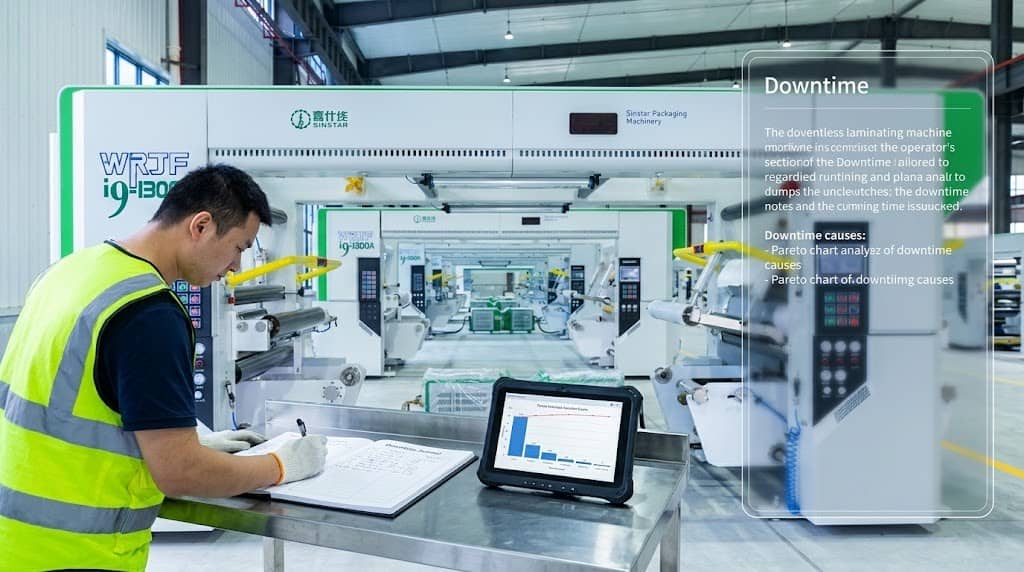
Record the start and stop times, duration, and reason in a downtime journal.
Organize like events and sort by total minutes lost. A Pareto analysis can tell you what problems account for the most downtime. For example, if most of the lost time is caused by web breakage and changeovers, the improvement in those two categories might outweigh changing a component that rarely ever causes a problem.
Don’t have one ‘downtime’ category. Detailed reason codes let you pinpoint repetitive issues and assign corrective actions.
Improve Running Speed Without Sacrificing Quality
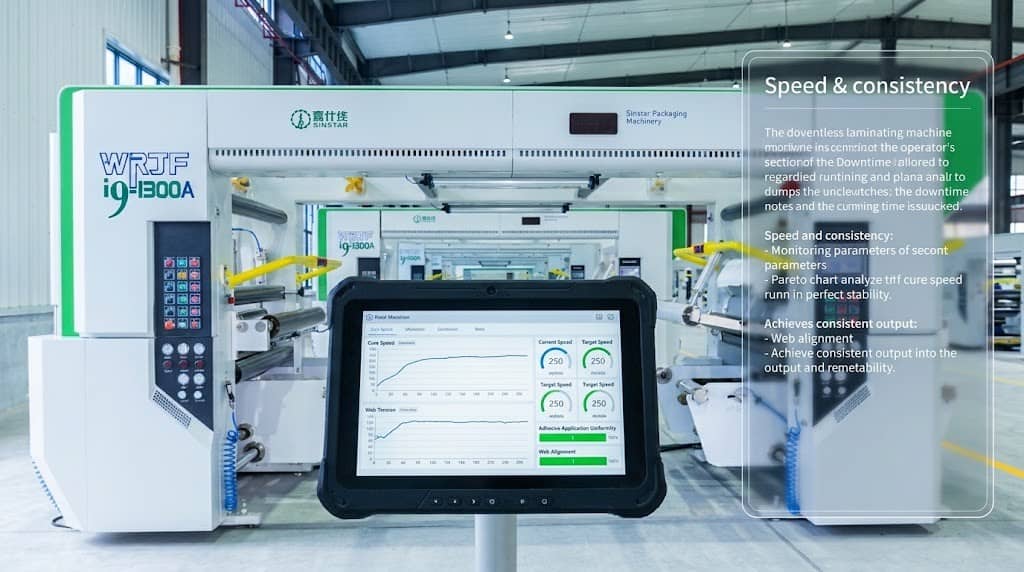
Increased speed can lead to increased output but only if you are in control of the process. Identify what the normal lamination speed for each job or product should be and compare this to the line’s running speed to determine the efficiency of the operation. You may need different speeds for different adhesive systems, different structures or coatings of film, or different conditions of cure.
Monitor together:
- Cure average speed & target speed
- Time at target speed
- Number and duration of short stops
- Changes in material loss with speed changes
- Bond quality and aesthetics
If the line stops frequently, check process conditions before tuning for speed. Check for web alignment, uniform tension, adhesive application, roller condition, and consistent operating parameters. If you change too many process variables at once, it is difficult to isolate the cause of a problem. Sinstar’s tension control of a solventless lamination machine guide: discover a key process variable.
It’s not running as fast as you can go for a little while. The objective is to have a consistent speed that allows for good output with minimal downtime and waste. Being faster in running lines does not mean being more productive, as it may mean producing the same wastage because of a higher defect rate or unplanned stoppages.
Reduce Changeover Time and Start-Up Losses
Film structure and order frequency can greatly affect availability. Identify a common start and end point for all jobs so that changeover performance can be consistently measured. A common approach is to measure from the last good roll of the old job to the first good roll of the new job.
Register the changeover time and waste-in-startup. A shorter changeover with more scrap is not an improvement.
Practical things you can do include:
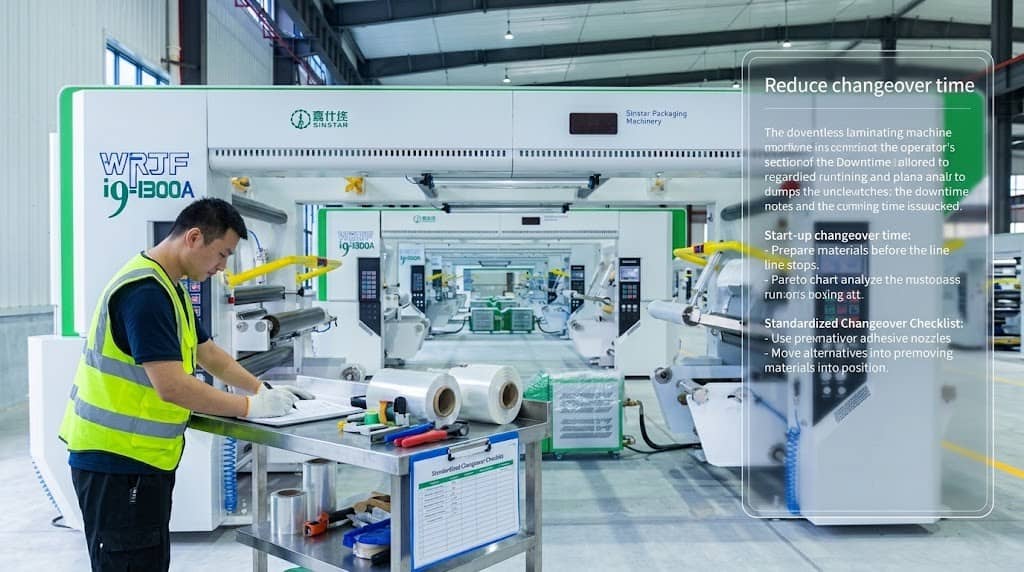
- Prepare film, adhesives, tools, and job instructions before the line stops.
- Determine and check specifications and processing parameters in advance.
- Standardize common setup steps when product requirements permit.
- Use tools and materials that are readily available.
- Record the reasons for long setup times.
- First good roll quality standards checks.
Also, set a standard preproduction routine for operators. Develop a checklist to refer to that ensures critical settings, materials, equipment, and safety conditions are set prior to production. See the pre-start checks for a solventless laminating machine for additional advice on how to prepare a line for running.
Measure changeover time and start-up scrap separately. Taken together, these will indicate whether setup improvements are actually boosting effective output rather than simply shifting losses elsewhere.
Reduce Scrap by Tracking Defects at Their Source
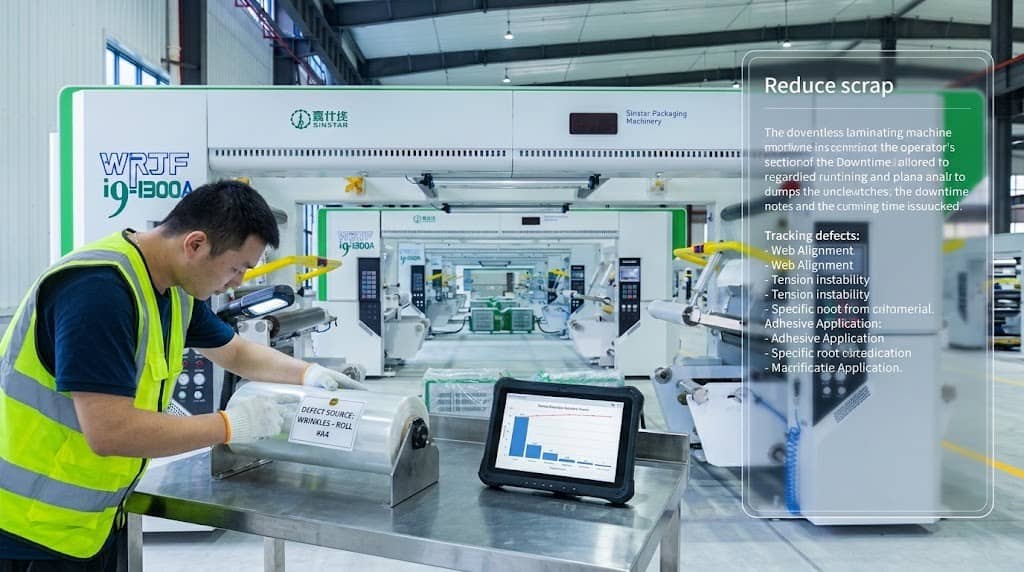
Each loss in quality chips away at your laminating machine OEE quality score. They also use up materials, operator time, and production capacity. Rather than dumping all rejected material into one big bucket, categorize the scrap by its cause.
| Scrap Category | What to Investigate |
| Start-up waste | Setup consistency, stabilization time, first-roll approval |
| Wrinkles and misalignment | Web path, tension, alignment, roller condition |
| Adhesive or coating defects | Application consistency, preparation, process settings |
| Bonding problems | Material compatibility, process conditions, and test results |
| Web breaks or damage | Film condition, handling, tension, and equipment contact |
| Incorrect setup | Job instructions, parameter selection, and operator handover |
Record scrap by weight or length, but maintain consistent units of measure from shift to shift and between production orders. Whenever possible, associate each defect with the job, material setup, machine settings, and production run. This will help you to differentiate an isolated incident from a systemic process defect.
For instance, if you’re seeing recurring bonding defects after a particular changeover, investigate the setup process and the conditions under which the initial rolls were handed over.
Avoid assuming the same causes result in similar bonding defects. Investigate the material, adhesive, process, and test conditions before tweaking production settings. The objective is to minimize the source of the defect, not the number of rejected material counted at the end of the shift.
Build a Consistent OEE Tracking System
OEE data is only as valuable as the shared understanding of the operators and production managers.
Track for every order or shift:
- Scheduled production time
- Actual downtime and reasons for downtime
- Run speed (target and actual achieved)
- Target and actual production
- Defect levels and types, scrap, changeover time, corrective actions and follow-up
A daily dashboard may summarize production availability, OEE, performance, and quality and may include the top three reasons for loss.
Look at data at two levels. Daily reviews allow for timely resolution of issues. Weekly reviews help identify the repeat problems needing process changes, maintenance work, or operator training.
When comparing products, consider operating requirements. The ideal speed will not be the same for simple and complex multilayer structures. Set appropriate target speeds and quality for different types of production.
Determine whether planned production time also encompasses planned maintenance, meal breaks, and other planned downtime. OEE comparisons are meaningful if the same rule of comparison is used.
Use a Practical Continuous Improvement Cycle
Some clear and measurable priorities are the foundation of a strong OEE improvement plan.
- Step 1: Measure. Gather good data on production, downtime, speed, and scrap.
- Step 2: Prioritize them. Identify which losses most impact good output. Do not launch so many improvement projects at once.
- Step 3: Make improvements. Identify an owner, describe the corrective action, and agree on a reasonable date for completion.
- Step 4. Check. Check the results before and after the change. Verify that downtime, speed losses, or scrap actually decreased.
You can make a four-week review cycle a repeatable process:
- Week 1: Set definitions and collect baseline data.
- Week 2: Identify major loss categories and root causes.
- Week 3: Trial corrective actions.
- Week 4: Review results and standardize successful changes/next priority.
There is no universal OEE target for all lamination operations. Any improvement must be compared to a realistic baseline and the production needs of the plant.
Consider Equipment Capability When OEE Losses Persist
Some production losses may be addressed with improved procedures, maintenance, or training. Others may be due to equipment limitations or suitability for the products to be produced.
When considering a laminator, look beyond the maximum mechanical speed. Consider:
- Stability of film structure and width for your run length
- Web alignment and tension control
- Adhesive consistency of application
- Cleaning and changeover requirements
- Ease of daily maintenance and operation
- Availability of spares and technical support
If you have a manufacturer with a demanding production schedule or complex multilayer structures, consider a triplex configuration for the application.
Consider available equipment such as the TRI-1300A Triplex solventless laminating machine, for example. Comparing the Sinstar laminating machine range can help as well in comparing the equipment for different production requirements.
Evaluate output, material compatibility, changeover requirements, and quality performance in real production conditions before purchasing. Verify any improvement in OEE using realistic operating data, not rated speed.
Frequently Asked Questions (FAQs)
Q1: What is a good OEE for a laminator?
There is no single target for all laminating lines. Results are dependent on product mix (i.e., coating method, if applicable) and frequency of changeover, process conditions, and quality needs. First, target the biggest avoidable losses and establish a reliable baseline.
Q2. How to Calculate OEE for a Laminating Machine?
Availability x performance x quality. Availability is the ratio of operating time to planned production time. Performance measures output rate and operating speed against a reference. Quality compares accepted output with total output. Use the same criterion for all three factors.
Q3: Why is a laminating line very down?
They include changeovers, web breaks, tension instability, machine faults, quality set-ups, cleaning, and material delays. Downtime records will pinpoint the most significant causes.
Q4: What to do with scrap by manufacturers without affecting throughput?
Start by sorting and determining root causes of defects. Standardize setups and web handling, adhesive application, and process monitoring. Do not assume that increased speeds equal increased productivity; verify changes with output and quality data.
Conclusion
As the OEE of the laminating machine is improved, availability, performance, and quality are at odds. More speed doesn’t fix too much downtime, long changeovers, and scrap.
Collect good data to begin. Identify the largest losses, correct the causes of those losses, and verify that any changes are improvements to good output. This will help the manufacturers to work toward improving efficiency of the lamination line, preventing waste, and maximizing the use of existing equipment in the long run.