
How to Build a Monthly Production Plan for Solventless Lamination

A solventless laminating line can run at high speeds, but still not meet monthly delivery targets. The problem may not be machine performance. Frequent changeovers, uneven order distribution, curing time, material shortages, and downstream bottlenecks can delay production.
A good monthly plan of production ties customer orders to available machine time, readiness of materials, curing schedules, and delivery dates. It helps flexible packaging converters to balance workloads, cut avoidable downtime, and identify capacity risks before they impact customers. This guide is about how to create a practical production plan for a solventless laminating line.
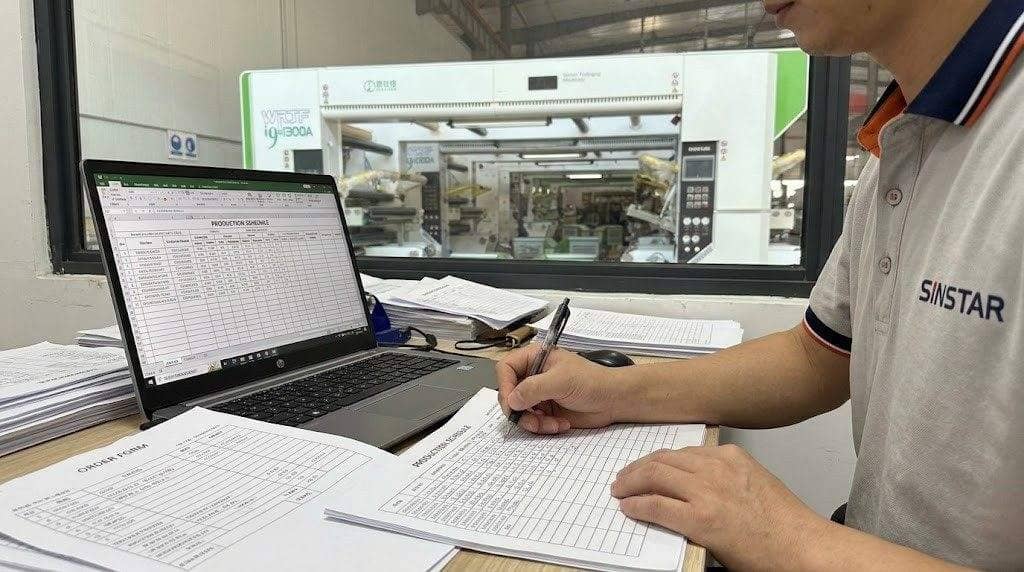
Combine Orders Before Scheduling Production
Start with a complete list of confirmed orders and realistic forecasts of demand. Never plan jobs by their required delivery dates alone.
Record the following information for each order:
| Planning item | Information to record |
| Order quantity | Required finished area or linear meters |
| Film structure | Materials, layer count, and film thickness |
| Web width | Required usable width |
| Delivery date | Customer’s required dispatch date |
| Production priority | Urgency and customer commitments |
| Curing requirements | Required curing conditions and release timing |
| Quality requirements | Bond strength, appearance, and other acceptance criteria |
Next, group compatible orders together where possible. Orders with similar film structure, width, and adhesive requirements may be candidates for consecutive production runs. However, the allocation of orders should not take priority over the material compatibility, quality requirements or delivery priorities. Running production longer is not helpful if it causes a more urgent order to miss its deadline.
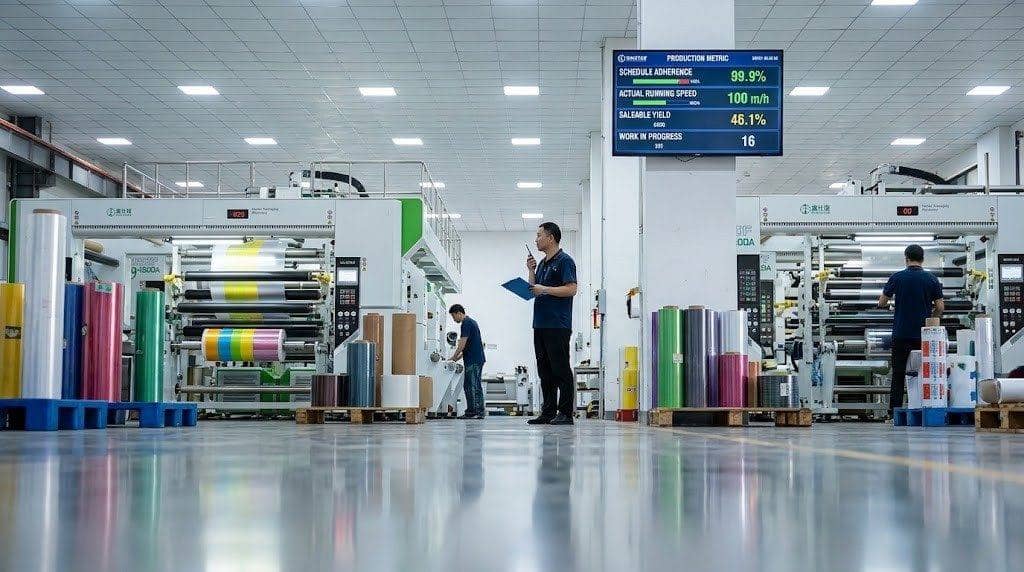
Calculate monthly available production capacity
The monthly plan should be based on usable time for production, not just scheduled hours.
Take the total minutes scheduled in the month. Subtract planned maintenance, non-overlapping changeover, and other foreseen stops.
Available production time = Scheduled time – Planned maintenance – Changeover time – Other downtime
For example, assume a laminating line is scheduled for 22 days with one 8-hour shift per day.
- Time scheduled = 22 × 8 × 60 = 10,560 minutes
- Scheduled maintenance: 240 minutes
- Changeovers and preparation: 900 minutes
- Other expected downtime: 420 min
Available runtime is:
10,560 – 240 – 900 – 420 = 9,000 minutes/month.
If the line is producing 150 m/min, then the estimated processed line length is 1,350,000 linear meters. This is not necessarily the amount of salable finished product. Actual output also depends on usable web width, quality yield, product mix and process conditions.
Estimate realistic running speeds using historical production records. The maximum rated speed should not be used as the default planning assumption.
Translate Customer Orders into Machine-Time Demands
Once you know how much time is available, estimate how long each order will take.
Calculate the planned run time of each job based on the required length and the expected operating speed.
Planned running time = Required linear meters ÷ Anticipated run speed
For example, a 90,000 linear meter order at a target speed of 150 m/min requires approximately 600 minutes of run time, not including setup and changeover time.
Add relevant preparation, roll changes, inspection, and other machine-specific activities.
For orders based on area, convert the required square meters into linear meters using the usable web width:
Required linear meters = Required area ÷ Usable web width
Use the same measurement basis. Do not directly compare finished laminate square meters with linear meters of web without considering the width.
For orders with different material structures, use separate estimates if running speeds or process needs vary. This results in a more realistic monthly workload than assigning the same speed to every job.
Plan Orders Around Curing and Delivery Deadlines
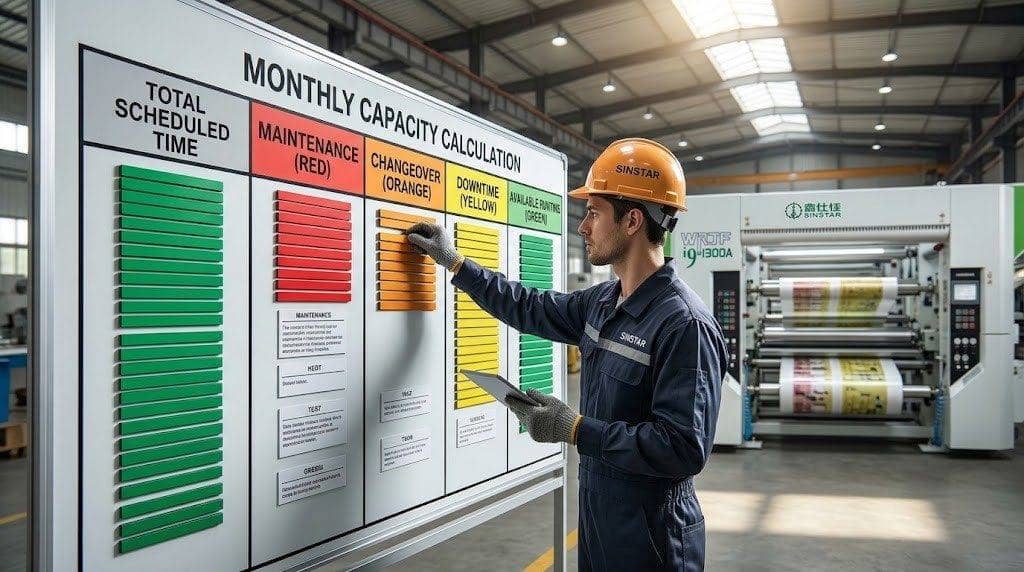
Solventless lamination planning doesn’t stop when the material leaves the machine. Depending on the adhesive system and the laminate structure, the material may require a defined cure time before slitting, further converting or final quality release. The conditions and time required shall be in accordance with the adhesive supplier’s recommendations and the approved production process.
Allow for cure time in the production schedule.
For each order, document:
- Planned lamination completion time.
- Curing conditions and time required.
- Earliest time allowed to start downstream processing.
- Planned inspection & quality release time.
- Deadlines for final slitting, packing and dispatch.
The curing time is not the downtime of the laminator. With sufficient room for curing, material identification and process controls, the machine can take another order while the previous batch cures.
Work backward from the customer dispatch deadline. Allow for lamination, cure, inspection, downstream processing, and unexpected delays. Don’t promise delivery based on the estimated completion time of the laminator alone.
Identify the Bottlenecks Before You Settle the Schedule.
A monthly plan should consider the whole production route, not only the laminator.
Some typical constraints are:
- Laminating capacity: Too many scheduled running minutes to match available machine time.
- Changeover frequency: High mix of short orders resulting in too much setup time.
- Curing space: Insufficient space to contain material under the required conditions.
- Slitting capacity: The finished laminate builds up faster than the slitting department can handle.
- Material availability: Films or adhesives come later than planned.
- Quality release: Inspection or open defects delay downstream processing.
Track planned versus actual production time, output, changeovers, and waiting time If material builds up before one stage repeatedly, check whether that stage is restricting throughput.
For repeat three-layer orders, verify if the current process requires separate lamination passes and extra handling. A proper triplex arrangement may reduce intermediate processing, but the benefit has to be evaluated against actual order mix, equipment availability, and confirmed production performance.
Discover SINSTAR solventless laminating machines and S3 triplex laminator for configurations relevant to different production workflows.
Build Flexibility Into Your Monthly Production Plan
A schedule that provides no time for anything but what is planned leaves no margin for urgent orders or unexpected difficulties.
Leave some reasonable amount of capacity for maintenance, trial runs, urgent jobs, and production variability. The right buffer depends on historical downtime, order volatility, and customer service requirements.
The practical planning process includes:
- Confirm order and delivery dates.
- Calculate available machine time.
- Estimate running and setup time for every job
- Schedule compatible orders without sacrificing quality.
- Reserve space for curing and downstream processing.
- Check that every order can be dispatched on time.
- Review actual performance and update the plan regularly.
Use a weekly review to tweak the rest of the monthly schedule. When a job runs over, consider the effect on future orders; don’t just shove all deadlines around without thought.
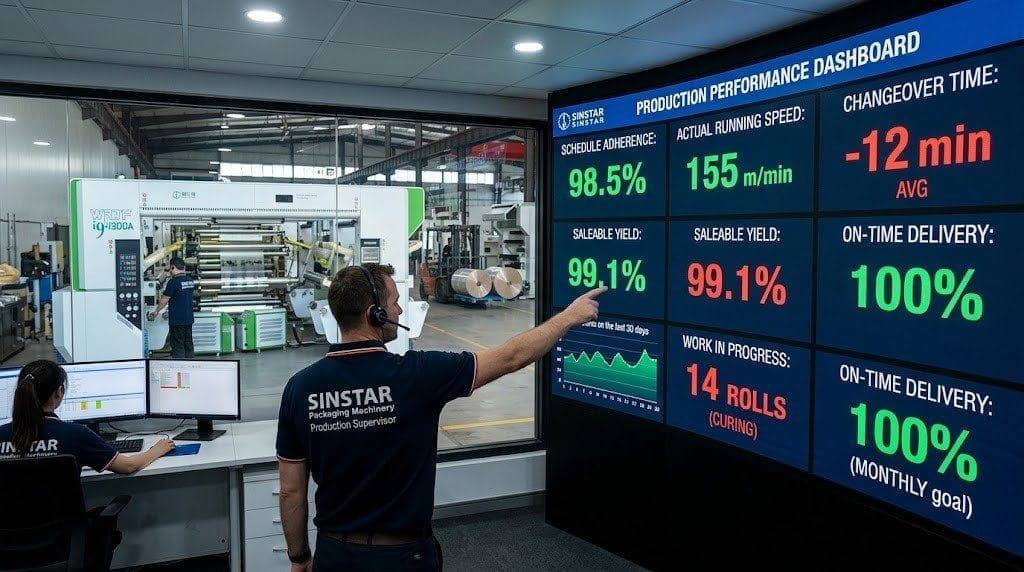
Track the Right Production Planning Metrics
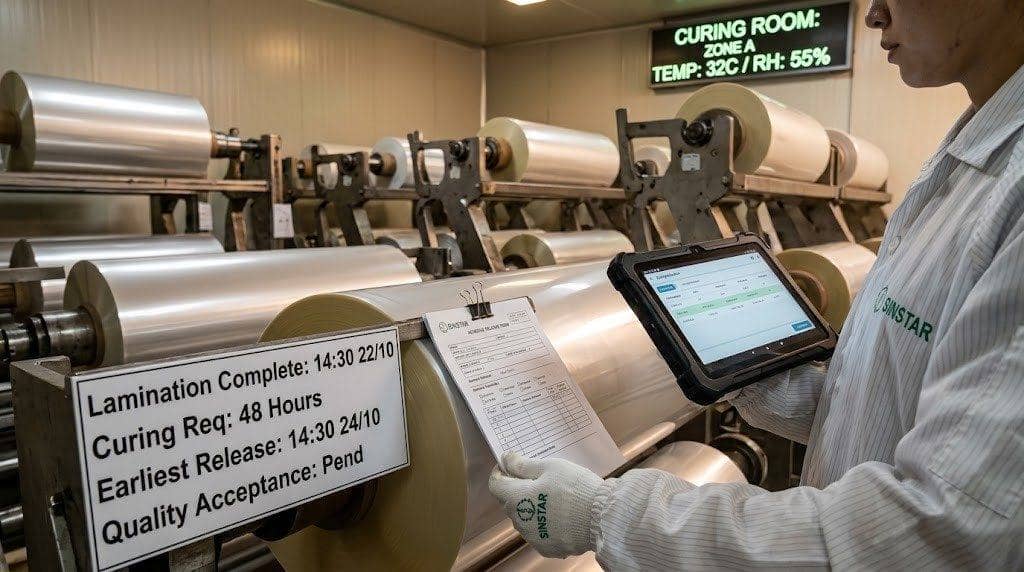
The only value of a monthly plan is if the factory can compare the plan performance against actual.
| Metric | What it reveals |
| Schedule adherence | Whether jobs start and finish as planned |
| Actual running speed | Whether production assumptions are realistic |
| Changeover time | Whether order sequencing creates avoidable losses |
| Saleable yield | How much output meets quality requirements |
| Work in progress | Whether material is accumulating between stages |
| On-time delivery | Whether production supports customer commitments |
Review these metrics, by order type or material structure, where useful. This helps distinguish a general scheduling problem from a specific product or process problem.
Don’t rely on one efficiency number. High machine utilization rates can be accompanied by late deliveries if curing, slitting, or quality release is the real bottleneck.
Frequently Asked Questions
Q1: How frequently should a solventless laminating production plan be updated?
Review it at least weekly and update it whenever there are major orders, downtime, or changes in material availability.
Q2: Should curing time be considered in the monthly production plan?
Yes. Curing affects when material can be moved to downstream processing and when finished orders can be released.
Q3: How can you increase the order capacity of a laminating line without adding a machine?
Review order sequencing, reduce avoidable changeovers, improve material readiness, and address downstream bottlenecks before adding additional equipment.
Q4: What is the biggest mistake in monthly production scheduling?
Scheduling based on theoretical machine output, without regard to actual running time, curing requirements, quality release, and delivery constraints.
Summary
A good monthly production plan will tie machine availability to order priority, realistic running speeds, cure schedules, and downstream capacity.
Plan around salable output and delivery dates to customers – not just machine speed. By using actual production data and finding bottlenecks early, flexible packaging converters can increase schedule reliability and make better decisions about process changes or future equipment investment.