
Packaging Film Glossary: 20 Essential Terms Every Flexible Packaging Converter Should Know

Flexible packaging comes with its own set of terms. You may see BOPP, PET, CPP, CoF, OTR, WVTR, corona treatment, or mono-material structure on a film specification sheet and know that each one matters, but what do they actually mean when you are choosing a film or setting up a lamination process?
This packaging film glossary explains 20 common flexible packaging terms in plain English. The focus is not only on what each term means, but also on why it matters when different films are laminated together, especially in solventless lamination.
With nearly 20 years in the solventless lamination industry, Sinstar has extensive experience with the films, structures, and terminology used in flexible packaging. In this glossary, we explain these terms from a practical lamination perspective, let’s started.
Core Packaging Film Materials
1. PE – Polyethylene
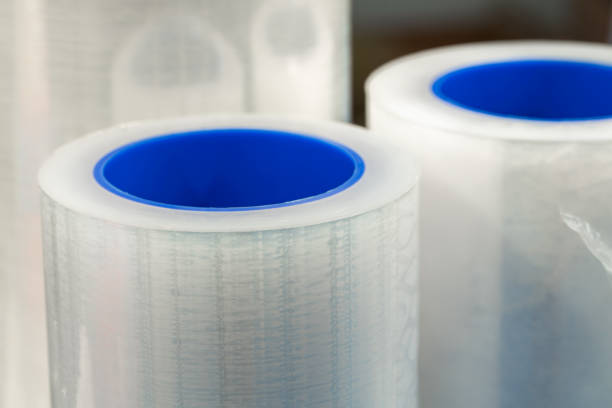
PE is one of the most widely used packaging films. Common types include LDPE, LLDPE, HDPE, and MDO-PE. PE is flexible, has good heat-sealing properties, and is often used as the inner sealing layer of a pouch.
2. BOPP – Biaxially Oriented Polypropylene
BOPP film is stretched in both the machine and transverse directions. It offers good clarity, stiffness, moisture resistance, and printability. It is commonly used for snack packaging, labels, and other applications where a relatively stiff and attractive outer layer is required.
3. PET / BOPET – Polyethylene Terephthalate
PET, also called BOPET when biaxially oriented, has good dimensional stability, tensile strength, and temperature resistance. It is widely used as an outer layer in structures such as PET/PE and PET/AL/PE.
4. CPP – Cast Polypropylene
CPP is produced through a cast film process rather than biaxial orientation. It has good heat-sealing performance and is often used as a sealing layer or inner film, particularly in food packaging.
5. PA / Nylon – Polyamide
Nylon film has high mechanical strength and good puncture and impact resistance. It is useful for packaging products that may experience rough handling, such as meat, frozen food, and some vacuum-packed products.
6. Metallized Film
Metallized film has a very thin metal coating, usually aluminum, deposited on a plastic film such as PET or CPP. It can provide improved light and gas barrier properties while using less material than a full aluminum foil layer.
7. Aluminum Foil
Aluminum foil provides very high barrier protection against oxygen, moisture, light, and other external factors. Structures such as PET/AL/PE are commonly selected when product protection is more important than transparency.
8. EVOH – Ethylene Vinyl Alcohol
EVOH is a high-barrier polymer used in many multilayer packaging structures. It is particularly effective at limiting oxygen transmission. Because it is sensitive to moisture, it is usually protected by other polymer layers.
Film Manufacturing and Structure Terms
9. Blown Film
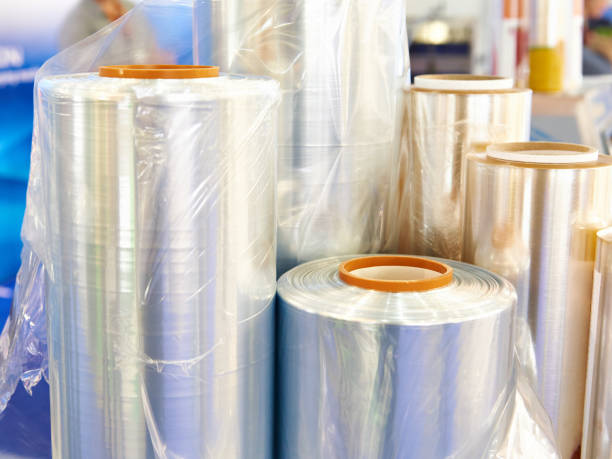
Blown film is made by extruding a polymer tube and expanding it with air before cooling. This process is widely used for PE films and can produce films with useful strength and flexibility.
10. Cast Film
Cast film is produced by extruding polymer through a flat die onto a cooling surface. Compared with blown film, it generally offers good thickness uniformity and optical clarity.
11. Biaxial Orientation
Biaxial orientation means a film is stretched in two directions. This changes its mechanical and thermal properties and is the reason materials such as BOPP and BOPET have different characteristics from their non-oriented counterparts.
12. Co-extrusion
Co-extrusion combines two or more polymer layers during film production. Different layers can perform different jobs, such as providing sealing, strength, stiffness, or barrier performance.
13. Lamination
Lamination joins two or more films to create a structure with combined properties. For example, one layer may provide printability while another provides sealing or barrier protection.
In solventless lamination, adhesive is applied without using a solvent carrier. The process requires accurate adhesive application, film tension control, and suitable substrate surface conditions.
14. Mono-material Structure
A mono-material structure uses mainly the same type of polymer across its layers, such as All-PE or All-PP packaging. It is increasingly considered for packaging designs intended to simplify recycling, although the actual recyclability depends on the complete structure and local recycling system.
15. Multi-layer Laminate
A multilayer laminate combines several functional layers. A typical structure may have an outer printing layer, a barrier or strength layer in the middle, and an inner heat-sealing layer. The right combination depends on the product and packaging requirements.
Key Performance and Testing Terms
16. OTR and WVTR
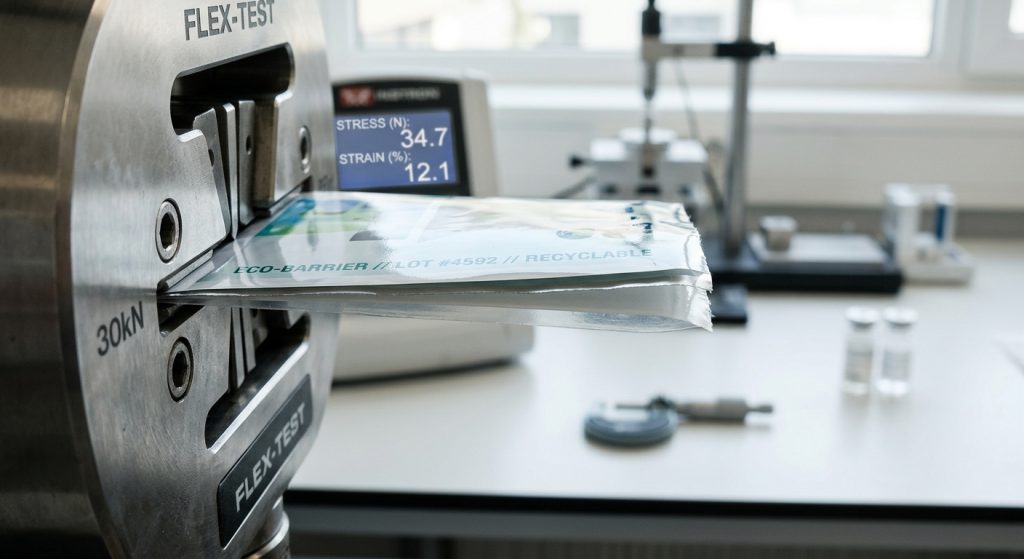
OTR means Oxygen Transmission Rate, while WVTR means Water Vapor Transmission Rate. Both are important barrier measurements.
A low OTR means less oxygen can pass through the film. A low WVTR means better resistance to moisture transmission. Products such as coffee, snacks, pharmaceuticals, and oxygen-sensitive foods may require specific barrier levels.
17. CoF – Coefficient of Friction
CoF describes how easily two surfaces slide against each other. It can affect film feeding, bag making, and machine running speed. A film with an unsuitable CoF may cause slipping, feeding problems, or unstable web movement.
18. Gauge / Film Thickness
Film thickness is usually expressed in microns (µm) or mils. Thickness affects stiffness, strength, barrier performance, sealing behavior, and material consumption. Two films made from the same polymer can behave quite differently when their thicknesses are different.
19. Corona Treatment
Corona treatment increases the surface energy of a plastic film so that inks, coatings, or adhesives can bond more effectively. This is particularly important for films such as PE and PP, which naturally have relatively low surface energy.
For solventless lamination, the actual surface condition matters. Film treatment should be suitable for the adhesive and application rather than simply meeting a number on a specification sheet.
20. Seal Strength and Heat Seal Window
Seal strength describes how well a package seal holds after sealing. The heat seal window refers to the range of temperature and processing conditions under which the film can form an acceptable seal.
This is one reason PE and CPP are commonly used as inner layers. Their sealing behavior needs to match the packaging machine, filling process, and final product requirements.
Why Do These Terms Matter When Choosing a Laminating Machine?
Film terminology is useful not only when buying materials. It also matters when setting up and running a laminating machine. Different films have different stretching behavior, surface properties, thicknesses, and tension requirements. In solventless lamination, these differences can affect adhesive coating, web alignment, curing, and the quality of the finished laminate.
For converters, understanding common films such as PET, BOPP, PE, and CPP makes it easier to discuss laminate structures with film suppliers and equipment manufacturers. It also helps when troubleshooting problems such as wrinkles, poor bonding, unstable web tension, and uneven laminate quality.
Sinstar’s solventless laminating machines are used with a wide range of flexible packaging structures, including PET/PE, BOPP/CPP, PET/AL/PE, and other common combinations. With more than 2,680 machines in operation, Sinstar has experience working with different film materials, laminate structures, and production requirements.
The key is to understand what each film does in the structure and how the layers work together. From there, the film structure can be matched with the right lamination process and machine settings.Once you are familiar with these 20 terms, film specifications and laminate structures are easier to read and discuss. It also makes communication between converters, film suppliers, and laminating machine manufacturers more straightforward.