Best Films for Solventless Lamination: A Complete Material Selection Guide

Unlike solvent or water-based conventional lamination processes that require drying tunnels to evaporate the carriers, solventless lamination employs 100% solid two-component polyurethane adhesives. Consequently, different materials impose very different requirements on adhesive chemistry, web tension control and mechanical press design. The removal of lamination flaws like tunnelling, curling, channelling and delamination is tied to the knowledge of surface properties, crystallisation behaviour, elongation properties and slip additive migrations of different substrates. This complete technical guide covers the essential criteria for the selection of packaging films, discusses the behaviour of individual substrates, examines ideal composite structures and presents innovative machine engineering that can handle even the most difficult multi-layer combinations.
How Solventless Lamination Works
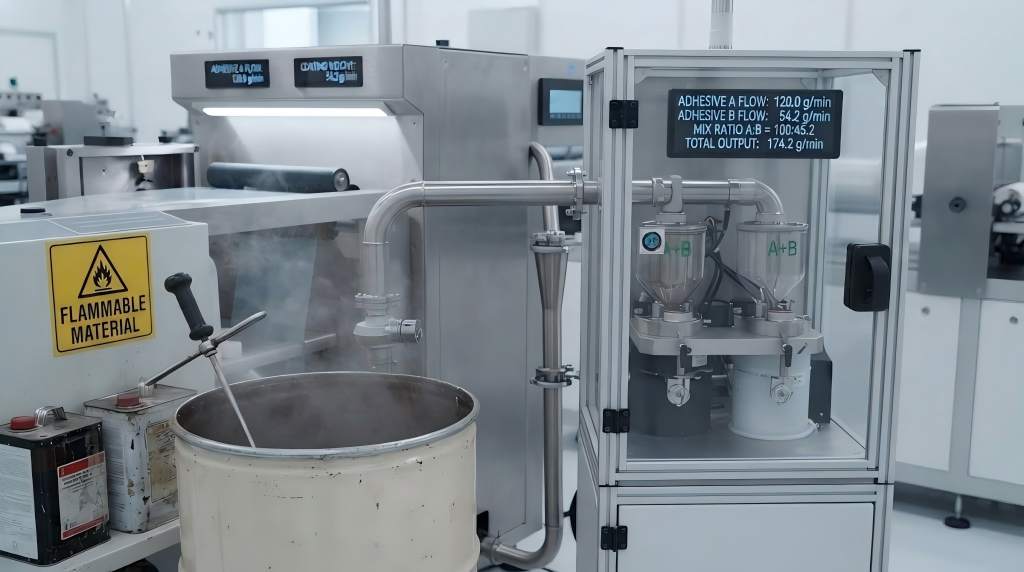
The solventless lamination process is a mechanical and chemical operation engineered for precision, which joins two or more moving webs without the need for thermal drying. The operation is based on two-component polyurethane adhesives, which are made up of an isocyanate-terminated prepolymeric resin (Part A) and a hydroxyl-terminated polyol curative (Part B). Obtaining the stoichiometric mix ratio is essential. Slight variations will change the cross-linking density, leading to a weakened bond strength or uncured residual monomers.
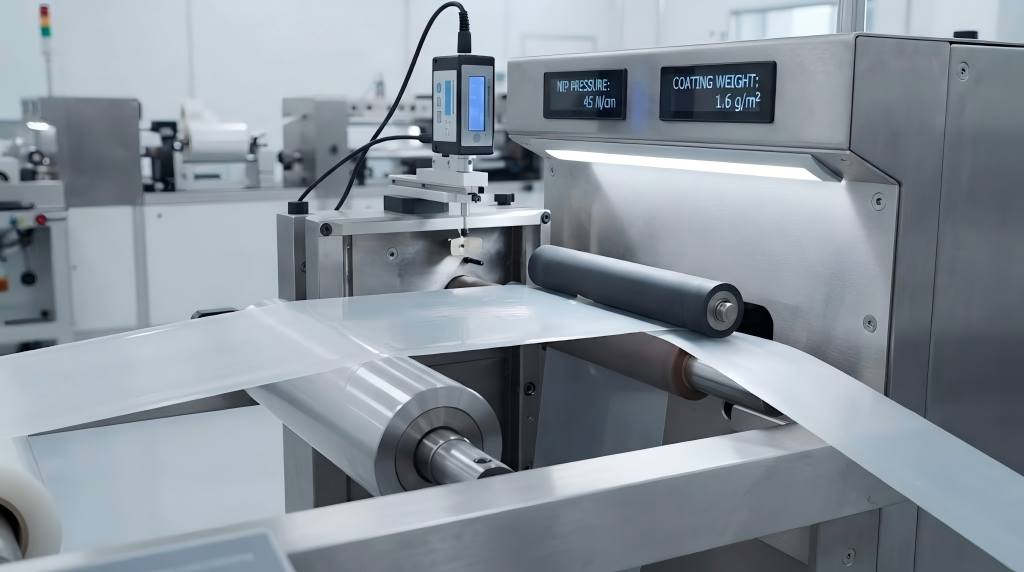
The operational workflow proceeds through several strictly controlled stages:
- Mixing and Metering: An automated, gravimetric or volumetric Mixing and Metering unit precisely doses Parts A and B, blending them homogeneously under vacuum to prevent air entrapment before feeding the mixture to the coating nip.
- Gravure Coating: The mixed adhesive is transferred via a precision-engraved Gravure coating cylinder. The cellular geometry of the roller controls the dry coat weight, typically ranging from 1.0 to 2.5 g/m².
- Nip Roller Pressing: The coated primary web meets the secondary web at a heated steel-and-rubber Nip roller station. Controlled nip pressure forces immediate wetting across both substrate surfaces.
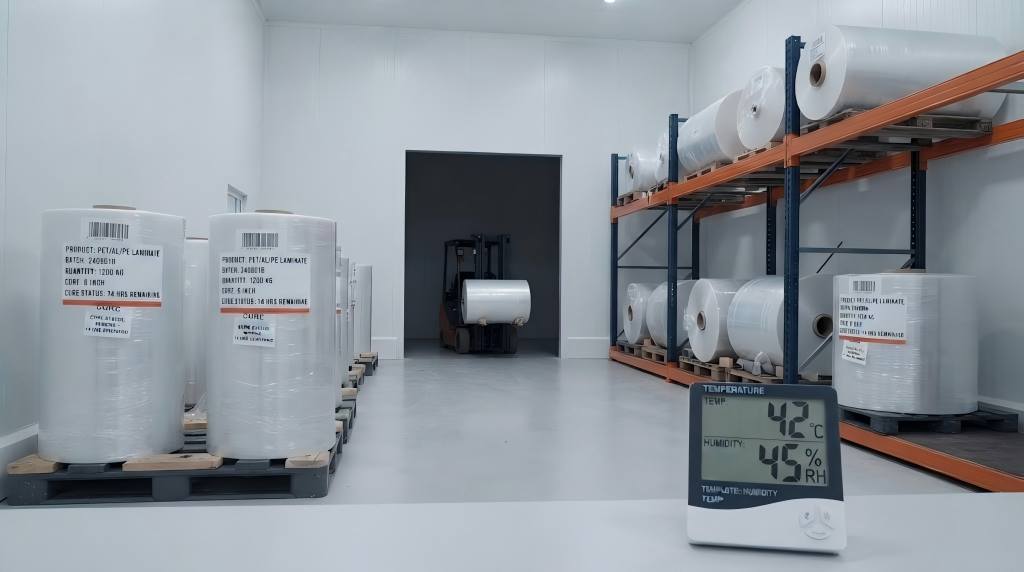
- Chemical Curing: The newly formed laminate is wound into a master roll and transferred to a temperature-controlled curing room, where moisture diffusion initiates the final Curing reaction, developing ultimate polymer chain cross-linking.
Some materials will laminate easily; others will give you a lot of mechanical and chemical problems, because you are not using any heat to evaporate the solvents. Polyurethane coatings are easily taken up by high surface energy dimensionally stable non-porous films. On the other hand, extensible substrates, such as PE, high-moisture films, such as BOPA, or inert surfaces, such as untreated polyolefins, require rigorous pre-treatment, specialised tension profiles and customised adhesive formulations to achieve robust, long-term interlayer adhesion.
Key Factors When Selecting Films
Engineers and material specifiers must evaluate several vital parameters before pairing substrates for solventless lamination:
- Surface Energy & Corona Treatment: Polymeric films possess inherently low surface energy due to non-polar molecular backbones. Inline or offline Corona Treatment is mandatory to polarize the film surface, creating active bonding sites for isocyanate groups.
- Dyne Level: The minimum threshold for reliable solventless bonding is 38 to 42 dynes/cm. Substrates falling below 38 dynes consistently exhibit poor wetting and catastrophic delamination under stress.
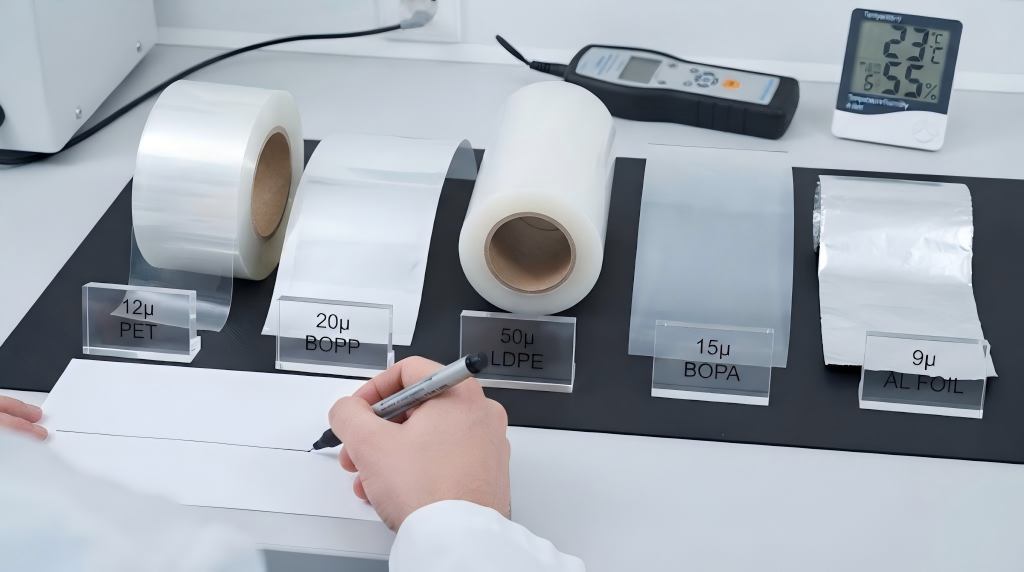
- Film Thickness: Dimensional stability is directly related to gauge. Standard gauges such as 12μ PET, 15μ BOPA, 20μ BOPP, or 30–50μ PE offer optimal rigidity, whereas ultra-thin films demand advanced closed-loop tension control to prevent elongation deformation.
- Surface Roughness & Slip Additives: Slip additives such as erucamide or oleamide migrate to the film surface over time to form a microscopic barrier to prevent wetting by the adhesive. Smooth profiles (low surface roughness) also help with lamination; too much slip requires special high-tack adhesives.
- Heat Resistance & Chemical Compatibility: Films must be able to withstand thermal exposure from nip rollers without thermal shrinkage or dimensional distortion and must remain chemically inert when exposed to aggressive food contents or aggressive adhesive monomers.
Best Plastic Films for Solventless Lamination
1. PET (Polyethylene Terephthalate) Film
PET is the principal structural backbone for print web and flexible packaging. Its excellent tensile strength, thermal stability up to 200 °C, and brilliant optical clarity make it indispensable.
- Advantages: High tensile modulus, excellent dimensional stability, very good gas barrier properties and very good printability with rotogravure or flexography.
- Applications: Retort pouches, vacuum packaging, snack food pillows, stand-up pouches.
- Suggested Structures: PET/PE, PET/CPP, PET/VMPET/PE, PET/AL/PE.
- Typical problems: static build-up, web curling due to uneven drying, asymmetric tension
- Recommended coating weight for standard barrier laminates: 1.2 to 1.8 g/m².
2. BOPP (Biaxial Oriented Polypropylene) Film
BOPP is the workhorse substrate for high-speed confectionary, bakery, and dry food packaging, prized for its moisture resistance and cost-effectiveness.
- Advantages: Excellent moisture barrier, high gloss, low material cost, and outstanding puncture resistance.
- Disadvantages: Low melting point, high sensitivity to thermal shrinkage, and poor oxygen barrier.
- Best Suited For: High-speed snack packaging, overwraps, and cold-seal confectionery wrappers where low sealing temperatures are required.
3. CPP (Cast Polypropylene) Film
The decision to use CPP as the inner seal web in multiwall structures is primarily due to its better tear resistance and low heat seal initiation temperatures.
- Seal Layer Optimization: CPP provides robust, hermetic seals across a broad temperature window, making it ideal for high-speed vertical form-fill-seal (VFFS) packaging lines.
- Retort Grade CPP: Specially modified copolymer grades withstand sterilization temperatures up to 121°C or 135°C without delaminating or deforming.
4. PE (Polyethylene) Film
The flexible sealing layer in the whole packaging industry is from the families of polyethylene like LDPE, LLDPE, HDPE and MDO-PE.
- Substrate Variants: LDPE offers good clarity & sealability, LLDPE offers excellent tensile & puncture strength, HDPE offers rigidity & moisture resistance, MDO-PE (Machine Direction Oriented PE) offers mono-material recyclable packaging solutions with high stiffness.
- Lamination Challenges: Low surface tension, slip additive blooming, and high elasticity require precise, low-tension handling.
5. Nylon (BOPA – Biaxially Oriented Polyamide)
BOPA film – Best-in-class toughness and flex-crack resistance for demanding packaging applications
- High Puncture Resistance: No piercing by sharp or heavy food items into the packaging wall.
- Retort & Vacuum Packaging: Withstands aggressive thermal processing and deep-draw vacuum forming without structural failure.
- Hygroscopic Nature: BOPA absorbs ambient moisture rapidly; conditioning and immediate lamination are required to prevent bubbling and tunnel defects.
6. EVOH (Ethylene Vinyl Alcohol) Film
EVOH is the premier polymer for oxygen and aroma barrier protection in modern high-performance packaging.
- Barrier Excellence: Blocks oxygen transmission effectively, preserving perishable foods without foil layers.
- Humidity Sensitivity: EVOH loses barrier performance when exposed to high relative humidity; thus, it must be encapsulated between hydrophobic layers such as PE or PP.
7. Metallized Films (VMPET & VMCPP)
Vacuum-metallized films provide a brilliant metallic sheen alongside dramatically improved barrier properties against light, moisture, and oxygen.
- Bonding Dynamics: The thin aluminum vapor deposition layer requires careful corona maintenance; excessive nip pressure can fracture the metal layer, destroying barrier integrity.
8. Aluminum Foil
Aluminum foil remains the gold standard for absolute barrier protection against light, moisture, and gases.
- Advantages: Zero permeability (absolute barrier) and excellent dead-fold characteristics.
- Defects & Bonding: Pinholes, edge wrinkles, and oil residues from rolling mills can impair adhesion. Thorough corona treatment or chemical priming on the dull side ensures robust polyurethane anchorage.
Best Film Combinations
The following matrix outlines standard commercial packaging structures, their primary applications, and relative lamination difficulty:
| Structure | Application | Lamination Difficulty |
| PET/PE | Frozen Food Packaging | Easy |
| PET/CPP | Snack Food Pouches | Easy |
| PET/VMPET/PE | Coffee & Powder Packaging | Medium |
| PET/AL/PE | Retort & Pharmaceutical Pouches | Medium |
| BOPP/CPP | Bakery & Confectionery Wraps | Easy |
| PET/NY/PE | Heavy-Duty Vacuum Packaging | Medium |
| PET/EVOH/PE | High Barrier Meat Packaging | Medium |
| Paper/PE | Sustainable Eco-Friendly Packaging | Medium |
Films That Require Extra Attention
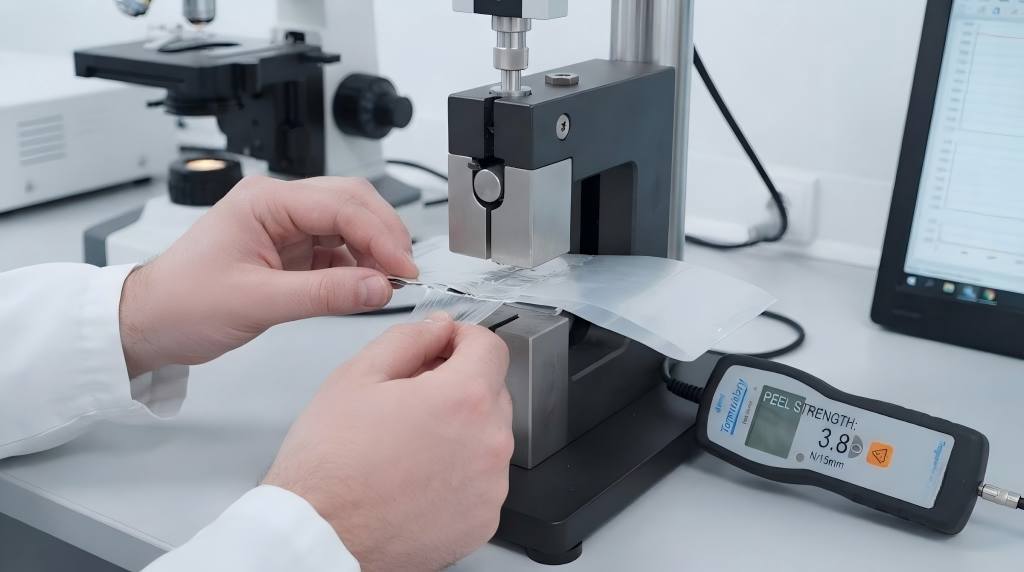
Certain modern substrates present unique rheological and surface challenges during solventless lamination, specifically PE, low dyne films, slippery films containing high slip agent concentrations, recycled post-consumer resins (PCR), and bio-based polymers (PLA, PHA).
These materials require advanced engineering interventions, including Higher Nip Pressure to force intimate adhesive contact, Higher Thermal Control to stabilize extensible webs, and Superior Mixing Accuracy from gravimetric dosing units to prevent stoichiometric imbalance. Without these adjustments, low surface energy and slip migration will inevitably trigger interlayer failure.
Common Lamination Problems by Film Type
Troubleshooting solventless lamination defects requires correlating specific visual flaws with root material causes and corrective machine parameters:
| Film Type | Identified Problem | Root Cause | Corrective Solution |
| PET | Web Curling | Uneven web tension or thermal gradient | Optimize web tension profile and cooling rolls |
| PE | Poor Peel Adhesion | Low dyne level or slip agent migration | Inline corona treatment and primer application |
| Nylon (BOPA) | Interlayer Bubbling | Moisture absorption in nylon film | Pre-dry film and maintain climate-controlled storage |
| Aluminum Foil | Delamination | Insufficient adhesive coating weight or rolling oil residue | Increase coating weight and clean/prime foil surface |
| VMPET | Pinholes / Barrier Loss | Excessive nip roll pressure fracturing metal layer | Reduce nip pressure and optimize rubber roller durometer |
Recommended Machine Features
To successfully process the diverse range of films detailed in this guide, converters require state-of-the-art laminating machinery equipped with precision engineering. Essential technological features include:
- Servo Control & Auto Tension: Closed-loop vector drives ensure ultra-stable web tension, preventing elongation of stretchy films like PE and BOPA.
- Automatic Mixing & Dosing: Gravimetric dual-component proportioning units guarantee 100% stoichiometric accuracy.
- Low Coat Weight Capability: Advanced metering rolls designed to apply precise coats down to 0.8 g/m² without skipping.
- Triplex Capability & Dual Stations: Enabling simultaneous three-ply laminations (e.g., PET/AL/PE) in a single pass.
- PLC & Remote Monitoring: Intelligent diagnostics and recipe management systems for rapid job changeovers.
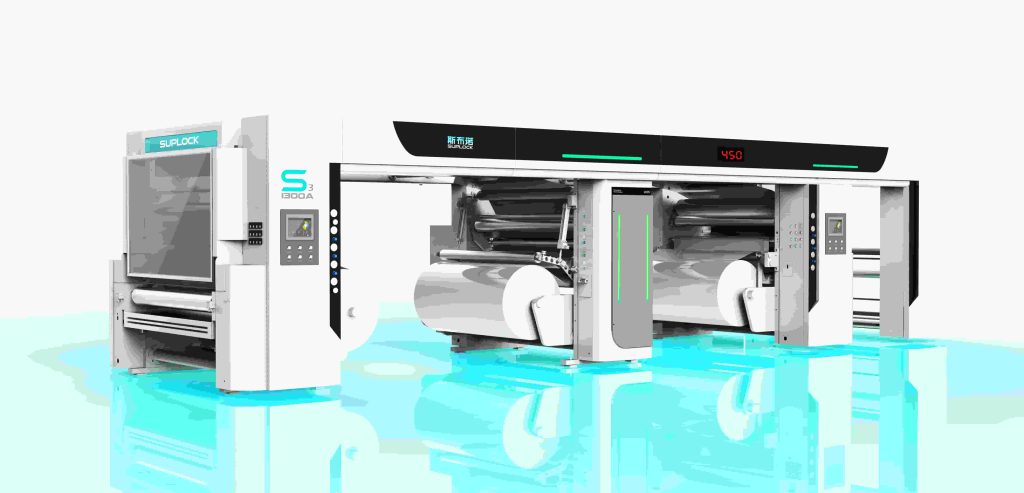
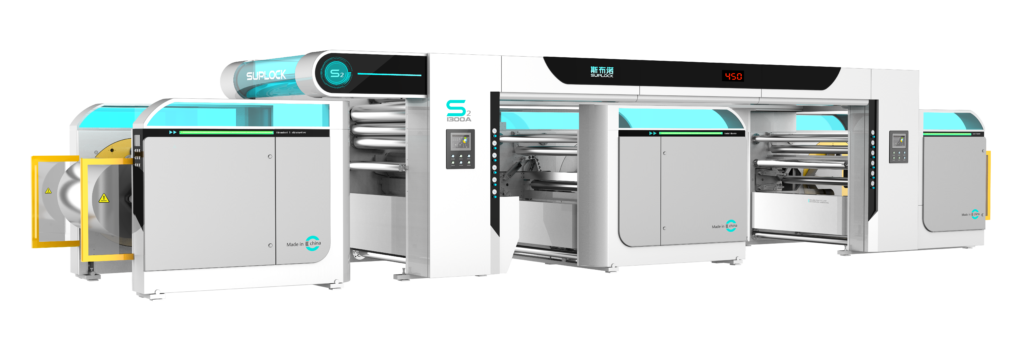
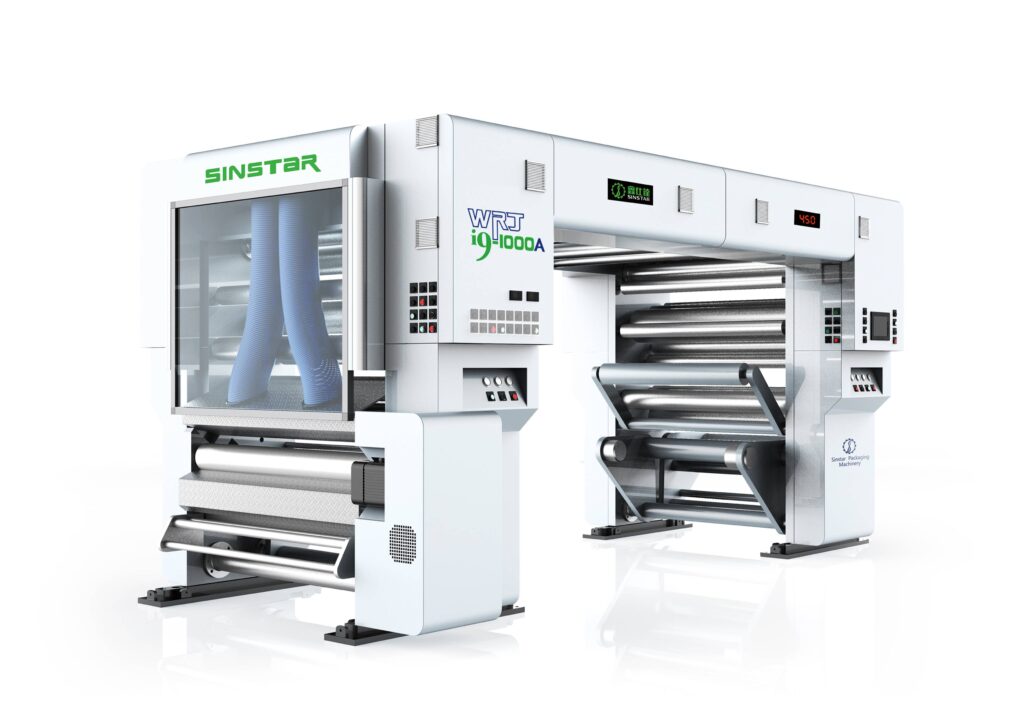
For converters seeking uncompromising quality and versatility, industry-leading machinery from Sinstar—such as the Sinstar WRJ i9, WRJF i9, TRI, and Suplock series—delivers unsurpassed precision, robust mechanical stability, and exceptional reliability across all advanced solventless lamination applications.
Frequently Asked Questions
Can PE be laminated without solvent?
Yes, polyethylene can be laminated regularly with 100% solid solventless polyurethane adhesives if the film is correctly corona treated and tension is tightly controlled.
Is PET the easiest film to laminate?
Yes usually. PET is one of the most forgiving substrates in solventless lamination, offering high dimensional stability, high surface energy retention and excellent heat resistance.
Can you use solventless technology to laminate aluminium foil?
Of course. Foil is often laminated with PE or CPP for retort and barrier pouches, but rolling oils need to be controlled with good priming or cleaning.
What is the best dyne for films?
38 to 42 dynes/cm minimum surface energy to wet reliably and for long-term bond strength.
What is the correct coating weight?
Standard solventless adhesive coat weights range from 1.2 to 2.0 g/m² depending on film texture and barrier requirements.
What are good films for a retort pouch?
PET, BOPA (Nylon), Aluminium Foil and Retort grade CPP are specifically designed for thermal sterilisation up to 135° C.
Best film for recyclable packaging?
Mono-material structures using MDO-PE combined with conventional PE sealant webs are currently the best solution for completely recyclable flexible packaging.
How long does solventless glue take to cure?
The full chemical cure usually takes 24 to 72 hours in a temperature-controlled cure room (35°C to 45°C), depending on the moisture and the adhesive formulation.