How to Master Tension Control for Monomaterial PE Film Lamination?

Converters switching to all-PE laminates for recyclability often run into the same problem: tension settings that worked fine for years on PET/PE structures start producing curling, uneven winding, or intermittent delamination once the structure changes to PE-PE. The film itself isn’t more difficult to work with.
The issue is that most lamination equipment and operator experience were built around structures where one layer is noticeably stiffer than the other, and mono-PE removes that difference entirely.
Why Mono-PE Structures Are Harder to Tension-Control Than PET/PE
In a typical PET/PE structure, PET does most of the work of holding the web steady. It’s stiff, resists stretching, and needs relatively high tension — often in the 20N range — to run true. PE stretches far more easily and needs much less, usually somewhere between 3N and 5N. PET anchors the structure, and PE follows its lead, which is why the combination tends to run predictably even when tension settings aren’t perfectly dialed in.
Laminate PE to PE and that anchor is gone. Both webs stretch under load in roughly the same way, and both respond to speed changes similarly, so neither layer holds a fixed reference point while the other adjusts. A tension mismatch that would go unnoticed in a PET/PE run shows up clearly in a mono-PE run, since there’s no stiffer layer to absorb it. Mono-material lines end up needing tighter tension tolerances than converters are used to working with on legacy multi-material setups.
What Goes Wrong When Tension Isn’t Controlled in Mono-PE Runs
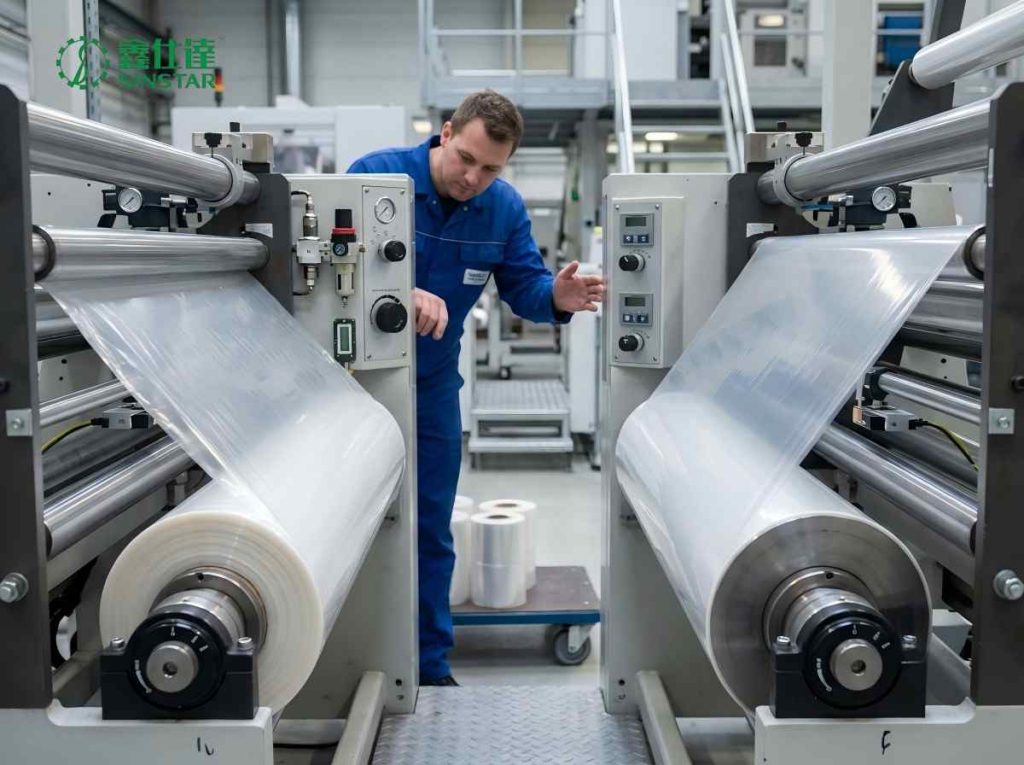
The visible symptoms are ones anyone running flexible film will recognize — wrinkling, curling once the roll comes off the winder, and delamination that shows up in specific zones rather than across the whole roll. Uneven roll build is a quieter problem but costs just as much: inconsistent winding tension leaves rolls with variable diameter across their width, and that unevenness turns into slitting or pouch-forming defects further down the line.
Mono-material production adds a compliance wrinkle that PET/PE structures didn’t really have. A roll can be genuinely all-PE, with no incompatible layers mixed in, and still fail quality checks if the lamination itself is inconsistent. Recyclability assessments are starting to look at how the packaging actually performs, not just what it’s made of, so delamination pockets or thickness variation can work against a recyclability claim that the material composition alone would otherwise support.
Key Equipment Requirements for Precise Mono-PE Tension Control
Equipment choice matters more here than it did with mixed-material structures. Mechanical tensioning systems, the kind built around spring-loaded brakes or manually set friction, were designed with structures that have a built-in tension differential in mind. Two similar, stretch-prone PE webs held at matched tension across a full run tend to drift on that kind of system, and adjustments made manually at the start of a job rarely hold once roll diameter and speed change mid-run.
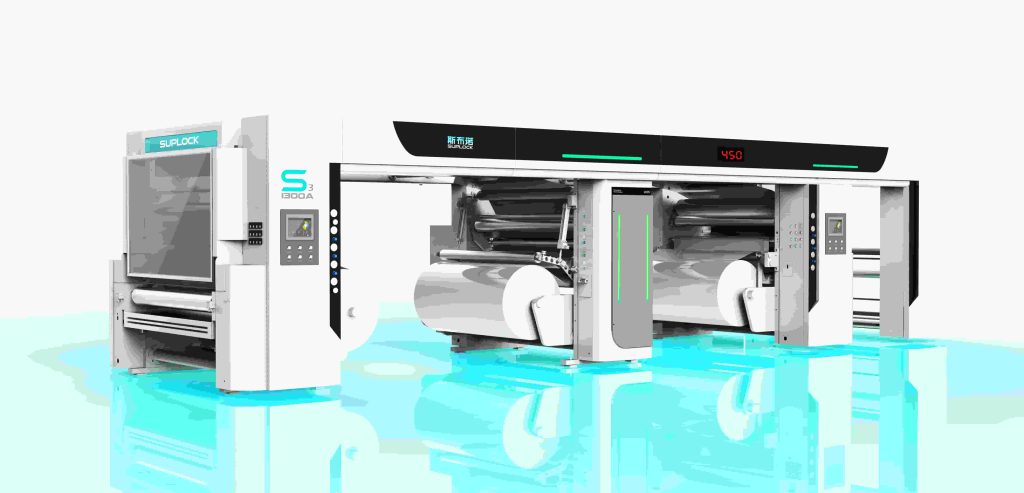
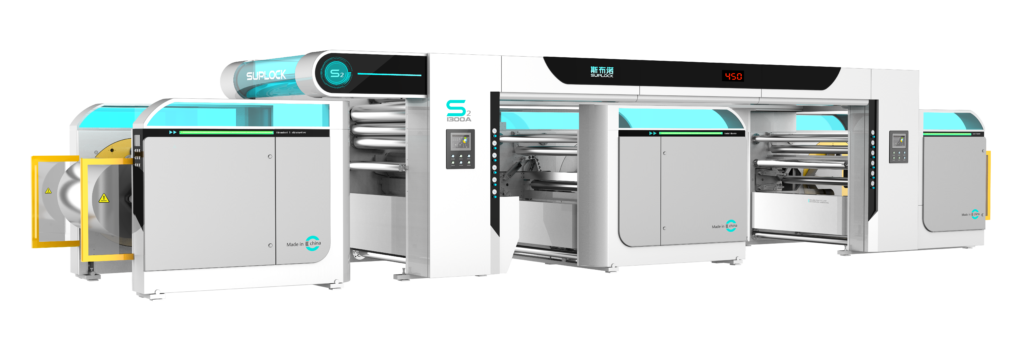
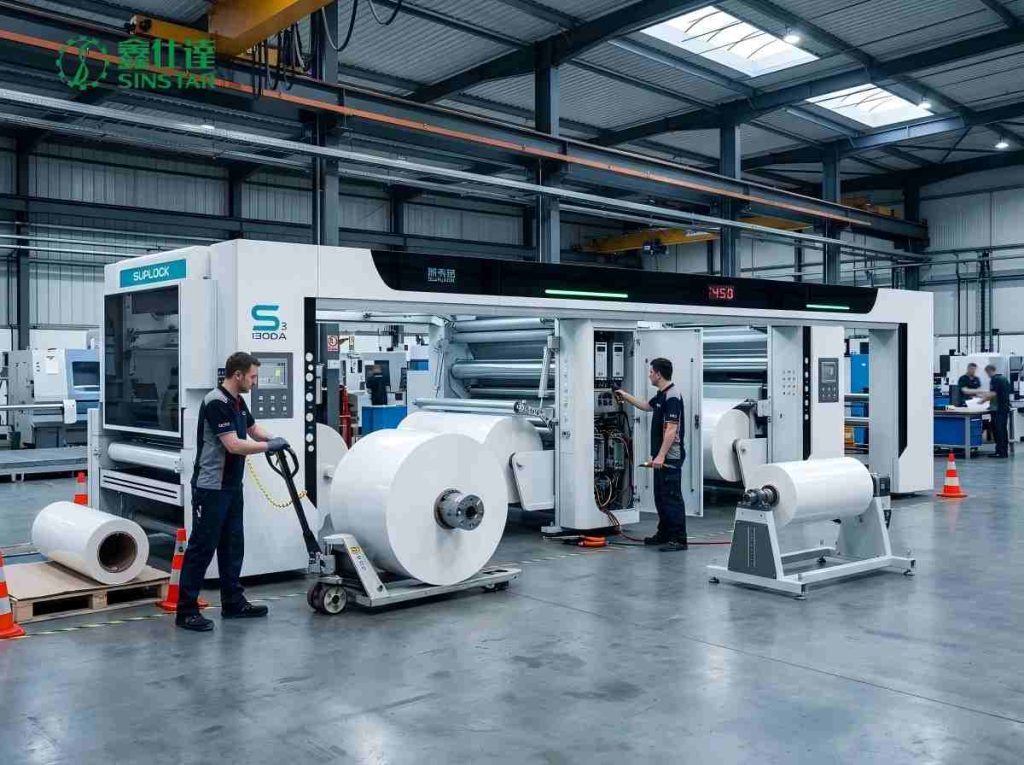
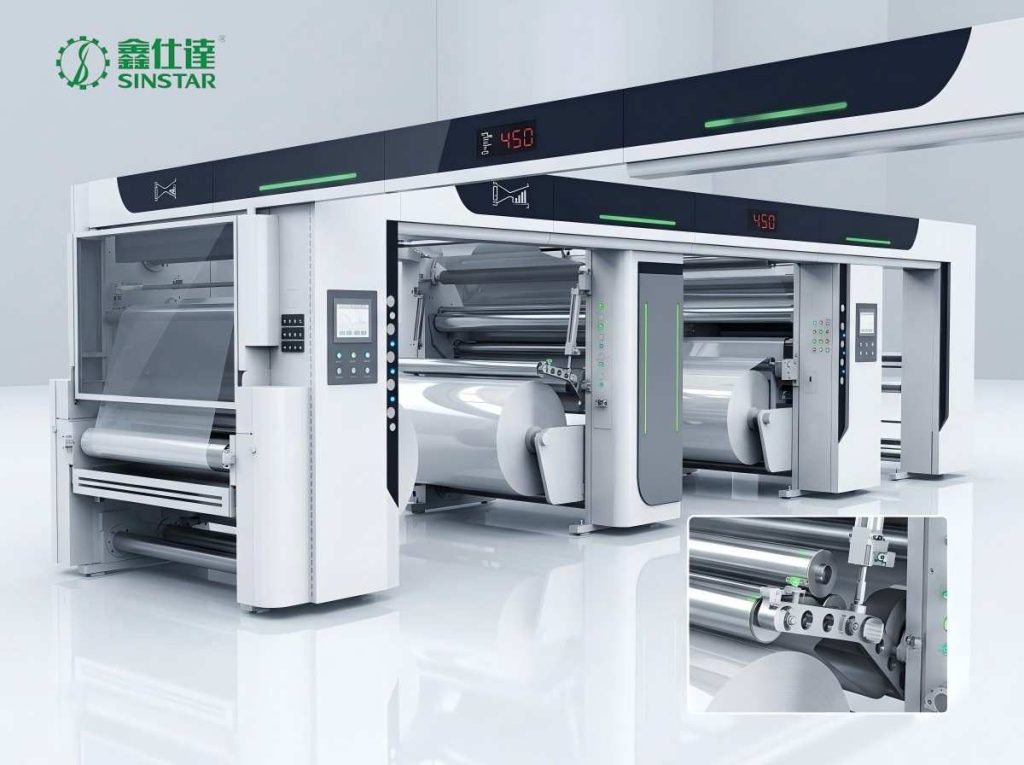
Servo-driven systems handle this better because they adjust in real time instead of running off a fixed setting. Sinstar’s S2-1300AⅡ dual-station laminator manages tension through a five-spindle servo motor setup paired with a swing arm tension linkage, so each unwind station keeps responding to changes in web behavior rather than holding a static baseline. On PE-PE structures, that’s often what separates a run that stays stable from one that needs an operator watching it constantly.
Roll changeover is where mono-PE tension control tends to fall apart in a different way. Every stop to swap rolls means tension has to build back up from zero, and that restart routinely leaves a section of the roll wound slightly looser or tighter than the rest. Equipment built to swap material without stopping the line, as the S2 series is, skips that restart altogether — a detail that matters more for PE-PE than it does for stiffer, more forgiving combinations.
Setting Tension Parameters for Different Mono-PE Structures
Duplex mono-PE structures are relatively straightforward to tension because there’s only one bond interface to manage. Triplex structures add a middle layer, and each extra interface is another point where a tension mismatch can turn into a defect, so the acceptable margin shrinks with every layer added.
MDO-PE (machine direction oriented PE) complicates things further. It’s already been stretched and set during manufacturing, which makes it behave more like a semi-rigid film than standard PE. Pair it with standard PE in a laminate and the tension gap between layers comes back, though it’s much narrower than the PET/PE gap converters are used to managing. When it’s set wrong, the defect usually shows up as bowing or curl on the MDO-PE side of the structure specifically.
Converters running a mixed job list — some duplex PE, some triplex, some built around MDO-PE — end up needing a system that can store and recall tension profiles instead of resetting parameters by hand every time the job changes. That’s the production pattern the S2-1300AⅡ’s digital tension management is built for: it holds up to 5,300 work order settings, so frequent structure changes don’t come at the cost of repeatability. The same machine’s three-layer co-lamination capability fits into this picture too, since it’s designed for structures that replace PA with PE-compatible layers, the substitution behind most of this shift to mono-material, and that only works if the middle layer bonds as cleanly as the outer two.
How PPWR and Recyclability Requirements Are Raising the Bar
The push toward mono-PE is largely a response to EU packaging regulation. Under the Packaging and Packaging Waste Regulation, which entered into force in February 2025 and becomes generally applicable in August 2026, all packaging placed on the EU market has to be recyclable in an economically viable way by 2030. Multi-material laminates combining PET, PA, and PE fall outside that direction, since separating incompatible layers for recycling isn’t commercially practical at the scale regulators are aiming for.
That’s the pressure pushing so many converters toward all-PE structures faster than their existing equipment was built to handle. It’s also why the tension tolerances covered here carry real weight beyond the production floor: a roll with inconsistent lamination quality can undercut the recyclability performance a converter is trying to document for a brand-owner customer.
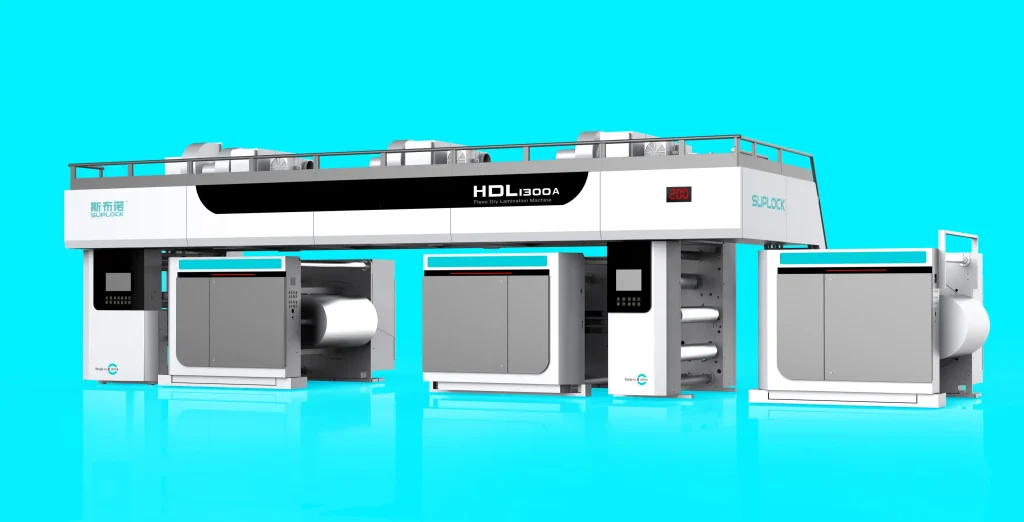
A converter weighing whether their current lines can support this shift will find our comparison of dry and extrusion lamination processes useful for seeing how each process handles the move toward mono-material structures. Either way, the equipment question comes down to whether the tension system can keep pace with tighter, PE-specific tolerances, not just whether it can run PE film at all.