How to Improve Clarity in Solventless Lamination: Causes and Solutions

Solventless lamination stands out as the primary force of adoption in the field of flexible packaging due to advancing benefits, reduced costs of production, and faster production speeds. Nonetheless, maintaining the expected visual quality has been a challenge. Unlike solvent-based systems that allow film flows by solvent evaporation, solventless lamination systems depend on material flow/volume and how perfectly the movement can be controlled. Sometimes, visual images can have blemishes like “orange peel”, “haze”, or “white spots” that destroy the appearance of the final product. This paper made an analysis of the optical clarity factors, and explained some of the issues with aspects and the processes that can be standardized and well optimized.

Part I: Analysis of the Four Core Factors Affecting Transparency
The loss of transparency in solvent-free lamination is usually not caused by just one thing. It is most likely to be connected with the kind and perfection of adhesive joining, the wettability factors of substrate material, and other factors.
1. Adhesive Leveling and Rheology (Orange Peel Effect)
The orange peel effect in lamination is the most frequent cause of poor clarity. It occurs when the adhesive fails to form a perfectly smooth, continuous film after being transferred from the coating rollers to the primary substrate. Solventless adhesives are 100% solidspolyurethane, and their viscosity is highly temperature-dependent.
If the adhesive viscosity is too high at the point of application, the microscopic ridges created by the gravure or multi-roller system do not flatten out before the secondary substrate is joined. This results in a patterned surface that scatters light. According to industry benchmarks, most solventless adhesives require a working temperature between 35°C and 45°C to achieve a target viscosity of 800 to 1,200 mPa·s. If the temperature drops by even 2°C-3°C, the viscosity can increase exponentially, leading to adhesive leveling problems.
2. Solventless Adhesive Coat Weight Optimization
There is a direct correlation between coat weight and optical clarity. In solventless applications, the standard coat weight typically ranges from 1.2 to 2.0 g/m2.
1. Under-coating: If the coat weight is less than 1.2 g/m2, the adhesive layer may not be thick enough to fill in the tiny spaces between the two films. This traps tiny pockets of air, which look like “white spots” or a “haze” in general.
2. Over-coating: Putting on more than 2.5 g/m2 of coating can make things clearer, but it can also cause “squeeze-out” of the adhesive at the edges, which can lead to tunneling or higher costs without making things clearer.
The accuracy of the solventless adhesive coat weight must be verified using the “weight-difference” method, where a sample of a specific area (e.g., 100cm2) is weighed before and after coating, adhering to ISO 6721 standards for polymer testing consistency.

3. Humidity and Chemical Reaction (Carbon Dioxide Formation)
The structure of two-component solvent-free adhesives includes a mechanism for bonding Isocyanate (NCO) and Hydroxyl (OH) groups. The free isocyanate groups are highly susceptible to reaction with water (H2O).
When the ambient relative humidity in the workshop goes beyond 70%, the isocyanate group reacts with moisture in the air to produce carbon dioxide gas. Each of these tiny gas bubbles will be held within the adhesion substrate as the curing process takes place. There are so many because they are too minute to be observed as singular entities, but form a cloud-like form in their many numbers. Usually, it may help to keep the NCO/OH ratio a little lean relative to the fully stoichiometric mix requirement (often at 1.1:1 to 1.2:1), so as to account for some moisture, but this is not a fail-proof substitute for environmental protection.
4. Additive Migration and Surface Energy
Slip agent migration in flexible packaging is a primary cause of delayed transparency loss. Many polyolefin films (like PE or CPP) contain erucamide or oleamide to reduce the coefficient of friction (COF). During the 24–48 hour curing period in the hot room, these slip agents can migrate into the adhesive layer.
If the adhesive is not compatible with these additives, the slip agents crystallize at the interface, creating a veil of haze. Furthermore, the dyne level testing of the substrates is critical. For optimal wetting and clarity, the primary substrate should have a surface tension of at least 38–40 dyn/cm, and the secondary substrate should be no less than 36–38 dyn/cm, following ASTM D2578 standards. Low surface energy prevents the adhesive from “wetting out” the film, leading to beaded adhesive droplets rather than a smooth film.
Part II: Technical Solutions and Optimization Protocols
To solve solventless lamination transparency issues, a systematic approach to process control is required.
1. Thermal Management of the Coating System
The temperature of the coating rollers must be synchronized with the adhesive’s technical data sheet (TDS).
- Pre-heating: The adhesive should be pre-heated in the mixer to 40°C.
- Circulation: The coating steel roller and the transfer rollers must have internal water circulation to maintain a constant surface temperature.
- Adjustment: If “Orange Peel” is detected, increasing the temperature of the transfer roller by 2°C-5°C can significantly reduce viscosity and improve flow.
2. Precision Mechanical Adjustments
The gap between the metering roller and the coating roller determines the initial adhesive thickness. This gap is often measured in microns (μm).
- Roller Pressure: The nip pressure between the coating roller and the backup rubber roller should be maintained between 0.3 and 0.5 MPa.
- Web Tension: Consistent tension control is vital. If the secondary substrate is applied too loosely, air is trapped; if too tightly, the film stretches and then retracts during curing, causing optical distortion.
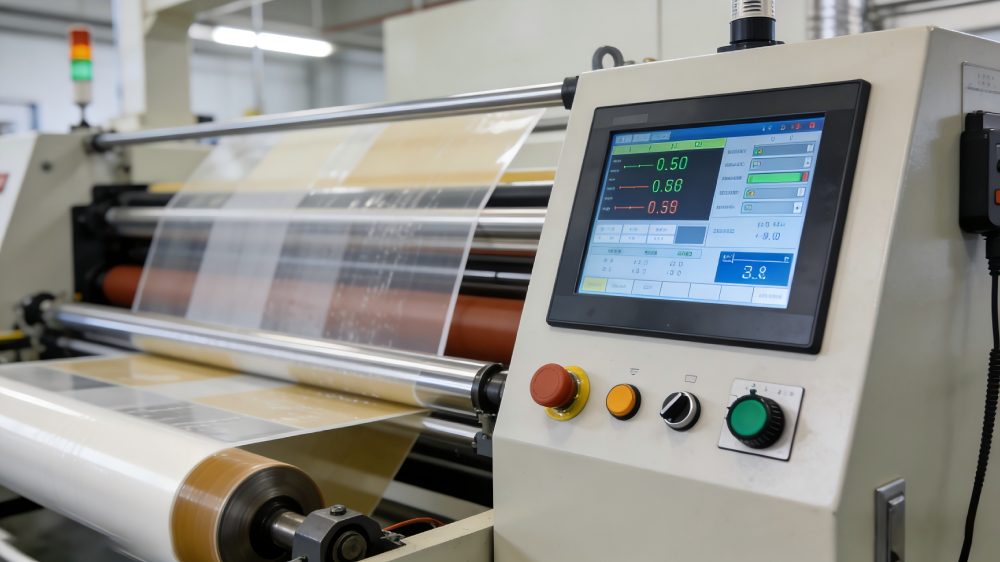
3. Environmental and Curing Controls
To prevent the CO2 reaction, the lamination area should be an enclosed, climate-controlled zone.
- Humidity Control: The ideal production environment is 23°C-25°C with a relative humidity of 50%-60%.
- Curing Room (Hot Room): Most solventless laminates require curing at 40°C-50°C for 24 to 48 hours. Rapid heating can sometimes cause “thermal shock” to the slip agents, so a gradual ramp-up in temperature is preferred for high-clarity structures.
4. Material Selection and Quality Control
When high transparency is the primary requirement (e.g., for “window” bags), specific adhesive grades with superior “wetting” properties should be selected.
- NCO/OH Ratio Monitoring: Use automatic mixing and dosing units with mass-flow meters to ensure the ratio remains within ±1% of the set point.
- Dyne Testing: Perform dyne pen tests on every roll of film before it is loaded onto the machine. If the dyne level has decayed below 38 dyn/cm due to storage time, the film must be re-corona treated in-line.
Improving clarity in solvent-free lamination requires a gradual move from an “experience-based” mode of operation to a stage where all operations are executed in a strictly data-oriented manner. With everything regarded, the intention of the operator is to initiate as many technical solutions as possible so that the final outcome would essentially match that obtained with solvent-based processes. These various mechanisms enable the system to conform to the prevailing international standards of quality and also promote zero waste in the making of sophisticated flexible packs.
| Troubleshooting Checklist | Potential Cause | Recommended Action |
| Foggy/Milky Appearance | High Humidity (>70%) | Reduce humidity; check NCO/OH ratio |
| Orange Peel Texture | High Viscosity / Low Temp | Increase coating roller temp to 42°C-45°C |
| Tiny Bubbles (White Spots) | Low Coat Weight | Increase coat weight to >1.5 g/m2 |
| Haze after 24 hours | Additive Migration | Lower curing room temp; check film COA |