How to Prevent Tunneling in Solventless Lamination

Tunneling is a common but often misunderstood defect in solventless lamination. It appears as elongated channels, lifted areas, or partial separation between laminated layers and may become more visible after rewinding or during curing. Unlike isolated bubbles, tunneling is often associated with stress imbalance between substrates, winding conditions, adhesive distribution, and dimensional changes during curing.
Preventing tunneling therefore requires more than simply increasing nip pressure or reducing web tension. A stable process must control the relationship between film properties, web tension, adhesive coating, nip conditions, rewinding, and curing.
This guide explains how tunneling develops, how to distinguish it from other lamination defects, and how to establish a systematic prevention and troubleshooting process.
What Is Tunneling in Solventless Lamination?
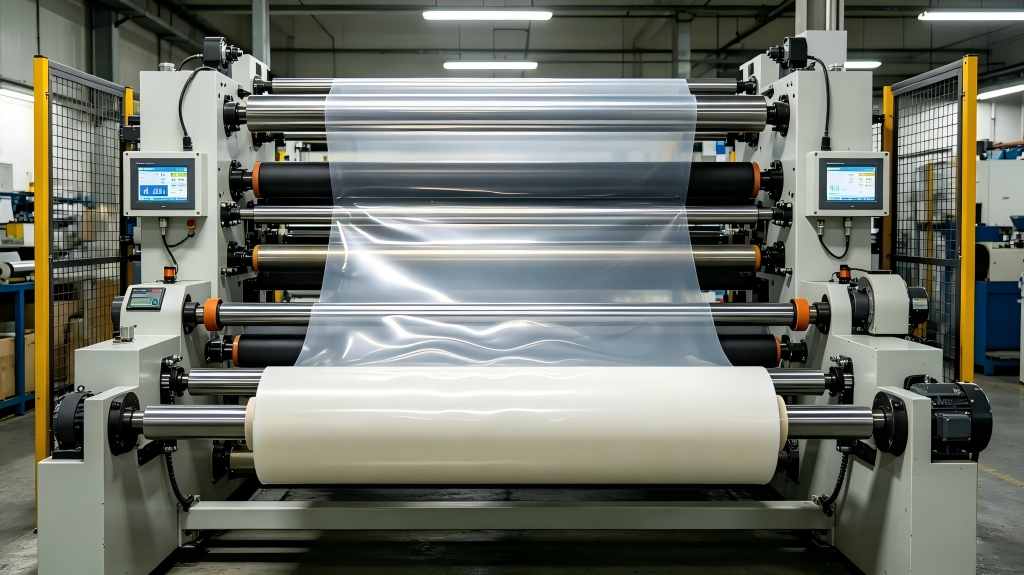
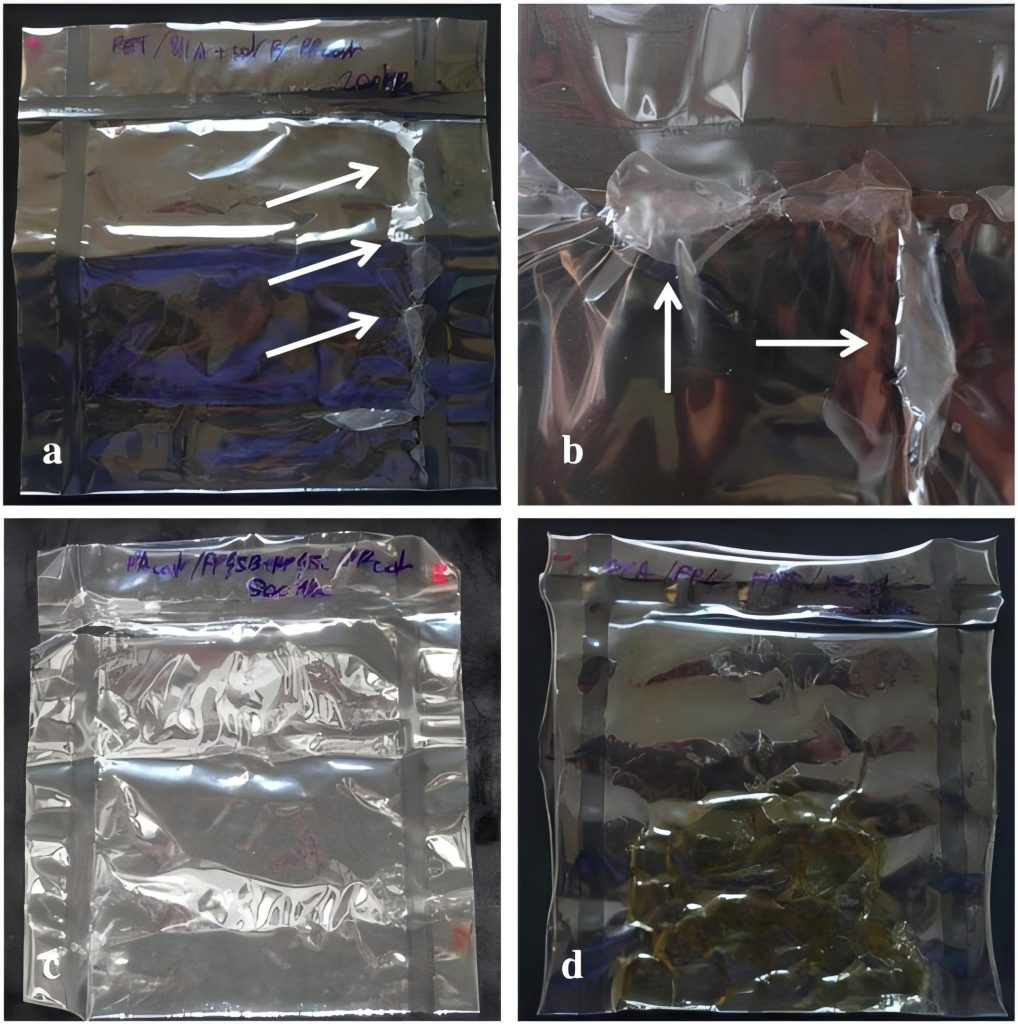
Tunneling occurs when the laminated layers do not remain uniformly bonded and a narrow, elongated channel develops between the substrates. The affected area can look like a tunnel running in the machine direction or, in some cases, appearing as localized channels across part of the web.
The defect may be visible immediately after the laminating nip, but it can also develop or become more pronounced after the laminate is wound into a roll. Some tunneling only becomes obvious during curing because the substrates and adhesive layer continue to relax and change dimensions.
The important point is that tunneling is not necessarily caused by one single parameter. It is usually the result of uneven mechanical stress or insufficiently uniform bonding between two or more layers.
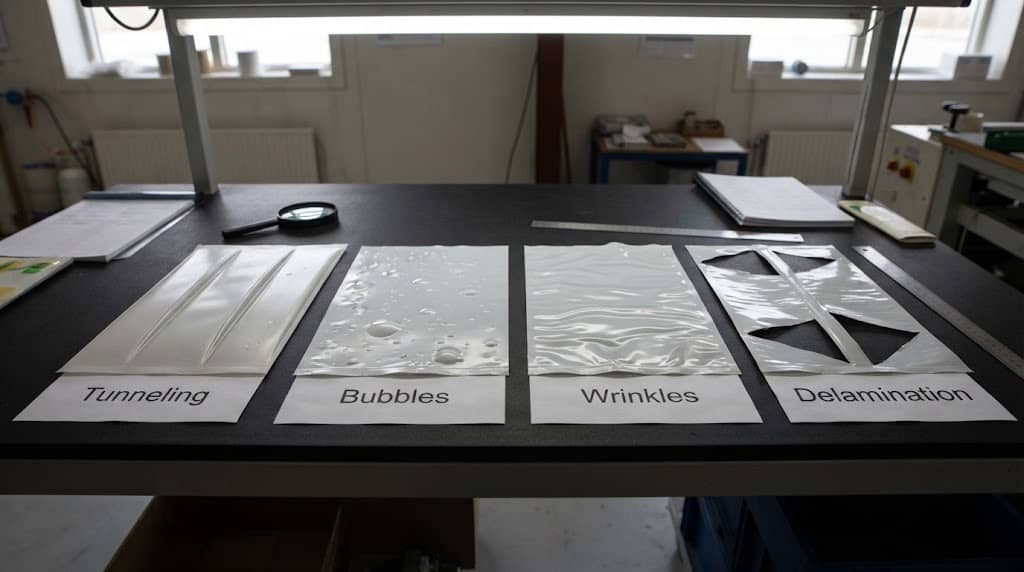
Tunneling vs. Bubbles, Wrinkles and Delamination
Several solventless lamination defects can look similar at first glance, but their mechanisms are different.
| Defect | Typical Appearance | Common Mechanism | Typical Timing |
| Tunneling | Long, narrow channels or lifted areas | Stress imbalance and layer displacement | After lamination, rewinding or curing |
| Bubbles | Round or irregular isolated spots | Entrapped air or gas | During or shortly after lamination |
| Wrinkles | Folds, waves or creases | Web instability or tension problems | During lamination |
| Delamination | Broad separation between layers | Poor adhesion or excessive interfacial stress | Often after curing or downstream processing |
This distinction matters because the corrective action is different. A bubble problem may require better air removal and wetting, while tunneling may require a closer examination of tension matching, winding pressure, coating uniformity and substrate dimensional behavior.
Why Does Tunneling Occur in Solventless Lamination?
1. Differential Web Tension Between Substrates
One of the most important causes of tunneling is a mismatch in tension between the substrates entering the laminating nip. Different films have different:
- Elastic modulus
- Elongation
- Thickness
- Shrinkage characteristics
- Dimensional stability
If one substrate is stretched more than another during lamination, the two layers may initially appear properly bonded. However, once the web leaves the nip and the stresses begin to relax, the substrates can attempt to return toward different dimensions.
This creates internal stress within the laminate. A simplified sequence is:
Tension mismatch → different substrate elongation → stress retention → dimensional relaxation → layer displacement → tunneling
This is why simply setting the same numerical tension value for every substrate is not always appropriate. The correct tension relationship depends on the physical properties of the complete film structure. For example, a relatively stiff PET film and a more flexible PE film may respond differently to the same web tension. The operator needs to consider the behavior of the complete laminate rather than treating both webs as mechanically identical.
2. Excessive Rewind Tension and Incorrect Taper Tension
Tunneling does not always originate at the laminating nip. A laminate that appears acceptable immediately after lamination can develop defects during rewinding.
As the roll diameter increases, the winding conditions change. If rewind tension remains unnecessarily high, the finished roll can accumulate excessive internal compression and stress. This becomes particularly important when the laminate contains substrates with different elasticity or thermal behavior.
An inappropriate winding profile can produce:
High winding tension → excessive roll compression → internal stress → layer displacement → tunneling
Taper tension is therefore an important part of tunneling prevention. As the roll diameter increases, winding conditions should be adjusted to prevent excessive buildup of stress inside the finished roll.
The objective is not simply to use the lowest possible rewind tension. Insufficient tension can create loose rolls, telescoping or poor winding quality. The goal is stable and controlled winding hardness without excessive compression of the laminate.
3. Incorrect Adhesive Coating Weight
Adhesive coating weight also influences tunneling risk. If the coating weight is too low for a particular substrate structure, the adhesive may not provide sufficient and uniform coverage. This can reduce the ability of the adhesive layer to distribute stress across the interface.
Potential consequences include:
- Incomplete wetting
- Localized weak bonding
- Uneven stress distribution
- Reduced peel strength
- Increased susceptibility to layer displacement
However, using excessive adhesive is not a universal solution either. Too much adhesive can affect flow behavior, curing characteristics, material consumption and process stability. The correct coating weight should therefore be determined according to the adhesive formulation, substrate structure, surface characteristics, production speed and required bond performance rather than applying one number to every application.
4. Uneven Adhesive Coating Across the Web
Average coating weight alone does not guarantee a stable laminate. Suppose the target coating weight is achieved on average, but the coating profile varies significantly across the web. Areas with insufficient adhesive may have weaker bonding, while areas with excessive adhesive may behave differently during curing.
This can create local variations in mechanical stress. Important factors include:
- Metering roller condition
- Roller alignment
- Coating gap
- Adhesive viscosity
- Adhesive temperature
- Coating roller condition
- Machine cleanliness
- Web stability
For this reason, a laminator should be evaluated not only by its nominal coating weight but also by its ability to maintain consistent coating distribution across the working width.
5. Nip Pressure and Air Removal
The laminating nip is responsible for bringing the substrates and adhesive layer into intimate contact and helping remove entrapped air. Insufficient or uneven nip pressure can contribute to:
- Poor substrate contact
- Entrapped air
- Incomplete wetting
- Localized bonding variation
However, increasing nip pressure to the maximum possible level is not an appropriate general solution. Excessive pressure can cause other problems, particularly with sensitive films, thin structures or certain metallized materials.
The objective should be uniform pressure and effective air removal, not maximum pressure. Roller hardness, roller surface condition, parallelism and nip footprint should also be considered. A worn or incorrectly aligned laminating roller can create different contact conditions across the web width.
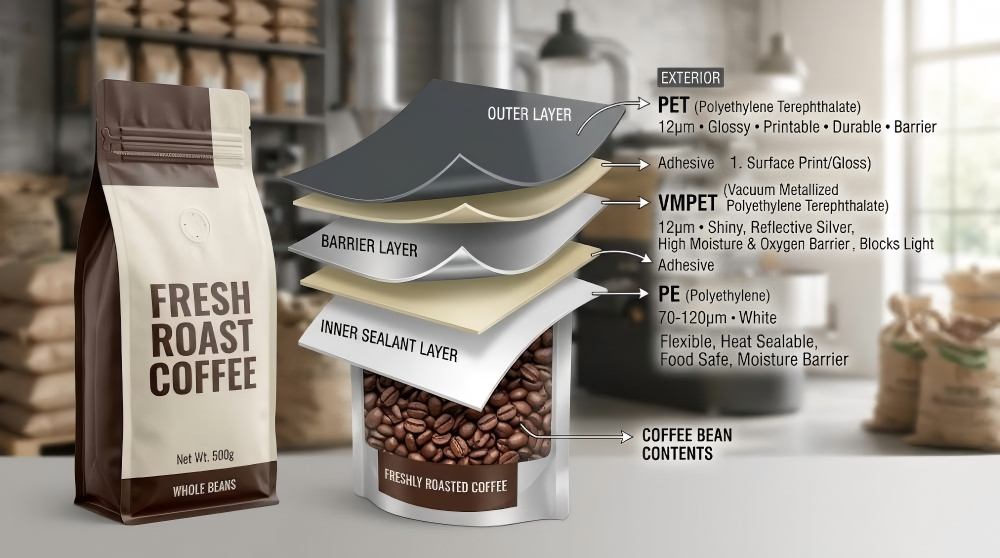
Which Film Structures Are More Susceptible to Tunneling?
Some structures require more careful process control because the individual layers have significantly different mechanical properties.
1. PET/PE Laminates
PET provides relatively high stiffness and dimensional stability, while PE is more flexible and may have greater elongation. If tension is not properly matched, the two layers can experience different levels of deformation during lamination and winding.
For PET/PE structures, pay particular attention to:
- PET web tension
- PE web tension
- Rewind tension
- Taper profile
- Adhesive coating uniformity
- Curing behavior
2. BOPA/PE and BOPA/CPP Laminates
Nylon-based films can introduce additional complexity because their mechanical properties can change with moisture and environmental conditions. BOPA may absorb moisture, which can influence dimensional stability and processing behavior.
When working with BOPA structures, consider:
- Film moisture condition
- Storage environment
- Surface treatment
- Tension stability
- Temperature
- Adhesive compatibility
A process that performs consistently with PET may therefore require different settings when BOPA is introduced.
3. PET/AL/PE Laminates
Aluminum foil behaves very differently from flexible polymer films. It has high dimensional stability but limited ability to tolerate certain forms of deformation.
In PET/AL/PE structures, multiple interfaces also increase process sensitivity. A tension error in one web can be transferred through the laminate and become more difficult to correct during subsequent processing. For these structures, control of web tension + adhesive coating + nip conditions + rewind tension is particularly important.
4. Multi-Layer and Triplex Structures
Each additional layer introduces another interface and another set of material properties. For a triplex laminate, the process is no longer simply about matching two films. Operators must consider:
- Individual web tension
- Intermediate laminate behavior
- Adhesive compatibility
- Coating uniformity
- Interlayer stress
- Rewinding conditions
Small deviations at one stage can become amplified in the final structure. This is why multilayer lamination generally benefits from precise tension control and consistent adhesive metering rather than relying heavily on manual adjustment.
How to Diagnose Tunneling Step by Step
Correct diagnosis is more effective than changing multiple machine settings simultaneously.
Step 1: Identify When the Tunneling Appears
First determine whether the defect appears:
- Immediately after the laminating nip
- During rewinding
- Shortly after rewinding
- During curing
- After curing
- During slitting or pouch making
If the laminate looks good immediately after the nip but develops tunneling after rewinding, winding conditions deserve particular attention.
If tunneling becomes progressively worse during curing, substrate shrinkage, stress relaxation and adhesive curing should be investigated.
Step 2: Identify the Direction and Distribution
Record whether the defect occurs:
- In the machine direction
- Across the web
- Only near one edge
- In the center
- At regular intervals
- Randomly
A defect concentrated on one side can indicate uneven nip pressure, roller alignment or coating distribution. A defect extending consistently in the machine direction may point toward web tension, winding or longitudinal stress.
Step 3: Check Web Tension
Measure and compare:
- Unwind tension
- Primary web tension
- Secondary web tension
- Laminated web tension
- Rewind tension
- Taper tension
Do not focus only on the displayed machine values. Check whether the actual tension relationship is appropriate for the substrate combination. Sudden tension fluctuations can be as problematic as an incorrect average tension.
Step 4: Verify Adhesive Coating Weight
Measure actual adhesive consumption instead of relying solely on the machine setting. Check:
- Average coating weight
- Machine-direction variation
- Cross-web variation
- Adhesive viscosity
- Adhesive temperature
- A/B mixing ratio
If coating weight is stable but tunneling remains, attention can then shift toward tension, winding and substrate behavior.
Step 5: Inspect Nip Conditions
Check:
- Nip pressure
- Pressure uniformity
- Roller hardness
- Roller surface
- Roller alignment
- Nip width
If tunneling is concentrated on one side of the laminate, an uneven nip condition becomes particularly important to investigate.
Step 6: Check Substrate Properties
Review:
- Film thickness
- Modulus
- Elongation
- Shrinkage
- Surface energy
- Corona treatment
- Moisture condition
- Film storage history
Two films with similar thickness can behave very differently during lamination.
Step 7: Examine the Curing Process
Check:
- Curing temperature
- Curing time
- Roll storage conditions
- Roll orientation
- Roll compression
- Changes in tunnel severity during curing
A laminate should not be judged only by its appearance immediately after production. Some solventless adhesive systems continue developing bond strength during curing, while residual mechanical stresses can also redistribute during this period.
How to Prevent Tunneling in Solventless Lamination
1. Match the Tension Profiles of Different Substrates
The first objective is to establish a stable tension relationship between the substrates. Avoid assuming that identical numerical tension values are appropriate for every film.
Instead, consider:
Film properties → required tension → elongation → stress relaxation
The best production condition is usually one that minimizes unnecessary stretching while keeping the web stable and wrinkle-free. Once an optimized setting is established, it should be recorded as part of the production recipe rather than repeatedly adjusted by different operators.
2. Optimize Rewind Tension and Taper
The laminate should be wound firmly enough to maintain roll stability without creating excessive internal compression. Monitor:
- Initial rewind tension
- Taper tension
- Roll diameter
- Winding hardness
- Core condition
- Roll edge alignment
If tunneling appears mainly after winding, do not immediately change the lamination nip or adhesive coating. First determine whether the winding process is introducing additional stress.
3. Maintain Stable Adhesive Coating Weight
Coating weight should remain stable throughout the production run. Important controls include:
- Accurate adhesive metering
- Stable adhesive temperature
- Consistent viscosity
- Correct A/B ratio
- Regular coating verification
For production environments, gravimetric verification can be useful because the theoretical machine setting does not always represent the actual amount of adhesive transferred to the substrate.
4. Control Adhesive Temperature and Viscosity
Solventless adhesives are highly sensitive to temperature because viscosity changes with temperature. A temperature change can affect:
Temperature → Viscosity → Metering → Transfer → Wetting → Bond Uniformity
If the adhesive becomes too viscous, transfer and wetting can become less stable. If viscosity becomes excessively low, coating behavior may also change.
The adhesive supplier’s recommended processing range should therefore be used as the starting point rather than adopting a universal temperature for every adhesive.
5. Optimize Nip Pressure and Roller Condition
Maintain consistent contact across the full web width. Inspect rollers regularly for:
- Wear
- Surface damage
- Contamination
- Misalignment
- Uneven pressure
The goal is a stable nip that produces uniform contact and effective air removal without unnecessarily compressing the laminate.
6. Control Film Surface and Storage Conditions
Film condition can change during storage. Important variables include:
- Surface energy
- Corona treatment
- Slip additive migration
- Moisture
- Temperature
- Storage time
For moisture-sensitive materials such as nylon, environmental conditions can be particularly important. Films should be stored according to the supplier’s recommendations and allowed to reach suitable processing conditions before production.
Tunneling Troubleshooting Table
| Symptom | Possible Cause | What to Check First | Corrective Direction |
| Tunneling appears immediately after lamination | Tension mismatch, poor wetting or uneven nip | Web tension and nip | Stabilize tension and nip conditions |
| Tunneling appears mainly after rewinding | Excessive winding stress | Rewind and taper tension | Optimize winding profile |
| Tunneling becomes worse during curing | Differential shrinkage or stress relaxation | Film properties and curing | Rebalance tension and curing conditions |
| Tunneling occurs mainly on one side | Uneven nip or coating profile | Roller alignment and coating distribution | Correct cross-web uniformity |
| Tunneling accompanies low peel strength | Poor bonding or insufficient coating | Coating weight and surface treatment | Improve wetting and adhesive coverage |
| Tunneling occurs in multilayer structures | Accumulated interlayer stress | Individual web tensions | Optimize each web separately |
The most important diagnostic principle is change one major variable at a time whenever possible. Changing tension, coating weight, speed and nip pressure simultaneously makes it difficult to identify the actual root cause.
How Machine Design Helps Prevent Tunneling
Process parameters are important, but machine design determines how consistently those parameters can be maintained.
1. Closed-Loop Web Tension Control
A modern solventless laminator can use sensors, controllers and servo systems to continuously monitor and correct web tension. The basic control sequence is:
Tension measurement → Controller → Servo correction → Stable web tension
This is particularly valuable when processing films with different elastic properties or when line speed changes.
2. Precision Adhesive Metering
A precision coating system helps maintain a stable adhesive layer across the working width.
A multi-roll coating configuration can provide controlled adhesive transfer while reducing dependence on manual adjustments. The benefit is not simply lower adhesive consumption. Consistent coating distribution helps create a more uniform bonding interface and reduces another potential source of stress variation.
3. Automatic Taper Tension Control
As the finished roll becomes larger, the winding conditions change. Automatic taper control can adjust winding tension according to roll diameter, helping maintain a more consistent roll structure without excessive compression. This is particularly useful for long production runs where manual winding adjustments can introduce inconsistency between rolls.
4. Accurate Nip Pressure Control
A stable nip system helps maintain consistent substrate contact across the web. For demanding structures such as PET/AL/PE and multilayer flexible packaging, maintaining uniform mechanical conditions is often more important than simply increasing pressure.
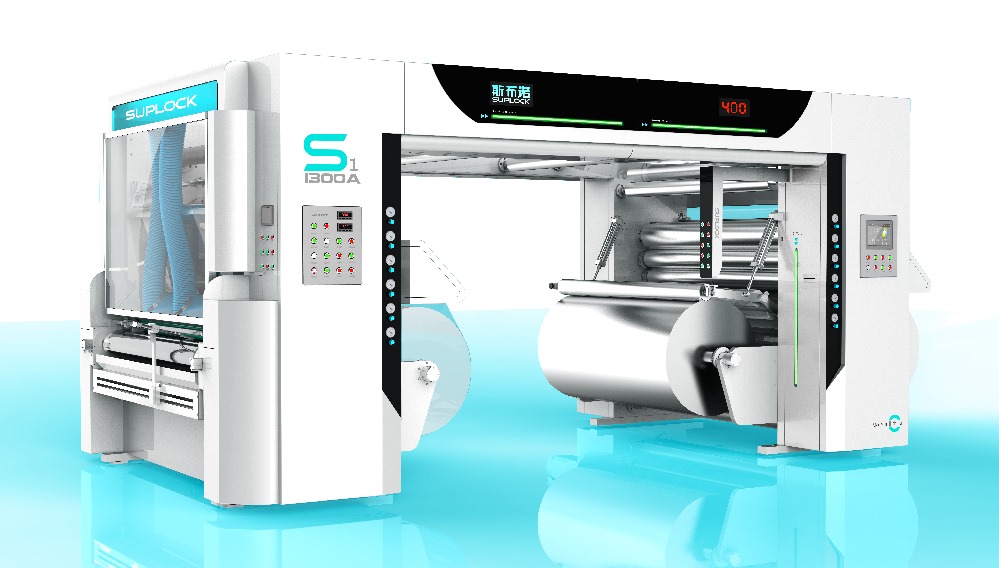
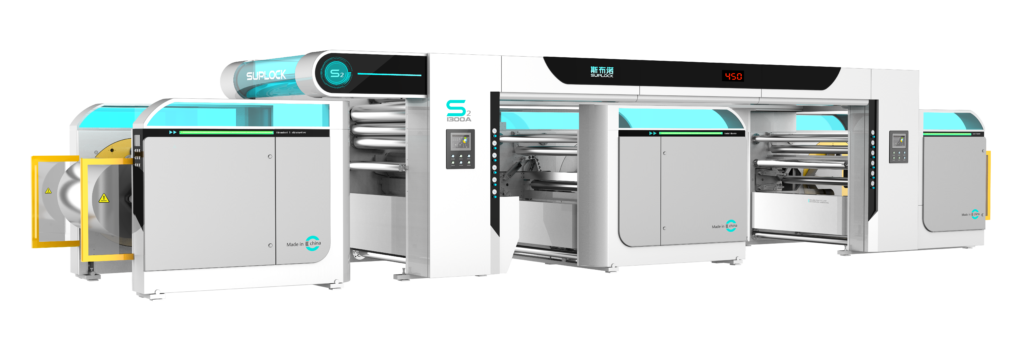
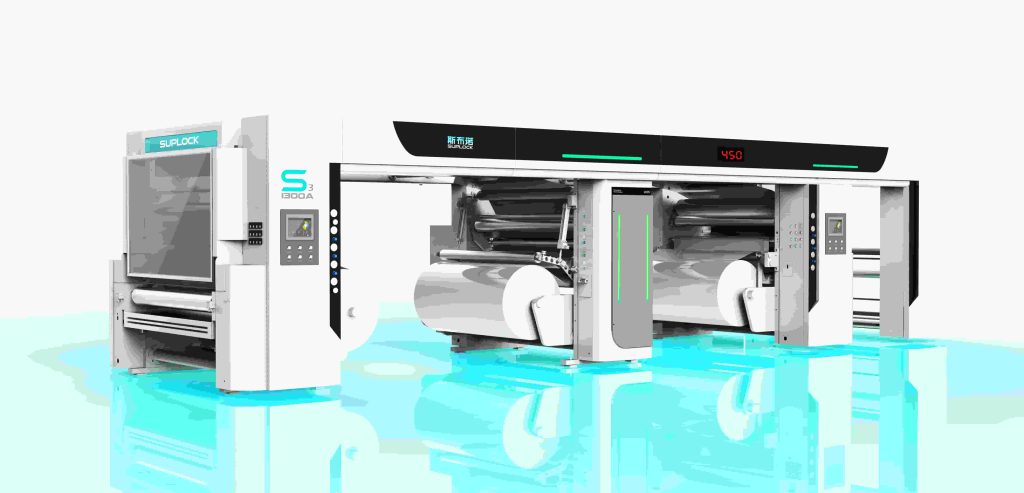
For Sinstar’s solventless laminating systems, these machine-level controls can be combined with precise coating and tension management to support stable production of flexible packaging structures.
Solventless Lamination Tunneling Prevention Checklist
- Before Production
- Verify substrate specifications and thickness.
- Check film surface treatment and storage condition.
- Confirm adhesive A/B ratio.
- Confirm adhesive temperature and viscosity.
- Inspect coating and laminating rollers.
- Verify tension settings against the approved production recipe.
- During Lamination
- Monitor web tension continuously.
- Check adhesive coating weight.
- Watch for cross-web coating variation.
- Maintain stable adhesive temperature.
- Monitor nip pressure.
- Avoid unnecessary manual tension corrections.
- During Rewinding
- Check winding tension.
- Verify taper tension.
- Monitor roll hardness.
- Inspect roll edges.
- Check for tunneling immediately after winding.
- During Curing
- Maintain the recommended curing temperature.
- Maintain sufficient curing time.
- Store rolls under controlled conditions.
- Inspect the laminate again after curing.
- Compare peel strength and appearance with production specifications.
FAQs
Q1: Can excessive rewind tension cause tunneling?
Yes. Excessive rewind tension can create internal stress and compress the laminated layers, increasing the risk of tunneling.
Q2: How does web tension affect tunneling?
Tension differences can stretch substrates unevenly. As the layers relax, the resulting stress can cause displacement and tunneling.
Q3: Can low coating weight cause tunneling in solventless lamination?
Yes. Insufficient coating weight can cause incomplete adhesive coverage and weak bonding, increasing tunneling risk.
Q4: Why does tunneling appear after curing?
Different substrates may shrink or relax during curing, causing internal stress that makes tunneling more visible.
Q5: How do you fix tunneling in PET/PE lamination?
Check PET and PE tension, rewind tension, adhesive coating weight, nip pressure, and substrate condition. Correct the largest source of stress first.
Q6: Why is tunneling more common in aluminum foil lamination?
Aluminum foil has different mechanical properties from polymer films, making tension mismatch and winding stress more critical in structures such as PET/AL/PE.
Q7: Can a solventless laminating machine prevent tunneling automatically?
Automation can reduce tunneling risk through precise tension control, adhesive metering, nip control, and automatic taper tension adjustment.