PET/PE Lamination: Process, Adhesive and Machine Requirements

PET/PE is one of the most widely used two-layer structures in flexible packaging because it combines the mechanical strength and dimensional stability of PET with the heat-sealing and flexibility of PE. However, producing a stable PET/PE laminated film is not simply a matter of applying adhesive between two films. Film surface properties, adhesive chemistry, coating weight, web tension, lamination pressure, curing conditions and machine configuration all influence the final laminate.
For converters considering solventless PET/PE lamination, understanding how these factors interact is essential for achieving consistent bond strength, low waste and reliable downstream pouch-making performance.
This guide explains the PET/PE lamination process in detail, including film requirements, solventless adhesive selection, process control, laminating machine requirements, common defects and production optimization.
What Is PET/PE Lamination?
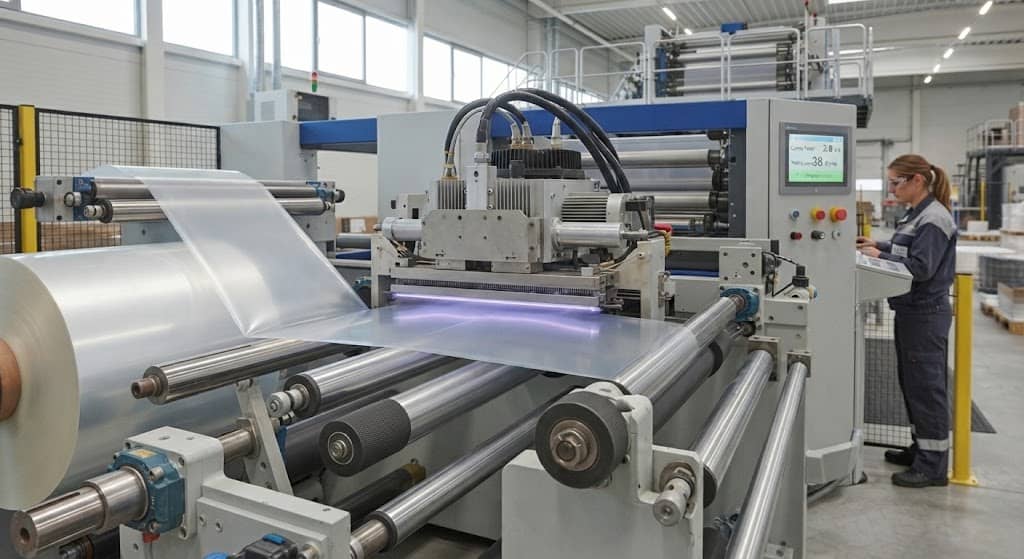
PET/PE lamination is a two-layer flexible packaging structure in which a polyethylene terephthalate (PET) film is bonded to a polyethylene (PE) film using an adhesive layer.
The basic structure is PET – Adhesive – PE. Each layer performs a different function.
| Layer | Primary Function |
| PET | Strength, stiffness, dimensional stability and printability |
| Adhesive | Creates interlayer bonding |
| PE | Heat sealing, flexibility and product-contact performance |
PET is generally used as the outer or print-supporting layer because of its good mechanical stability and resistance to thermal deformation. PE is normally used as the inner sealing layer because it provides the flexibility and heat-sealing properties required for pouch and bag production. The resulting PET/PE laminate can provide a useful combination of strength, appearance, sealability and processing stability for many general-purpose flexible packaging applications.
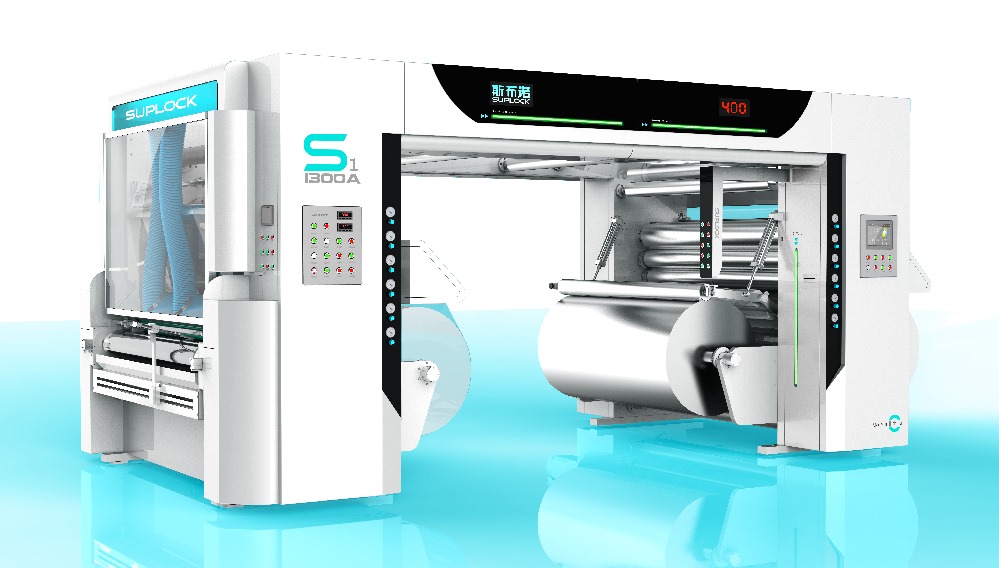
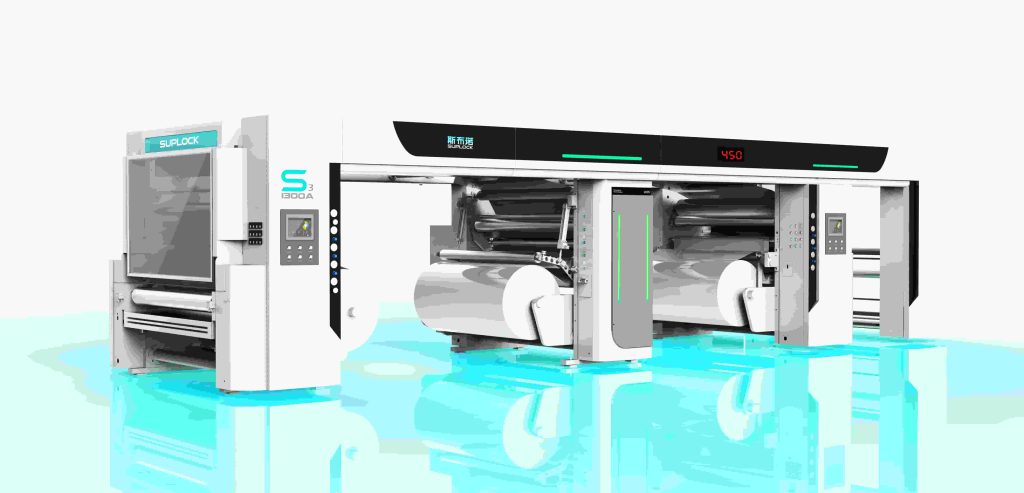
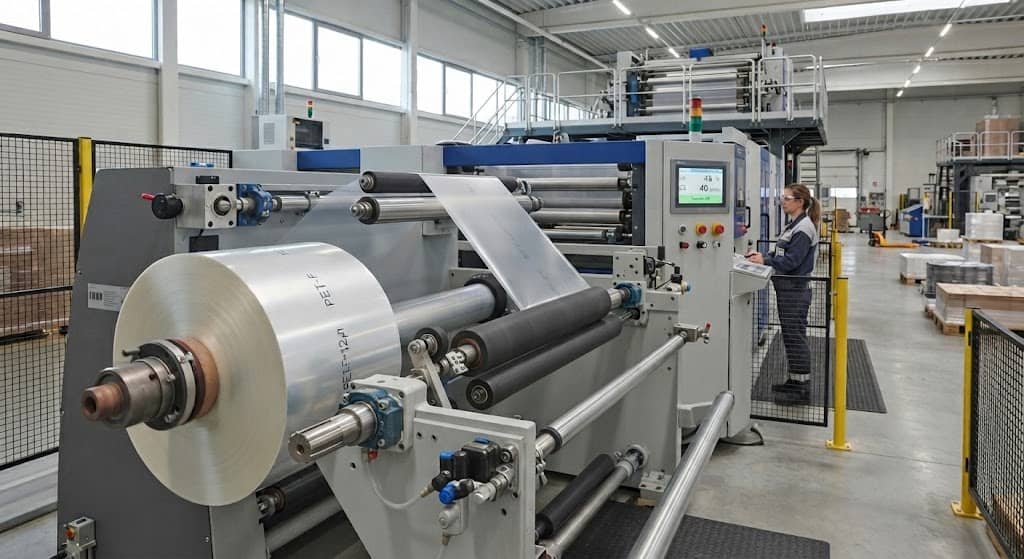
Sinstar’s WRJ i9-1300A, for example, is designed for two-layer solventless lamination and lists PET/PE among its typical structures, alongside BOPP/PE, PET/CPP, metallized-film/plastic-film and aluminum-foil/plastic-film combinations.
Why Is PET/PE Widely Used in Flexible Packaging?
The main advantage of PET/PE is the complementary performance of the two films.
PET provides the laminate with a strong and dimensionally stable outer layer. This helps the package maintain its shape during converting, filling, transportation, and handling. PET also provides a comparatively heat-resistant outer surface, allowing the PE sealing layer to perform its function without requiring the outer film itself to serve as the primary heat-sealing material.
PE, in contrast, is primarily valued for its heat-sealing characteristics and flexibility. It can form the seal required to close pouches and bags while providing a relatively soft and functional inner surface.
This combination makes PET/PE suitable for applications where the package needs both a reliable sealing layer and a stable structural layer. Typical applications include:
- Food packaging
- Pet food packaging
- Liquid and semi-liquid packaging
- Sauce and condiment packaging
- General-purpose pouches
- Household and daily-consumer-product packaging
The exact suitability of PET/PE depends on the product, required shelf life, barrier requirements, sealing conditions, and downstream packaging process. For applications requiring significantly higher oxygen or moisture barrier performance, additional structures such as PET/VMPET/PE or PET/AL/PE may be more appropriate.
PET and PE: Different Materials, Different Lamination Requirements
One of the most important points in PET/PE lamination is that the two substrates do not behave identically during production.
PET Film
PET is a polyester film with high dimensional stability and mechanical strength. During solventless lamination, its relatively stable dimensions make it well suited to high-speed processing. Important PET characteristics include:
- High tensile strength
- Good dimensional stability
- Good heat resistance
- Good printability
- Stable web behavior
- Relatively low deformation under normal processing tension
However, PET still requires appropriate surface treatment and tension control. A contaminated or inadequately treated PET surface can cause poor adhesive wetting and low bond strength.
PE Film
PE is a polyolefin film with significantly different surface characteristics. Its major advantages include:
- Good heat-sealing performance
- Flexibility
- Moisture resistance
- Good toughness
- Suitable product-contact characteristics
The main challenge is that untreated PE has relatively low surface energy, which can make adhesive bonding difficult. Corona treatment or another appropriate surface-treatment process is therefore commonly used to improve the surface for lamination.
PE films may also contain slip additives such as erucamide or oleamide. These additives can migrate toward the surface and potentially affect adhesion or downstream friction characteristics. Film age, storage conditions, corona treatment, and additive concentration should therefore be considered when troubleshooting PET/PE bonding.
PET/PE Lamination Process Step by Step
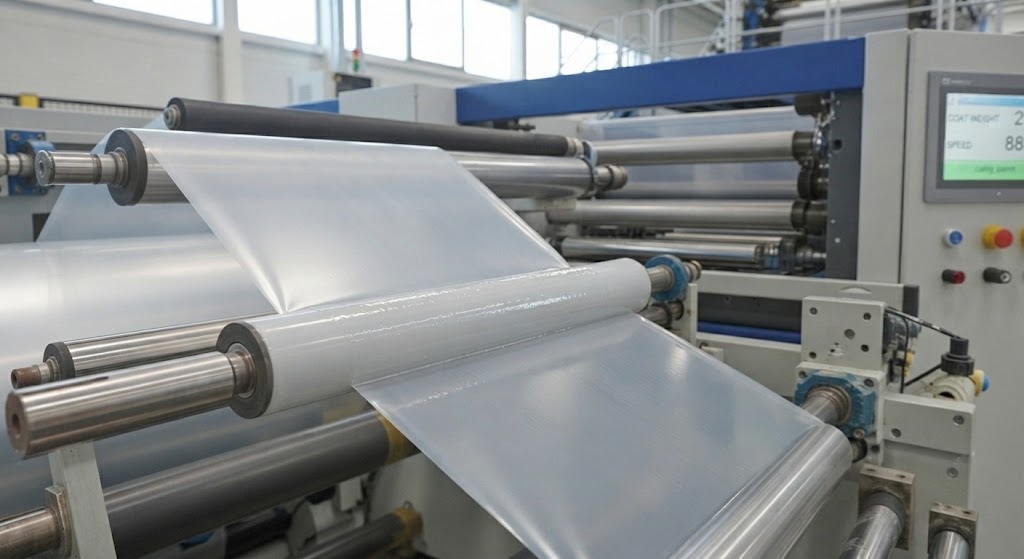
A stable PET/PE laminate begins with controlled preparation of both substrates and continues through adhesive mixing, coating, lamination, rewinding, and curing.
Step 1: PET Film Unwinding
The PET roll is loaded onto the laminator and introduced into the web path through the unwinding section.
At this stage, web tension stability is critical. Excessive tension can stretch the film or create unnecessary stress in the web, while insufficient tension can cause wrinkles, tracking problems, or unstable web transport. The required tension depends on factors such as:
- PET thickness
- Film width
- Roll diameter
- Machine speed
- Film mechanical properties
- Downstream winding requirements
A modern solventless laminator should therefore provide accurate and responsive tension control rather than relying on a single fixed tension value. The goal is not simply to apply high tension. The goal is to maintain stable tension appropriate to the substrate and production speed.
Step 2: PE Film Preparation
The PE film must also be prepared carefully before entering the lamination nip. The most important consideration is the bonding surface. Because untreated PE has relatively low surface energy, adequate surface treatment is normally required for reliable adhesive wetting and bonding.
Corona treatment can increase surface energy and improve adhesive interaction with the PE surface. However, the treatment level can decline during storage, and the actual condition of the film at the time of lamination may therefore differ from the supplier’s original specification. Converters should consider:
- Corona treatment level
- Film storage time
- Surface contamination
- Slip-agent migration
- Film formulation
- Adhesive compatibility
A simple dyne measurement can provide useful information about surface condition, but it should not be treated as the only indicator of final laminate quality. Actual adhesion depends on the combination of surface condition, adhesive chemistry, coating, lamination, and curing.
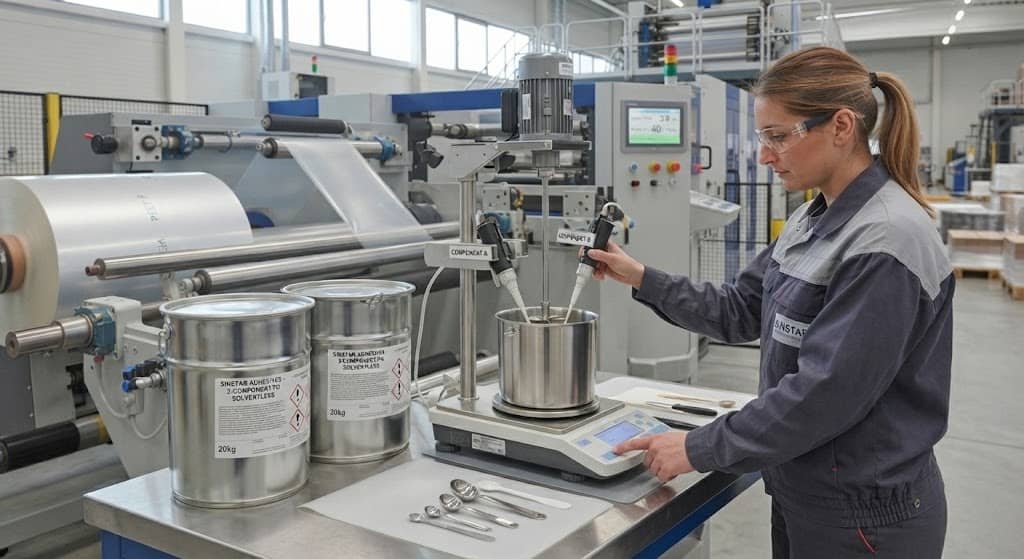
Step 3: Solventless Adhesive Mixing
For many PET/PE solventless applications, a two-component polyurethane adhesive is used. The two components are normally mixed at a specified ratio before application. Precise metering is essential because even a relatively small deviation from the adhesive manufacturer’s recommended ratio can affect curing behavior and final bond performance.
The adhesive system should therefore provide:
- Accurate component metering
- Stable mixing
- Controlled adhesive temperature
- Consistent viscosity
- Continuous adhesive supply
The adhesive supplier’s technical data sheet should always be treated as the primary reference for the required mixing ratio, temperature, coating weight, and curing conditions. A laminating machine should not be used to compensate for an incorrectly specified or incorrectly mixed adhesive.
Step 4: Adhesive Coating
After mixing, the adhesive is applied to one of the substrates through the laminator’s coating system.
In solventless lamination, coating weight is typically much lower than in conventional solvent-based systems, which makes coating accuracy particularly important. The coating process must maintain a consistent adhesive layer across the entire web width.
Several variables affect coating quality:
| Parameter | Effect on Lamination |
| Adhesive viscosity | Influences flow and coating uniformity |
| Coating weight | Affects bond strength and adhesive consumption |
| Adhesive temperature | Influences viscosity and wetting |
| Metering accuracy | Determines cross-web consistency |
| Machine speed | Changes process conditions |
| Roller condition | Can affect coating uniformity |
Too little adhesive can result in insufficient wetting or weak bonding. Excessive adhesive, on the other hand, increases material consumption and may affect curing, appearance, or production economics. For this reason, the objective is not to use the maximum amount of adhesive, but to achieve the minimum coating weight that reliably meets the required performance.
Step 5: PET and PE Lamination
After the adhesive is applied, PET and PE are brought together in the lamination section. At this point, the adhesive must wet the substrate surfaces and create a uniform interface between them. Lamination pressure, roller condition, web alignment, temperature, and tension all contribute to the result. The two substrates also need to enter the nip in a stable and synchronized condition.
If tension is poorly controlled, several problems may occur:
- Wrinkles
- Misalignment
- Curling
- Uneven roll formation
- Variable laminate dimensions
A stable nip pressure is equally important. Insufficient or uneven pressure can contribute to air entrapment and poor contact, while excessive pressure can create unnecessary mechanical stress or affect the finished roll.
Step 6: Rewinding and Curing
Once the PET and PE films have been laminated, the combined web is rewound into a finished roll. Rewinding is not merely a storage operation. The winding condition can directly affect the quality of the laminate during curing and subsequent converting.
Important factors include:
- Rewind tension
- Roll hardness
- Edge alignment
- Roll diameter
- Web tracking
- Surface condition
The laminate must then be given sufficient time and appropriate conditions for the adhesive to cure. Solventless lamination eliminates the need for solvent evaporation and a conventional drying oven, but this does not mean that the adhesive reaches its final strength immediately after lamination.
The curing requirements depend on the adhesive chemistry and the supplier’s technical specifications. Some applications may require controlled-temperature curing for a specified period before the laminate reaches its final bond performance.
PET/PE Solventless Adhesive Requirements
Adhesive selection is one of the most important decisions in PET/PE lamination. A suitable adhesive must provide adequate adhesion to both PET and PE while maintaining the required flexibility, chemical resistance, heat resistance, and final bond strength for the application.
What Adhesive Is Used for PET/PE Lamination?
Two-component polyurethane solventless adhesives are widely used for flexible-film lamination. The basic mechanism involves two components reacting to form a crosslinked adhesive layer. The advantages of solventless polyurethane systems can include:
- No solvent evaporation
- Low adhesive coating weight
- Reduced drying-oven requirements
- Lower solvent-related emissions
- Potentially lower energy consumption
- Suitable high-speed production
However, solventless technology requires accurate process control. Removing the solvent-drying step does not remove the need for precise adhesive management.
Adhesive Mixing Ratio
The A/B component ratio should be controlled according to the adhesive manufacturer’s technical data. Incorrect mixing can cause problems such as:
- Poor final bond strength
- Incomplete curing
- Excessive residual components
- Brittleness
- Poor appearance
- Changes in curing speed
An important production principle is: Do not manually modify the adhesive ratio to solve a machine or substrate problem.
If bond strength is low, the troubleshooting process should examine surface treatment, coating weight, adhesive temperature, mixing accuracy, machine conditions, and curing before making any changes to the specified adhesive formulation.
Adhesive Coating Weight
Coating weight directly influences both laminate performance and production cost. If the coating weight is too low, the adhesive may not adequately wet or cover the substrate surfaces. This can produce weak bonding or localized adhesion failures.
If the coating weight is unnecessarily high, the converter may experience:
- Higher adhesive consumption
- Increased production cost
- Longer curing requirements
- Potential appearance problems
- Reduced process efficiency
The correct coating weight depends on the adhesive, substrate combination, film surface, production speed, and application requirements. Therefore, there is no single coating weight that is correct for every PET/PE structure. The adhesive supplier’s recommendations and actual production trials should determine the final setting.
PET and PE Surface Treatment Requirements
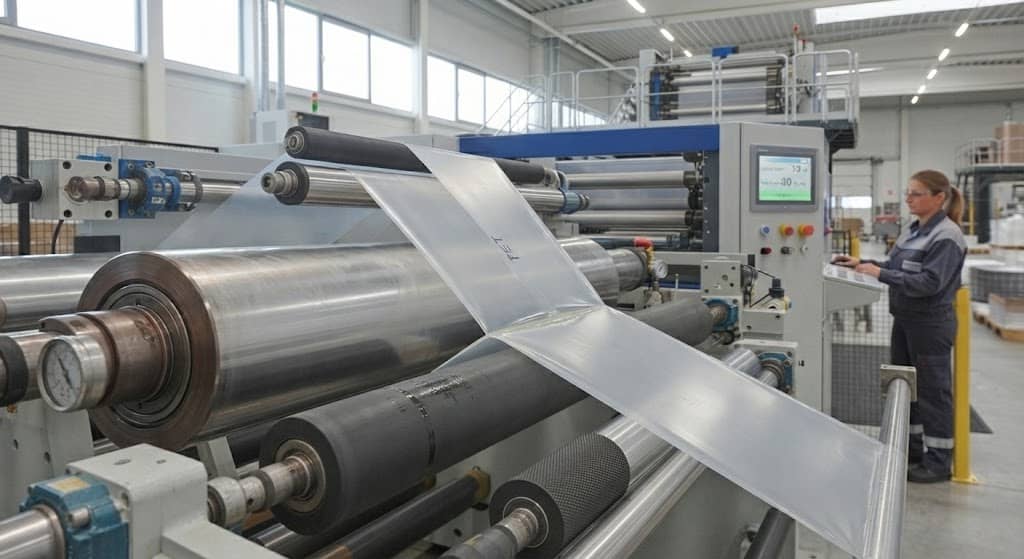
Surface preparation is often underestimated when investigating lamination defects.
PET Surface Treatment
PET generally provides a more favorable surface for adhesive bonding than untreated polyolefin films, but surface contamination, aging, printing residues, or inadequate treatment can still affect adhesion. Before production, converters should verify:
- Surface cleanliness
- Treatment level
- Film age
- Storage conditions
- Adhesive compatibility
PE Surface Treatment
PE requires particular attention because of its low surface energy. Corona treatment is commonly used to improve adhesive wetting. However, the treatment level can decline with time, especially when films are stored for extended periods or contain significant concentrations of slip additives.
A film that passed a surface-treatment specification when manufactured may therefore require verification again before lamination.
PET/PE Lamination Machine Requirements
A solventless laminator for PET/PE production should be selected according to the actual material structure, production speed, width, adhesive system, and expected output.
Precise Web Tension Control
PET is dimensionally stable, but PE can respond differently to tension and mechanical stress. The machine should therefore provide stable control through the unwinding, lamination, and rewinding sections.
Consistent tension is especially important when production speed increases. A high-speed machine without sufficient tension stability may produce more waste rather than more saleable output.
Accurate Adhesive Metering
The adhesive coating system needs to maintain consistent coating weight across the web. A high-quality coating system should provide:
- Stable adhesive delivery
- Accurate metering
- Consistent coating
- Suitable temperature control
- Easy process adjustment
This is particularly important when operating at high line speeds, where small process deviations can quickly translate into significant production losses.
Stable Lamination Pressure
The lamination nip should maintain consistent pressure across the working width. Uniform pressure helps:
- Improve adhesive wetting
- Reduce trapped air
- Maintain consistent bonding
- Improve finished-roll appearance
Roll alignment and surface condition should also be monitored regularly.
Controlled Rewinding
A good laminate can still be damaged during rewinding if the finished roll is wound with excessive or unstable tension. The rewinding system should therefore provide controlled:
- Tension
- Edge alignment
- Roll hardness
- Roll diameter
This is particularly important for converters that subsequently use the laminated rolls on high-speed pouch-making or form-fill-seal equipment.
What Type of Laminating Machine Is Suitable for PET/PE?
For a conventional two-layer PET/PE structure, a two-layer solventless laminating machine is generally an appropriate configuration.
For example, Sinstar’s WRJ i9-1300A is designed specifically for two-layer solventless lamination and lists PET/PE, BOPP/CPP, BOPP/PE, PET/CPP, metallized-film/plastic-film, aluminum-foil/plastic-film, and paper/plastic-film among its typical structures. It supports PET, PE, BOPP, CPP, PA, VMPET, VMCPP, aluminum foil, and paper materials. The published maximum lamination speed is 450 m/min, with maximum laminate widths of 1050, 1350, or 1650 mm depending on configuration. This type of configuration is well suited to converters whose production requirements center on mainstream two-layer flexible packaging structures.
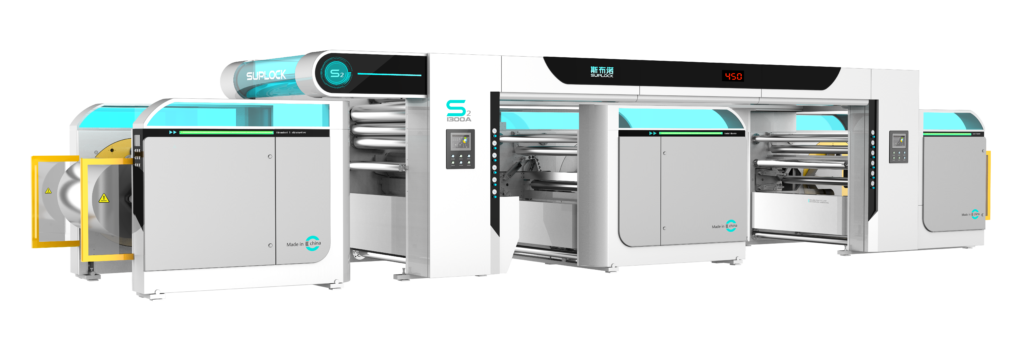
When the package requires three or more layers, a more complex adhesive structure, or specialized high-barrier construction, a multi-layer laminating system may be more appropriate. Sinstar itself distinguishes its two-layer equipment from higher-configuration machines for three-layer and other specialized applications.
Key Process Parameters for PET/PE Lamination
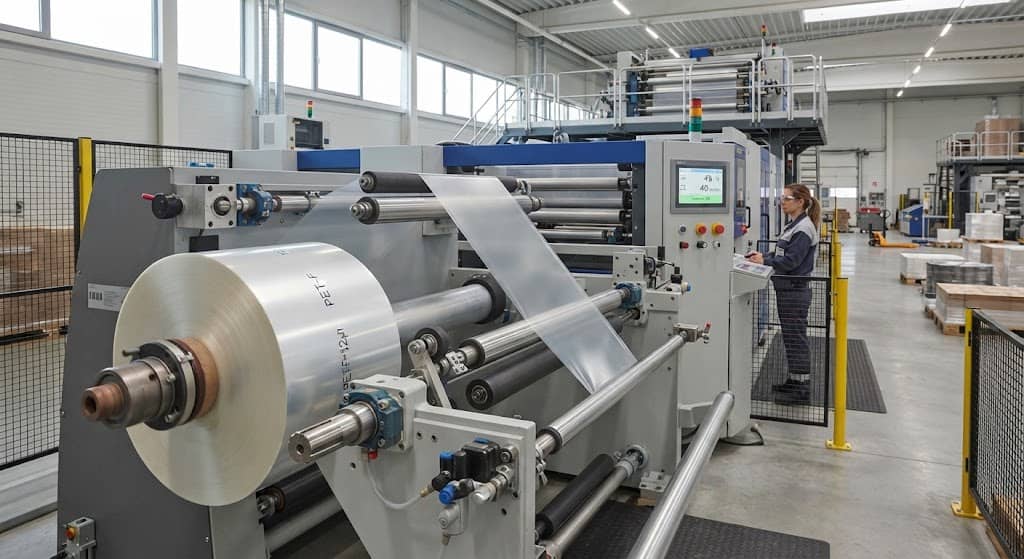
There is no universal set of machine settings for every PET/PE laminate. The correct operating window depends on film specifications, adhesive chemistry, machine configuration, and production requirements.
The following framework is useful when establishing a production recipe:
| Parameter | What to Control | Potential Problem if Incorrect |
| PET surface condition | Treatment and cleanliness | Poor adhesion |
| PE surface condition | Corona level and cleanliness | Delamination |
| Adhesive ratio | Accurate A/B dosing | Poor curing |
| Adhesive viscosity | Stable process viscosity | Uneven coating |
| Coating weight | Uniform application | Weak bond or excessive cost |
| Adhesive temperature | Within supplier specification | Poor flow |
| Web tension | Stable and balanced | Wrinkles or curl |
| Nip pressure | Uniform across width | Air entrapment |
| Rewind tension | Controlled roll hardness | Blocking or telescoping |
| Curing | Time and temperature | Low final bond strength |
The important point is that these parameters are interdependent. Changing one variable may require adjustments elsewhere.
For example, increasing machine speed can alter the available process window for coating, web handling, and curing. Simply increasing speed without checking adhesive behavior and tension stability can increase defect rates.
Common PET/PE Lamination Problems and How to Troubleshoot Them
Why Does PET/PE Lamination Delaminate?
Delamination can originate from several different points in the process. Possible causes include:
- Insufficient surface treatment
- Contaminated film surface
- Incorrect adhesive mixing ratio
- Inadequate coating weight
- Poor adhesive wetting
- Incompatible adhesive
- Insufficient curing
- Excessive mechanical stress
A systematic troubleshooting approach is more effective than immediately increasing adhesive consumption. Start with the substrate condition, then verify adhesive mixing and coating, followed by lamination conditions and curing.
Why Does PET/PE Film Curl After Lamination?
Curling generally results from an imbalance between the two layers. Potential causes include:
- Excessive web tension
- Unequal tension between PET and PE
- Film shrinkage differences
- Uneven adhesive distribution
- Excessive rewind tension
- Inappropriate curing conditions
Because PET and PE have different mechanical and thermal characteristics, the laminate can develop internal stress if the process is not properly balanced.
The solution is usually to identify where the stress is being introduced rather than simply reducing machine speed.
Why Are Bubbles Appearing in PET/PE Lamination?
Bubbles can indicate poor contact between the two films. Possible causes include:
- Air entrapment
- Poor adhesive wetting
- Uneven coating
- Inadequate nip pressure
- Surface contamination
- Incorrect adhesive viscosity
The lamination nip, coating system, substrate surface, and adhesive condition should all be inspected.
Why Is PET/PE Bond Strength Low?
Low bond strength should be investigated systematically. A practical diagnostic sequence is:
Surface → Adhesive → Coating → Lamination → Curing
First verify the surface condition of both films. Then check the adhesive ratio and coating weight. After that, inspect lamination pressure, web tension, and finally curing conditions.
This approach helps prevent a common mistake: increasing coating weight when the actual problem is poor PE surface treatment.
Why Does PE Blocking Occur After Lamination?
Blocking occurs when adjacent layers of the finished roll adhere to each other during storage or handling. Potential factors include:
- Incomplete adhesive curing
- Excessive adhesive coating
- High rewind pressure
- Elevated storage temperature
- PE surface characteristics
- Slip-agent behavior
The finished roll should therefore be evaluated not only immediately after production but also after the required curing and storage period.
PET/PE Lamination vs Other Common Structures
PET/PE is only one option available to flexible packaging converters. The correct structure depends on the product and performance requirements.
| Structure | Main Strength | Typical Consideration |
| PET/PE | Strength + heat sealing | General flexible packaging |
| BOPP/PE | Cost + moisture barrier | Dry foods and general packaging |
| PET/CPP | PET strength + CPP sealing | Selected high-performance applications |
| PET/VMPET/PE | Higher barrier | Coffee and dry-food packaging |
| PET/AL/PE | Very high barrier | High-barrier and demanding applications |
The selection should consider barrier performance, sealing requirements, mechanical strength, package format, product compatibility, production conditions, and total packaging cost rather than choosing a film combination based on one property alone.
For converters comparing PET/PE and BOPP/PE specifically, Sinstar’s existing technical comparison discusses differences in dimensional stability, surface treatment, tension management, and application suitability.
How to Improve PET/PE Lamination Efficiency
Improving PET/PE production efficiency does not necessarily mean increasing machine speed. A more effective approach is to improve the ratio between saleable output and total production time and material consumption.
- Reduce Adhesive Consumption: Accurate coating control can prevent excessive adhesive usage while maintaining the required bond strength.
- Reduce Setup Waste: Stable web tension, accurate alignment, and repeatable machine settings can shorten the time required to reach acceptable production quality.
- Optimize Web Tension: A stable tension profile reduces wrinkles, curl, roll defects, and unnecessary material waste.
- Reduce Lamination Defects: Every defect avoided at the lamination stage prevents additional waste during subsequent slitting, pouch making, and filling.
- Increase Speed Within the Process Window: The maximum machine speed is not necessarily the optimum production speed for every adhesive and film combination. The correct objective is to identify the highest speed at which coating uniformity, bonding, web handling, curing, and finished-roll quality remain stable.
Frequently Asked Questions About PET/PE Lamination
Q1: What adhesive is used for PET/PE lamination?
Two-component polyurethane solventless adhesives are widely used for PET/PE flexible-film lamination. The correct adhesive should be selected according to the specific PET and PE films, application requirements, and adhesive manufacturer’s technical specifications.
Q2: Can PET and PE be laminated using solventless adhesive?
Yes. PET/PE is a common two-layer structure for solventless lamination. The key requirements are appropriate surface treatment, adhesive compatibility, accurate mixing, controlled coating, stable web handling, and sufficient curing.
Q3: What coating weight is suitable for PET/PE lamination?
There is no universal coating weight for every PET/PE structure. The appropriate value depends on the adhesive, film surfaces, production speed, and required bond performance. The adhesive supplier’s technical data and production trials should be used to establish the operating range.
Q4: Does PET/PE solventless lamination require a drying oven?
Solventless lamination does not require a conventional solvent-drying oven because the adhesive does not rely on solvent evaporation. However, the adhesive still requires appropriate curing time and conditions before final bond strength is achieved.
Q5: Why does PET/PE laminate delaminate?
Common causes include poor surface treatment, contamination, incorrect adhesive ratio, insufficient coating weight, inadequate wetting, incompatible adhesive, and insufficient curing. Troubleshooting should examine the entire process rather than focusing only on adhesive quantity.
Q6: Why does PET/PE film curl after lamination?
Curl can result from unequal tension, film shrinkage differences, excessive rewind tension, uneven adhesive distribution, or inappropriate curing conditions. Stable tension control throughout unwinding, lamination, and rewinding is essential.
Q7: Can the same laminator process PET/PE and PET/AL/PE?
Not necessarily. PET/PE is a two-layer structure, while PET/AL/PE requires three-layer lamination. A laminator designed specifically for two-layer production may not provide the configuration required for a three-layer structure. The machine should therefore be selected according to the number and type of layers required.